
Section 4: Rock Groups
Igneous rocks are the most common rocks in Earth’s crust. They form when molten material called magma cools and hardens. This process is known as crystallization, because minerals form crystals as the liquid turns solid. Igneous rocks are classified as either intrusive or extrusive, depending on where they form. When magma cools slowly beneath Earth’s surface, it forms intrusive igneous rock. Because the cooling happens gradually, large crystals have time to grow. These rocks often have a coarse texture with visible, interlocking crystals. Granite is a common intrusive rock and is usually light-colored, such as pink or gray.
When magma erupts onto Earth’s surface, it is called lava. Lava cools much more quickly than magma underground. As a result, extrusive igneous rocks form with small crystals that may be difficult or impossible to see. Some extrusive rocks cool so quickly that crystals do not have time to form. Obsidian, a black, glassy rock, is an example of this rapid cooling.
Geologists use texture—the size and arrangement of mineral crystals—to determine whether an igneous rock formed underground or at the surface. Rocks may be coarse-grained (large crystals), fine-grained (small crystals), or glassy, depending on how quickly they cooled.
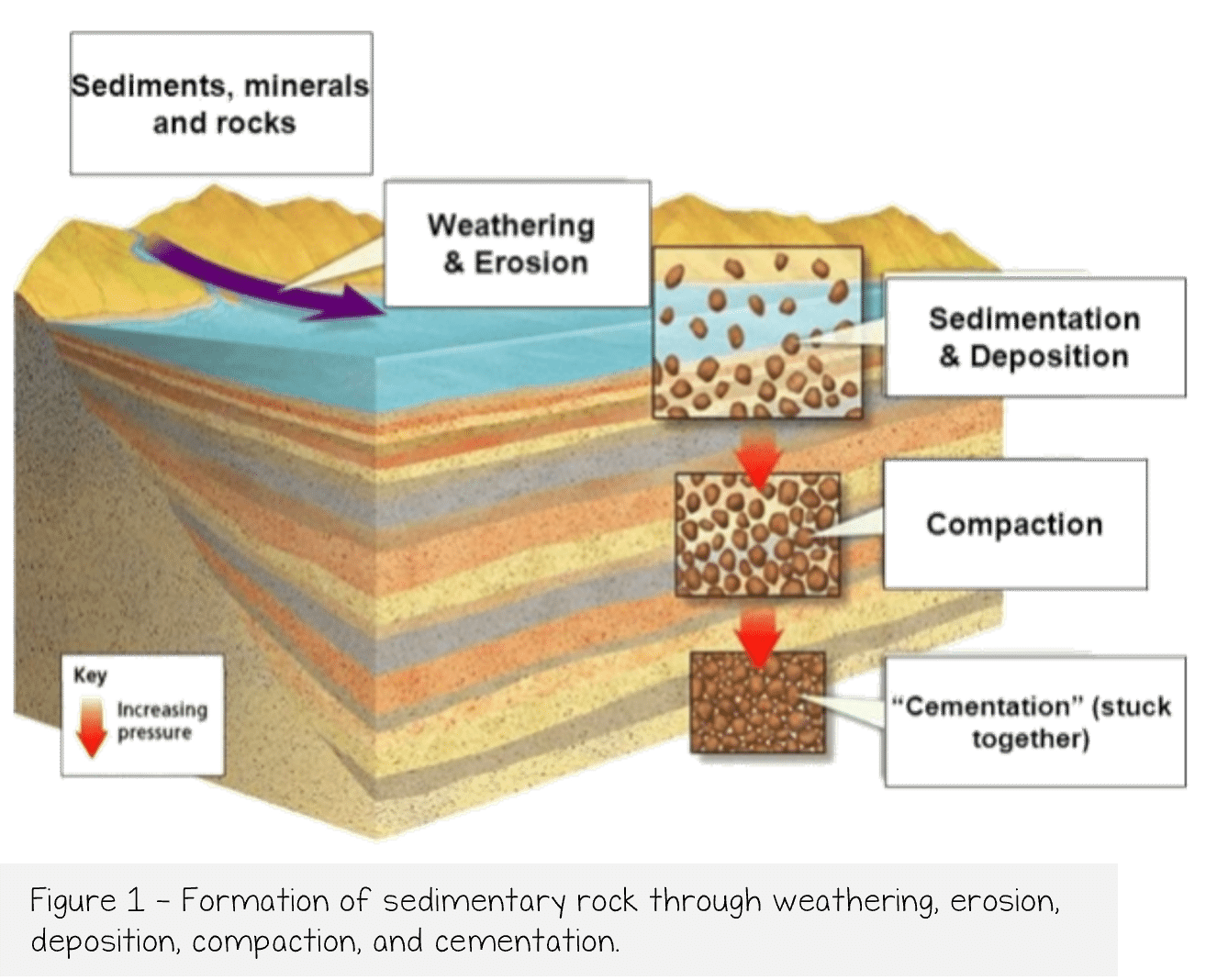 Sedimentary rocks, in contrast, form from sediments—small, solid pieces of material that come from weathered rocks or the remains of living things such as shells, leaves, bones, and stems. The formation of sedimentary rock happens through several connected processes.
First, weathering and erosion break down rocks into smaller pieces. Erosion occurs when wind, water, or ice carries sediment away from its original source. For example, heavy rain or strong winds can slowly wear down rock and change its shape. Next, the sediment is deposited in a new location, a process called deposition. Over time, layers of sediment build up. As more layers accumulate, the weight of the overlying material compresses the lower layers. This process, called compaction, squeezes sediments tightly together. Finally, cementation occurs when dissolved minerals in water crystallize between sediment particles, gluing them together into solid rock. Through compaction and cementation, loose sediments become sedimentary rock. Sometimes, the remains of plants or animals are buried within these layers. Over time, they may become fossils, preserving evidence of life from long ago.
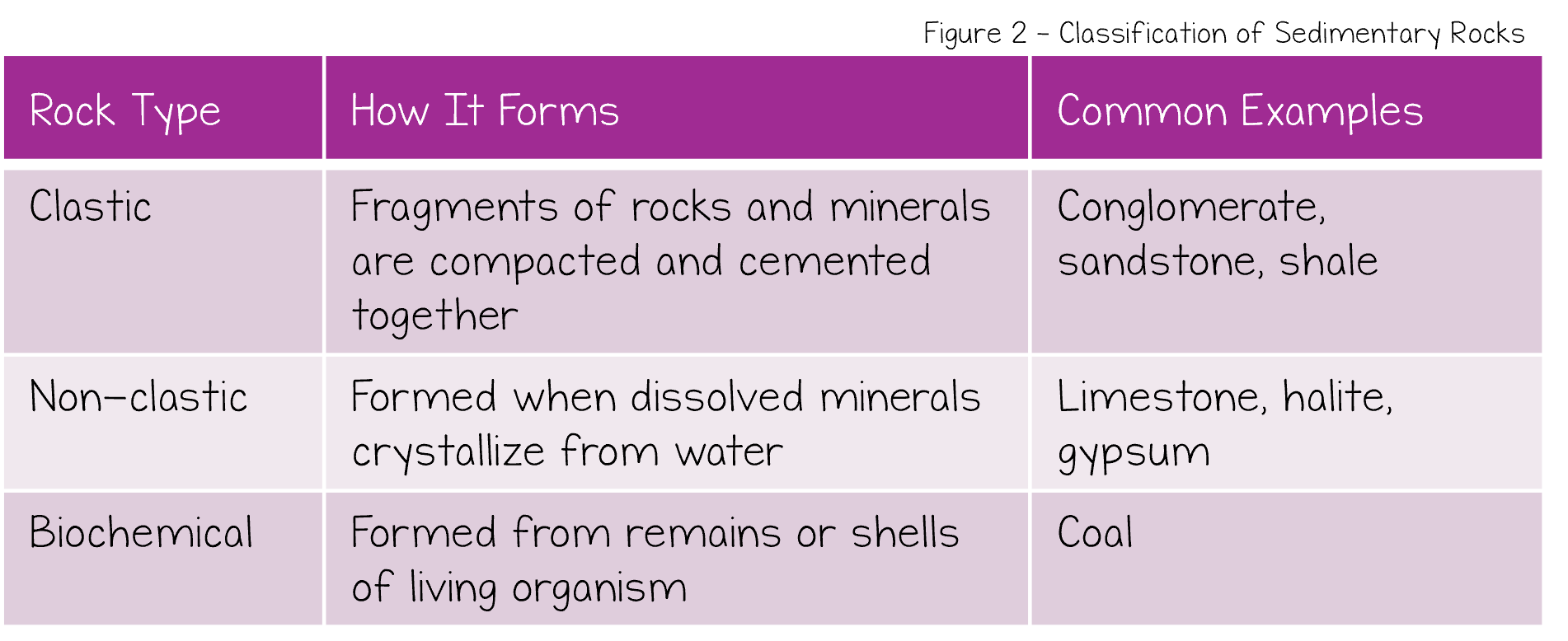 Sedimentary rocks are classified into groups based on what they are made of and how they form. One group is called clastic rocks. These rocks form when mineral and rock fragments are broken apart, compacted, and cemented together. An example of a clastic rock is sandstone. Another group is chemical (non-clastic) rocks. These form when minerals crystallize directly from water. Limestone is a common example. Chemical rocks are usually composed of a single main mineral and often have a uniform color. A third type is biochemical rock, which forms from the remains of living organisms. Coal is an example of a biochemical sedimentary rock. Overall, sedimentary rocks are made from fragments of other rocks that have been pressed and cemented together. They can have a wide range of grain sizes, from tiny clay particles to large boulders.
Deep beneath Earth’s surface, heat and pressure can change any type of rock into metamorphic rock. Metamorphic rocks form when existing igneous, sedimentary, or even other metamorphic rocks are changed by intense heat or pressure.
For example, when magma rises underground, it heats the surrounding rock. This extreme heat can cause minerals inside the rock to change or even partially melt. As the rock cools, new minerals form. Pressure also increases as you go deeper into Earth’s crust. This added pressure can squeeze rocks so tightly that their minerals rearrange, forming new minerals. These changes create a new type of metamorphic rock.
Although metamorphic rocks may sometimes look like sedimentary rocks, they are grouped by texture. Some metamorphic rocks are foliated, which means they have visible bands or layers of different minerals. Other metamorphic rocks are non-foliated, meaning their mineral grains are arranged randomly without bands.
Many metamorphic rocks show signs of bending, twisting, or blending because of the extreme heat and pressure they experienced during the rock cycle. For example, gneiss is a foliated metamorphic rock that forms from mudstone when it is exposed to high heat and pressure.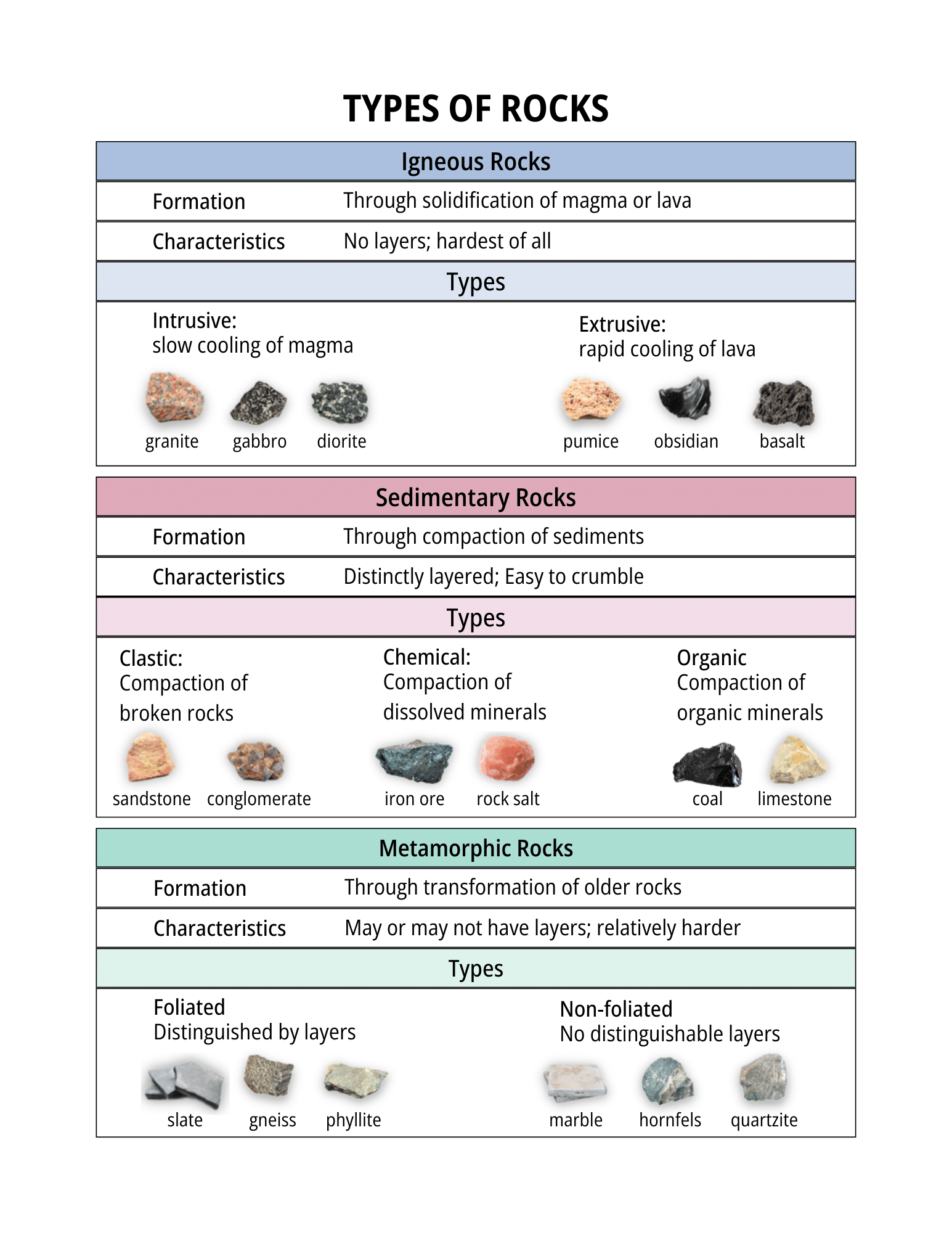
Review:
- What are the most common type of rocks found on Earth?
- Explain deposition and compaction.
- What is the difference between clastic and non-clastic rocks?