
Section 3: Classifying Rocks
Rocks have existed since Earth’s early history and have taken millions of years to form. Geologists classify rocks based on how they formed, using clues from their color, texture, and mineral composition. About twenty common minerals, known as rock-forming minerals, make up most of Earth’s crust. Minerals such as quartz, feldspar, mica, and amphibole combine in different ways to create the wide variety of rocks we see.
Color can provide important clues about a rock’s composition. For example, granite is usually light-colored because it contains large amounts of silica-rich minerals like quartz and feldspar. In contrast, basalt is dark-colored and contains less silica but more iron and magnesium. These color differences reflect the minerals that make up the rock.
Texture describes the look and feel of a rock’s surface. It is determined by the size, shape, and arrangement of mineral grains or rock fragments. Some rocks have large, visible crystals, while others are so fine-grained that the particles cannot be seen without a microscope. For example, granite has a coarse texture with visible crystals, while basalt has a fine texture because it cooled quickly. Sedimentary rocks such as sandstone feel gritty because they are made of cemented sand-sized grains.
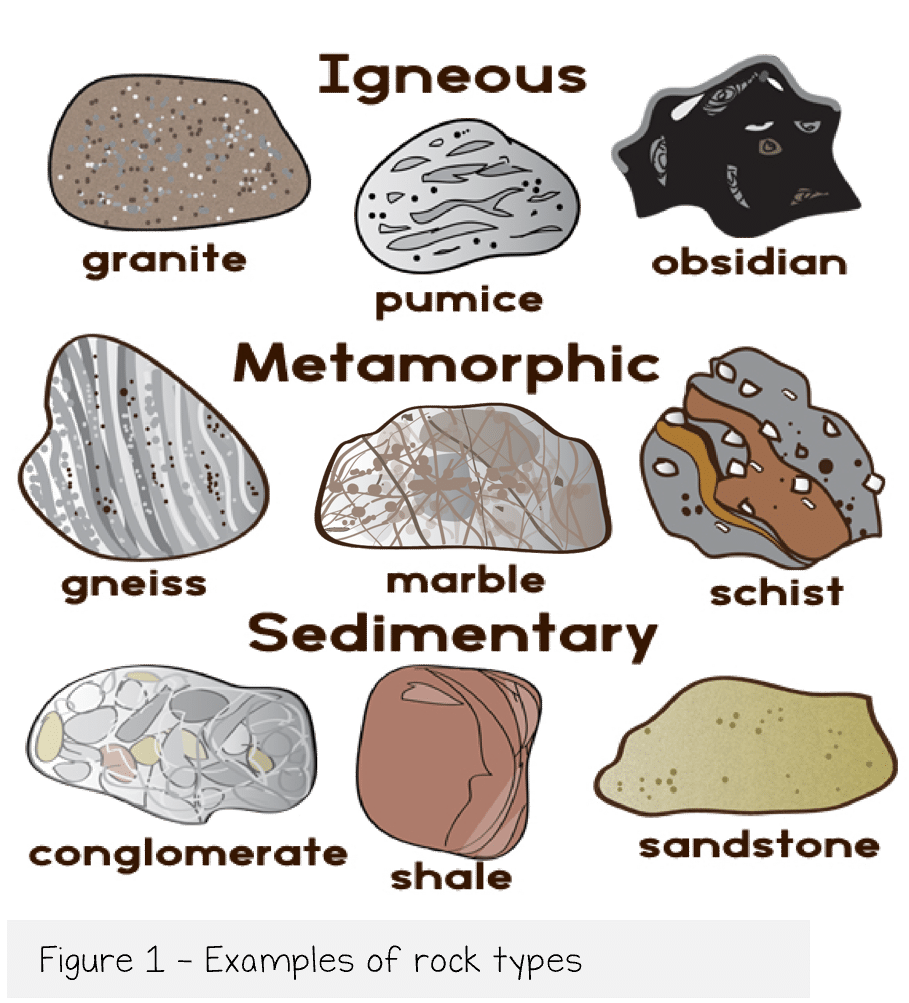 Rocks are grouped into three major types: igneous, sedimentary, and metamorphic.
- Igneous rocks form when magma beneath Earth’s surface or lava at the surface cools and crystallizes.
- Sedimentary rocks form when existing rocks are broken down by weathering and erosion into smaller pieces called sediments. These sediments are transported, deposited, and then compacted and cemented together over time.
- Metamorphic rocks form when existing rocks are changed by heat, pressure, or chemical reactions deep within Earth. These conditions cause minerals to rearrange without melting the rock completely. By studying a rock’s color, texture, and mineral composition, geologists can determine its history and better understand the processes that shape Earth over time.
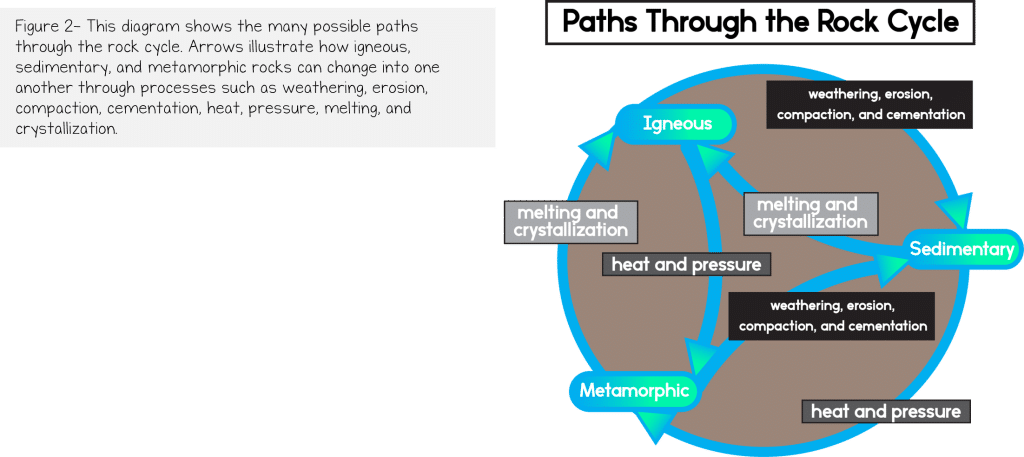
The rock cycle is a series of natural processes that change one type of rock into another over time. This cycle is driven by forces both at Earth’s surface and deep within the planet. Together, these forces slowly build, break down, and transform rocks in Earth’s crust. The rock cycle does not follow just one path—rocks can change in many different ways depending on the conditions they experience.
To begin, many changes take place at Earth’s surface. Here, weathering and erosion break rocks into smaller pieces called sediment. These sediments are carried by wind, water, or ice and eventually deposited in layers. Over time, the layers are compacted and cemented together through lithification, forming sedimentary rock. For example, layers of sand can slowly become sandstone over millions of years.
However, not all rocks remain at the surface. Some are buried deep underground, where temperatures and pressures increase. Under these intense conditions, rocks can change form without melting. This process produces metamorphic rock. For instance, limestone can transform into marble when exposed to great heat and pressure beneath Earth’s surface.
In some cases, rocks are buried so deeply that they melt completely, forming magma. When magma cools and solidifies below the surface, it forms igneous rock, such as granite. If molten material reaches the surface as lava during a volcanic eruption, it cools more quickly and forms igneous rocks such as basalt. Through these connected processes, rocks are continually recycled and reshaped over time.
Review:
- Identify three characteristics of rocks.
- Explain how igneous, sedimentary, and metamorphic rocks form.
- What is the rock cycle?