
Section 3: The Skeletal System
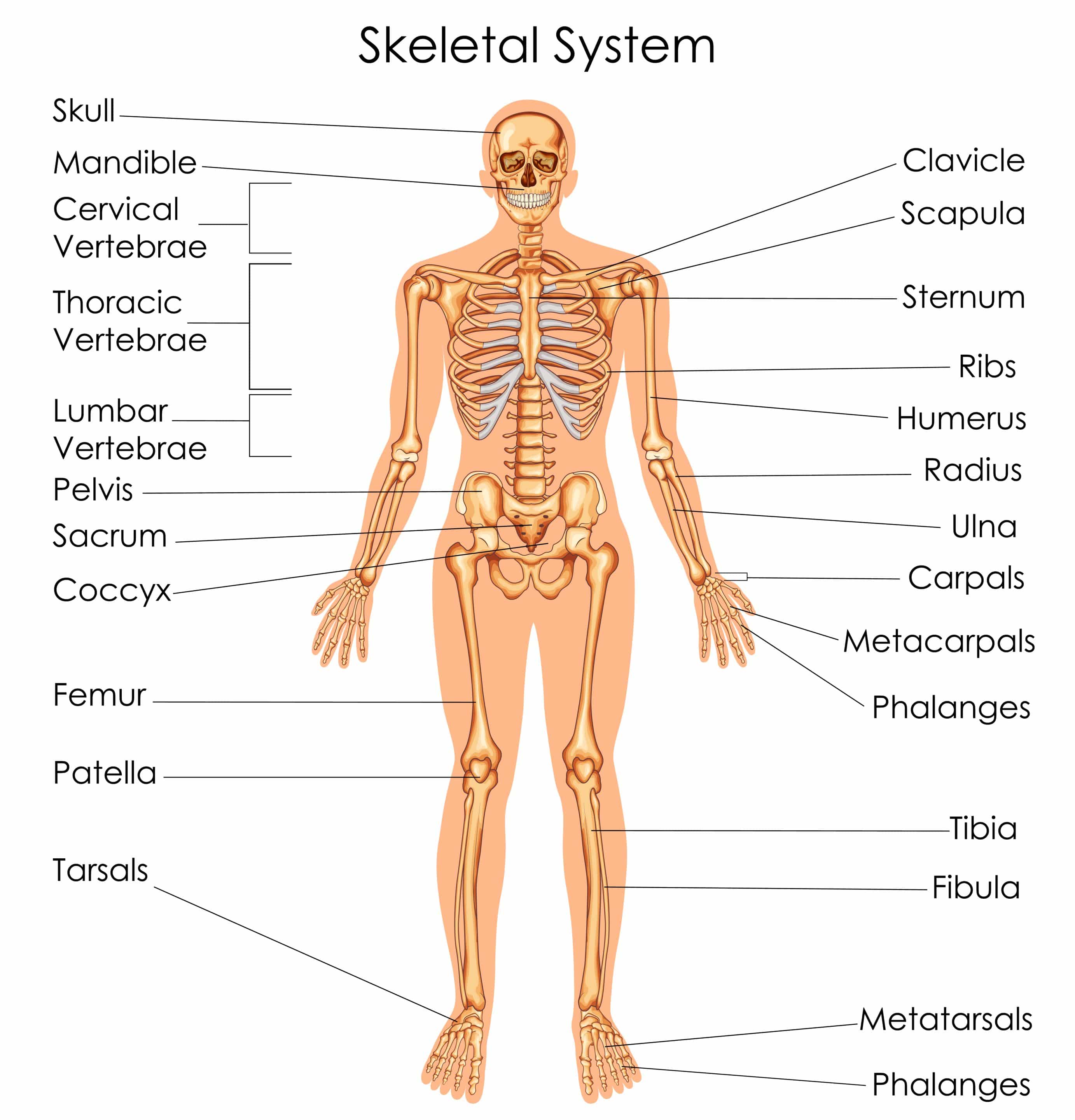
All movement in the human body depends on the interaction between muscles and the skeletal system. The adult human skeleton is made up of 206 bones that provide support, protection, and movement. Bones give the body its shape and create a strong framework that helps maintain stability and posture. They also protect delicate internal organs. For example, the skull protects the brain, while the rib cage surrounds and protects the heart and lungs.
Bones also work closely with muscles to produce movement. Skeletal muscles attach to bones by tendons, and when muscles contract, they pull on bones to create motion at joints. In addition to movement and support, bones perform other important functions inside the body. They produce blood cells and store minerals such as calcium and phosphorus, which are necessary for many body processes, including muscle contraction and nerve function.

Although bones may appear solid and lifeless, they are living tissues that continuously grow, repair, and remodel throughout life. The outer surface of a bone is covered by a thin, tough membrane called the periosteum. Beneath the periosteum is compact bone, a dense and strong layer that contains small passageways for blood vessels and nerves. Deeper inside, many bones contain spongy bone, which has many open
spaces that reduce weight while still providing strength. Spongy bone is commonly found near the ends of long bones, such as the femur. Inside the spaces of spongy bone is bone marrow. There are two types of marrow found in bones. Red marrow produces blood cells, including red blood cells, white blood cells, and platelets. Yellow marrow stores fat that can be used as an energy reserve. Another important connective tissue in the skeletal system is cartilage. Cartilage is a flexible, rubbery tissue found at the ends of bones where joints form. It cushions the areas where bones meet, reducing friction and helping joints move smoothly. Cartilage can also absorb shock and support body weight, making movement more comfortable and protecting bones from damage over time.

The point where two bones meet is called a joint. Joints connect bones and allow the body to move in many different ways. Strong connective tissues help hold joints together and provide stability. Ligaments are tough bands of connective tissue that connect bone to bone. They support joints and help limit excessive movement that could cause injury.
Joints are classified by both their structure and the type of movement they allow. Different joints are specialized for different motions depending on their location in the body. A pivot joint allows one bone to rotate around another bone. An example is found at the top of the neck, where the skull and vertebrae work together to let you turn your head from side to side. A ball-and-socket joint forms when the rounded end of one bone fits into a cup-like socket of another bone. This type of joint provides the greatest range of motion, allowing movement in many directions. The shoulder and hip are examples of ball-and-socket joints. Hinge joints allow movement back and forth in one direction, much like the opening and closing of a door. The elbow and knee are examples of hinge joints. A gliding joint allows bones to slide past one another. These joints are found in areas such as the wrist and ankle, where they help provide flexibility and smooth movement.
Some joints are classified as immovable joints because the bones are fused together and allow little or no movement. The joints between the bones of the skull are immovable and help protect the brain.
Review:
- Can you identify the different types of joints pictured above?
- What are three functions of bones?
- Compare red marrow to yellow marrow.