
Section 4: Volcanic Landforms

Volcanic eruptions can create a wide variety of landforms, each with its own shape and characteristics. The type of landform that forms depends on the type of eruption, the type of lava involved, and how the material accumulates over time. Common volcanic landforms formed from lava and ash include shield volcanoes, cinder cone volcanoes, composite volcanoes, lava plateaus, and calderas.
One type of volcano is a shield volcano. It forms when thin, low-viscosity lava flows easily and spreads out over a large area. Over time, repeated lava flows build a broad, gently sloping mountain with a wide base and a relatively flat top. Shield volcanoes are among the largest volcanoes on Earth, and their eruptions are usually quiet and nonexplosive. In contrast, a cinder cone volcano is the smallest and most common type of volcano. These form when magma with higher viscosity erupts explosively, producing ash, cinders, and volcanic bombs. This material falls back down around the vent and gradually builds up into a steep, cone-shaped hill or small mountain.
A composite volcano, also called a stratovolcano, is a tall, cone-shaped mountain formed from alternating layers of lava and ash. Because they are built from both explosive eruptions and flowing lava, composite volcanoes often have large craters at their summits and can produce powerful eruptions.
Volcanic activity can also create landforms that are not single mountains. A lava plateau forms when large amounts of lava flow out from long cracks in the crust rather than from a central vent. The lava spreads over wide areas before cooling and hardening, creating a high, flat region. Finally, a caldera forms in a very different way. After a massive eruption empties much of a volcano’s magma chamber, the top of the mountain can collapse inward. This collapse leaves behind a huge, bowl-shaped depression.
Together, these landforms show how volcanic activity can dramatically shape Earth’s surface in many different ways.
Not all volcanic landforms form at Earth’s surface. Some develop underground when magma cools and hardens beneath the crust. These features include volcanic necks, dikes, sills, batholiths, and dome mountains.
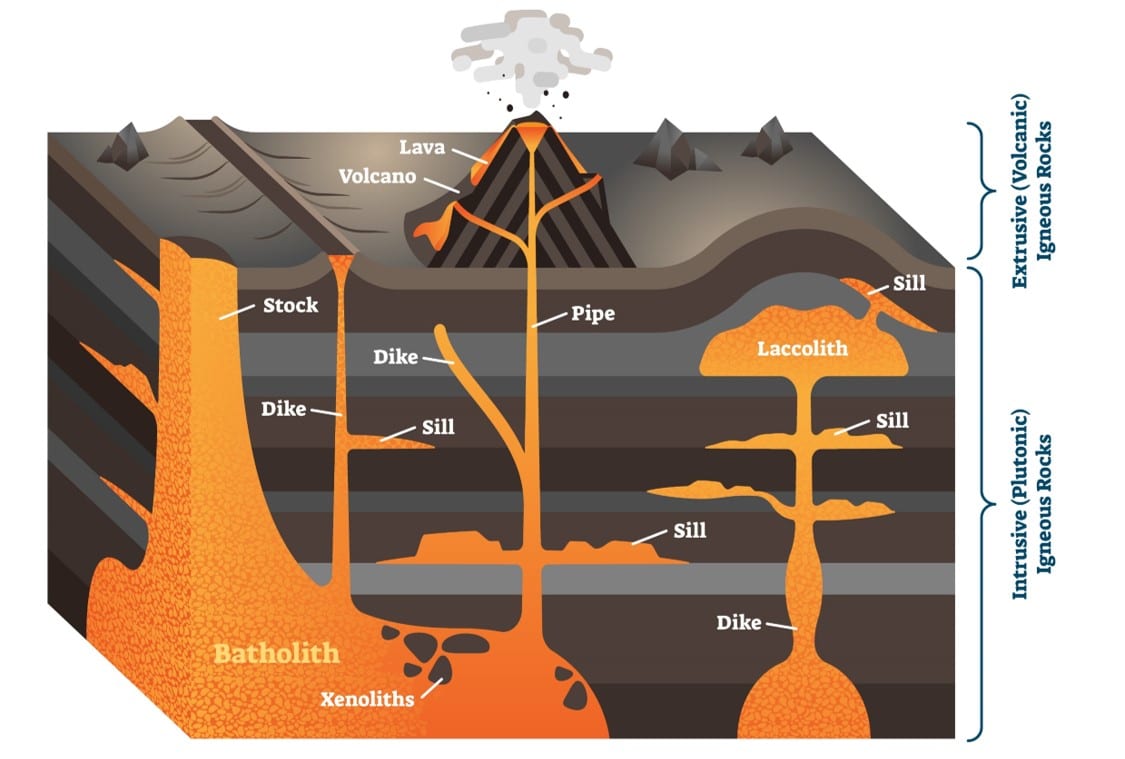
A volcanic neck forms when magma hardens inside a volcano’s pipe. Over time, the softer rock surrounding the pipe erodes away, leaving the hardened magma exposed as a tall, rocky pillar. In contrast, dikes form when magma forces its way across existing rock layers and then cools and solidifies. Because dikes cut across layers, they often appear as vertical or slanted walls of rock. Similarly, sills form when magma squeezes between horizontal rock layers rather than cutting through them. Once the magma cools, it creates a flat, sheet-like layer within the crust. Much larger underground formations, called batholiths, develop when enormous bodies of magma cool slowly deep within the crust. Batholiths can later become exposed at the surface through uplift and erosion. When a batholith or smaller body of hardened magma is pushed upward by tectonic forces, it can form a rounded, uplifted landform known as a dome mountain.
In addition to creating landforms, magma beneath Earth’s surface can also provide a valuable energy source. When underground water is heated by nearby magma or hot rock, it produces geothermal energy, which can be used to heat buildings and generate electricity. Geothermal activity occurs when magma located a few kilometers below Earth’s surface heats groundwater. This process can create surface features such as hot springs and geysers. A hot spring forms when groundwater is heated, rises through cracks in the crust, and collects in a natural pool at the surface. A geyser, on the other hand, forms when heated water becomes trapped underground. As pressure builds, the water suddenly erupts in a powerful burst of steam and hot water.
Together, these underground features and geothermal processes show that magma continues to shape and influence Earth—even when it never reaches the surface.
Review:
- How does a shield volcano form?
- What is a caldera?
- What are two examples of geothermal activity?