
Section 3: Volcanoes
Volcanoes are powerful features that shape Earth’s surface by building new land and reshaping existing landscapes. A volcano is a weak spot in Earth’s crust where molten material, called magma, rises to the surface. Magma is a hot, melted mixture of rock-forming substances, gases, and water from deep within the mantle. When magma reaches Earth’s surface, it is called lava. As lava cools, it hardens and forms solid rock, slowly building up layers of land over time.
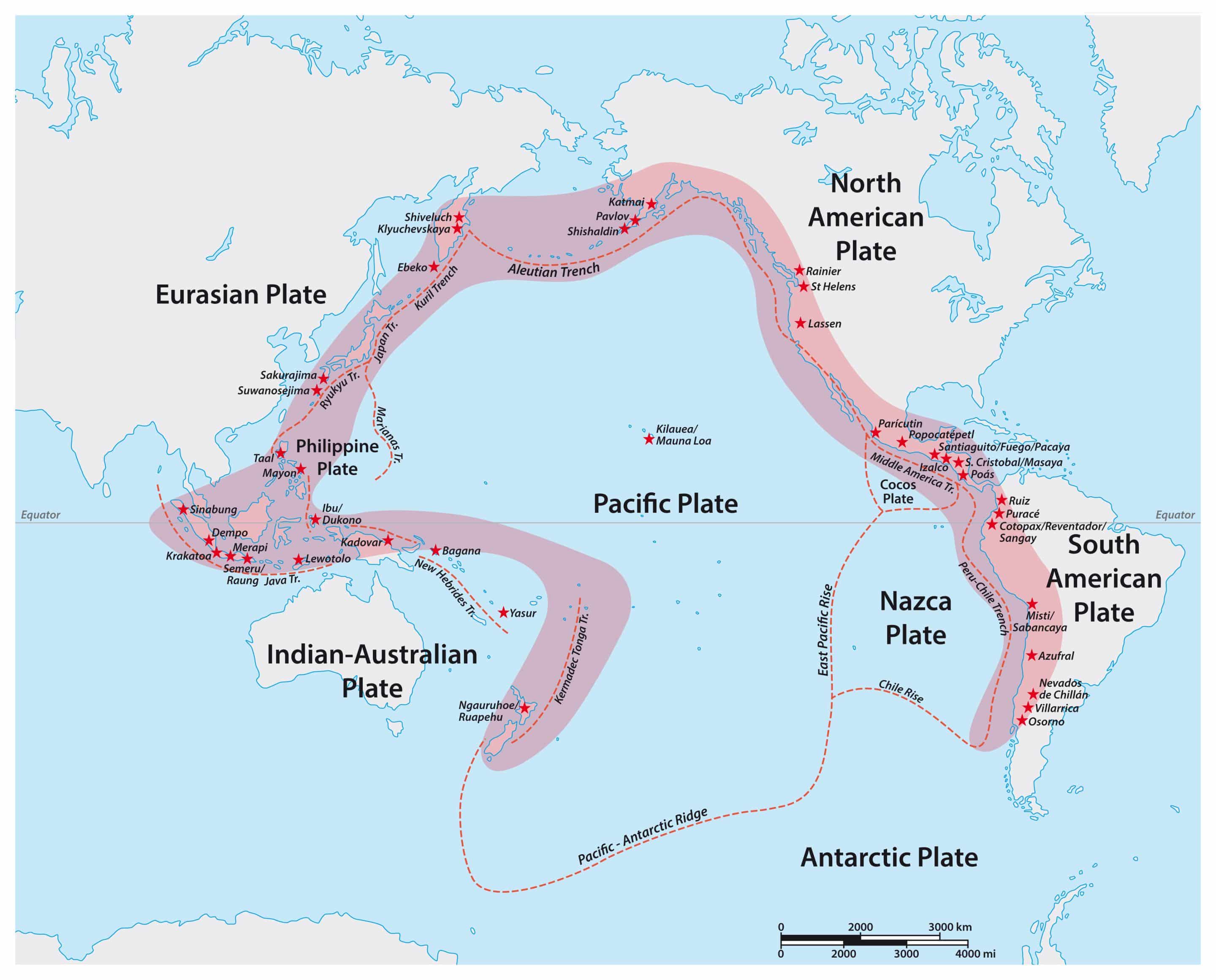
Volcanoes are closely connected to plate tectonics. At plate boundaries, Earth’s crust often fractures because of the pushing and pulling of tectonic plates. These cracks allow magma to rise to the surface, forming volcanic belts along plate boundaries. One major volcanic belt is the Ring of Fire, a chain of volcanoes that circles the Pacific Ocean.
Volcanoes can also form in other ways. An island arc is a chain of volcanic islands created when two oceanic plates collide, and one sinks beneath the other in a process called subduction. In contrast, a hot spot forms when hot material from deep within the mantle rises and melts through the crust, even far from plate boundaries. A volcano develops above the hot spot as magma erupts repeatedly over time. The Hawaiian Islands were formed as the Pacific Plate slowly drifted over a stationary hot spot.
Inside every volcano is a system of passageways through which magma travels. Magma first collects in a large underground pocket called a magma chamber. From there, it rises through a narrow tube called a pipe. When pressure builds, magma is forced out through an opening called a vent. Most volcanoes have one central vent at the top, but many also have smaller side vents. When lava pours out and spreads across the ground, it forms a lava flow. At the summit of many volcanoes is a bowl-shaped depression called a crater, which surrounds the main vent.
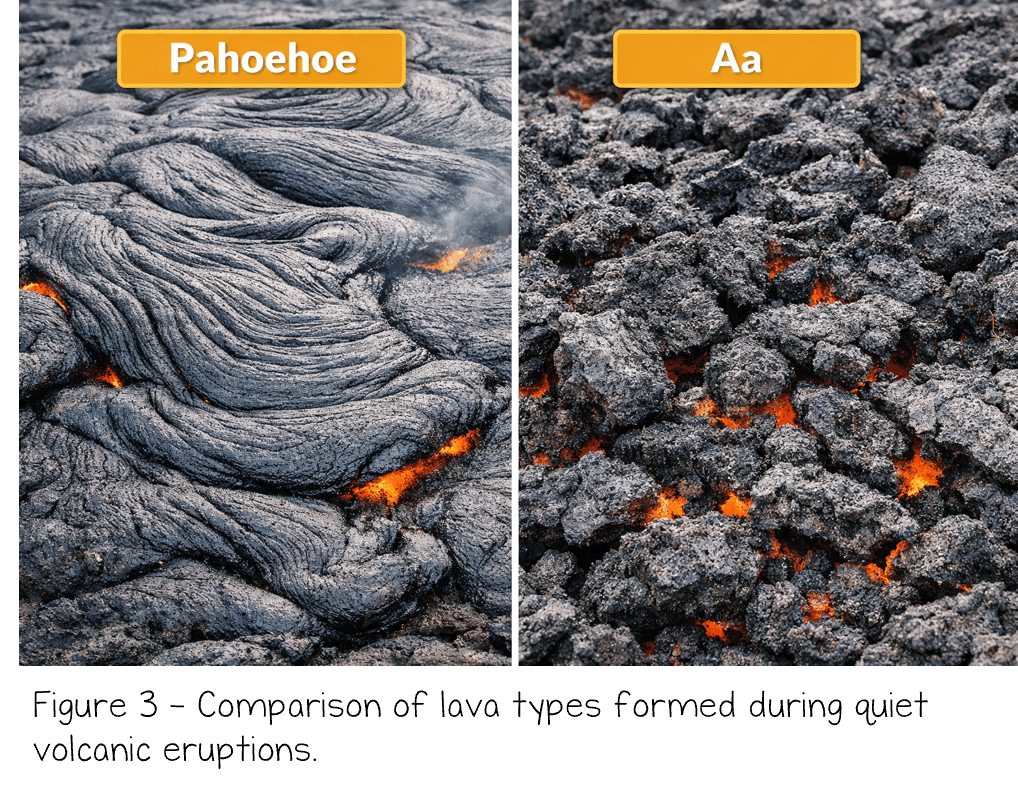 Volcanic eruptions can be either quiet or explosive, depending on the type of magma involved. A quiet eruption occurs when magma has low silica content and low viscosity (thickness). Gases escape easily, allowing lava to flow smoothly. Quiet eruptions often produce two types of lava: pahoehoe, which is hot, fast-moving, and smooth, and aa, which is cooler, slower-moving, and rough.
 In contrast, an explosive eruption happens when magma has high silica content and high viscosity. Thick, sticky magma traps gases inside. As pressure builds, it eventually explodes, sending ash, cinders, volcanic bombs, and fast-moving clouds of hot gas and rock called pyroclastic flows into the air.
Finally, scientists classify volcanoes based on their level of activity. An active volcano is one that is currently erupting or showing clear signs of imminent eruption. A dormant volcano is not erupting at the present time, but it still has the potential to become active again in the future. In contrast, an extinct volcano is not expected to erupt again because it no longer has a magma source feeding it.
Through eruptions that build islands, mountains, and new crust, volcanoes continue to play an important role in shaping our ever-changing planet.
Review:
- What is the difference between magma and lava?
- Where is the Ring of Fire located?
- Explain the difference between a quiet eruption and an explosive eruption.