
Section 5: Climate Cycles & Recent Climate Change
Earth has experienced many climate changes throughout its history. Scientists study evidence from ice cores—drilled from layers of glaciers—fossilized pollen, ocean sediments, and tree growth rings to learn about past climates. These natural records provide clues about temperature, precipitation, and atmospheric conditions from long ago.
Climate change often occurs in cycles, some of which take much longer than a human lifetime to complete. Long-term climate cycles include ice ages and interglacials. Ice ages are long, cold periods lasting from hundreds to millions of years during which glaciers cover much of Earth’s surface. During colder times, glaciers advance across the land. Between ice ages are interglacials, long, warmer periods when glaciers retreat.
In addition to these long-term cycles, the climate also changes over shorter periods. Short-term climate cycles include seasons, El Niño, and monsoons. Seasons are regular changes in climate that occur because different parts of Earth receive varying amounts of solar energy throughout the year. These changes happen because Earth is tilted on its axis, and as Earth revolves around the Sun, different regions tilt toward or away from the Sun at different times. El Niño is a climatic event that occurs about every 3–8 years when the trade winds weaken, and the usual pattern of high and low pressure across the Pacific Ocean changes. Monsoons are seasonal wind circulation patterns that reverse direction during the year due to temperature differences between land and ocean.
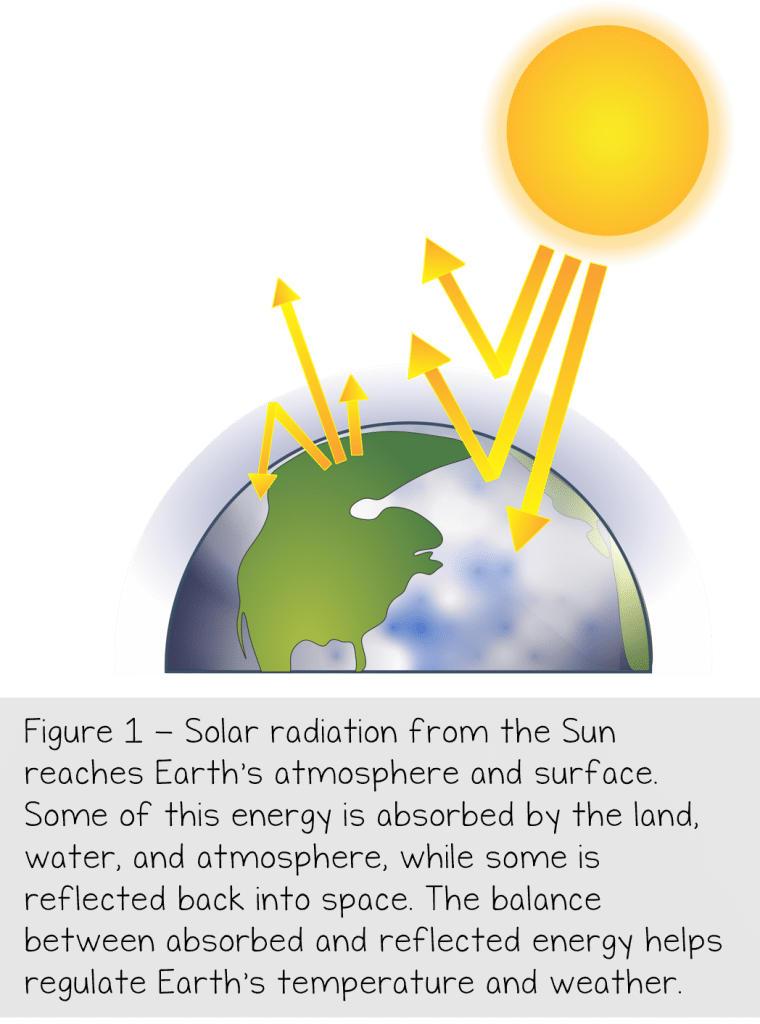 While natural cycles influence climate, human activities have also had a significant impact. Over the past 100 years, Earth’s average temperature has been increasing, a trend often called global warming. One major reason for this warming is the increase in atmospheric greenhouse gases. Greenhouse gases absorb Earth’s outgoing infrared radiation and trap heat within the atmosphere. Carbon dioxide is one of the most important greenhouse gases, and its levels have increased due to the burning of fossil fuels used to heat homes and power automobiles. Deforestation—the large-scale cutting and burning of forests—also raises carbon dioxide levels because fewer trees remain to absorb it. In addition, aerosols, which are tiny liquid or solid particles released when fossil fuels are burned, can affect the climate by blocking some of the Sun’s energy from reaching Earth.
Scientists also use clues preserved in tree growth rings to reconstruct Earth’s past climate. Dendrochronology is the scientific study of tree rings to determine a tree’s age and to learn about past environmental conditions. Each year, a tree grows a new ring, and the thickness of the ring can show how favorable the growing conditions were. Wide rings often indicate years with plenty of water and good growing conditions, while narrow rings may show periods of drought or environmental stress.
Dendroclimatology is a branch of dendrochronology that uses tree-ring patterns to study past climates. By examining variations in tree-ring width, density, and composition, scientists can reconstruct records of rainfall, temperature, and drought dating back hundreds or even thousands of years. This information helps scientists better understand how Earth’s climate has changed over time.
Review:
- What types of climate changes have occurred in Earth’s history?
- What is a monsoon?
- Explain global warming.