
Section 1: Earth’s Motion
The study of the Moon, stars, planets, and other objects in space is called astronomy. One of the most important objects studied in astronomy is the Sun, the star closest to Earth. The Sun is enormous—its diameter is about 100 times greater than Earth’s. Inside the Sun, temperatures are extremely high. The core reaches temperatures of more than 15,000,000°C, while the surface is about 5,500°C. Even though the Sun is far away, a small portion of its energy reaches Earth as light and thermal energy, providing the energy that helps warm our planet and support life.
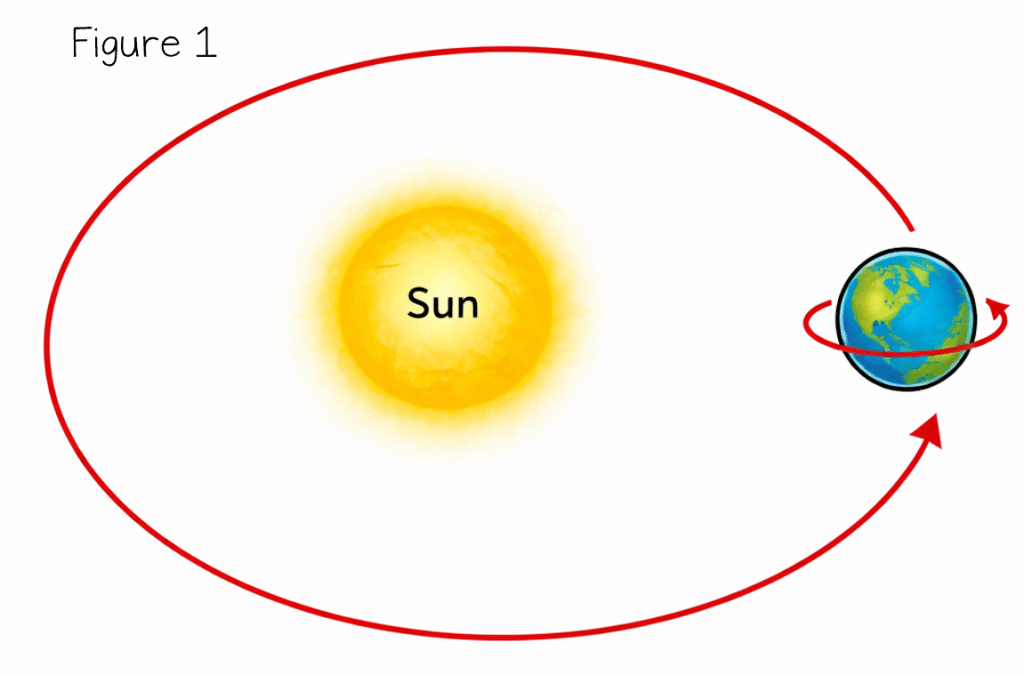 Earth moves through space in two main ways: rotation and revolution. During revolution, Earth travels in a path around the Sun, completing one orbit in about 365.24 days due to the Sun’s gravitational pull. A revolution is the movement of one object around another. As Earth revolves around the Sun, it also rotates, or spins, on its rotational axis, the imaginary line on which it spins. Earth’s path around the Sun is not a perfect circle. Instead, its orbit is an ellipse, or an elongated, closed curve. Because the Sun is not centered in the ellipse, the distance between Earth and the Sun changes slightly during the year. In addition, because Earth’s surface is curved, different parts of the planet receive different amounts of the Sun’s energy.
The seasons are mainly caused by the tilt of Earth’s rotational axis as Earth revolves around the Sun. The hemisphere tilted toward the Sun receives more hours of daylight than the hemisphere tilted away from it. Earth’s tilt also causes the Sun’s radiation to strike different parts of the planet at different angles. As a result, the hemisphere tilted toward the Sun receives more direct sunlight and more total solar energy.
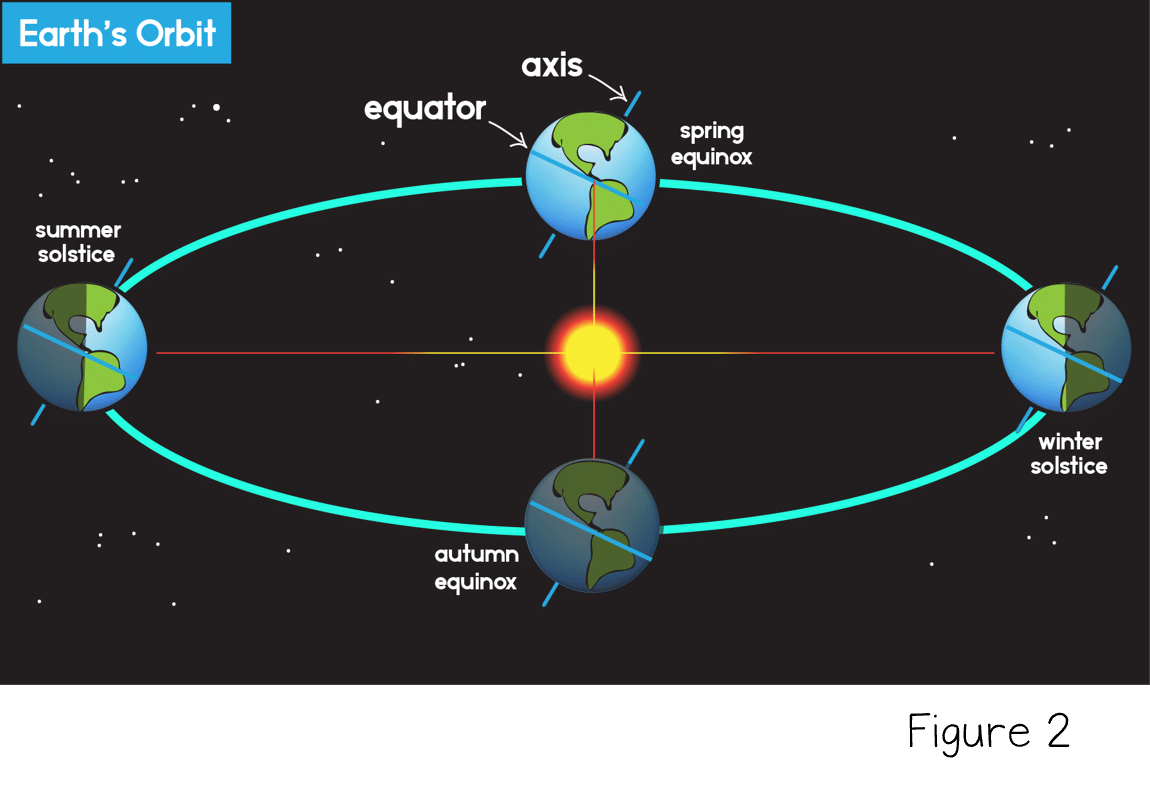 During the year, the Sun appears to reach its greatest distance either north or south of the equator. These points mark the solstices. The summer solstice occurs around June 20–21 in the Northern Hemisphere and marks the winter solstice in the Southern Hemisphere. The winter solstice in the Northern Hemisphere occurs around December 20–21, marking the summer solstice in the Southern Hemisphere. Halfway between the solstices are the equinoxes, which occur when Earth’s rotational axis is tilted neither toward nor away from the Sun. During an equinox, day and night are nearly equal in length everywhere on Earth. The spring (vernal) equinox occurs around March 20–21 in the Northern Hemisphere, and the fall (autumnal) equinox occurs around September 22–23.
Review:
- Explain the difference between rotation and revolution.
- What is an ellipse?
- What is a solstice?