
Section 2: Features of Waves

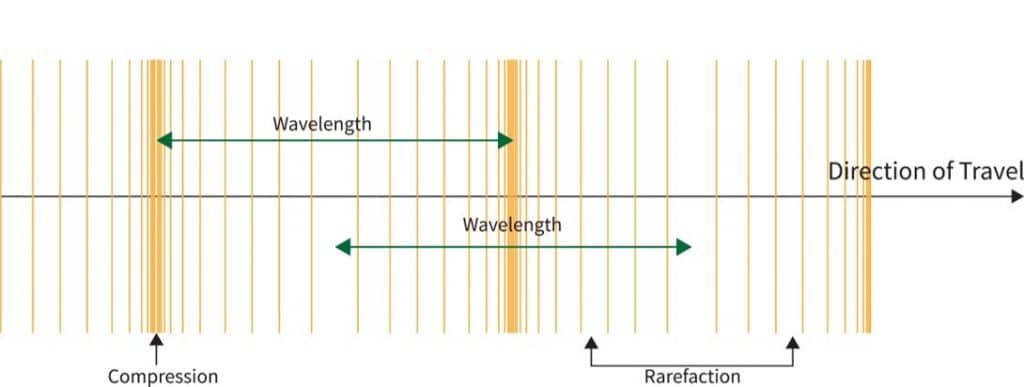
Waves have specific features and characteristics that make them different from each other. Each wavelength is the distance between a point on a wave and the nearest point, just like it, for example, from crest to crest. The wavelength of a wave decreases as the frequency increases. Transverse waves have crests, the highest points, and troughs, the lowest points. The crests and troughs can be seen where water is displaced above or below the normal water level. The amplitude of a wave is the measure of energy at the height of the wave. The more power a wave carries, the greater the amplitude. The amplitude decreases as the wave travels outward.
When a certain number of wavelengths pass a fixed point in a second, that is how wave frequency is measured. The frequency of a wave is the number of wavelengths that pass a fixed point each second, measured in hertz.
Compressional waves have dense regions called compressions, where their coils are close together, and less dense areas called rarefactions.
Review:
- Define amplitude.
- The frequency of a wave is measured in ___________ .
- Explain the difference between compressions and rarefactions.