
Section 1: Waves

While some types of waves may be more familiar than others, we are surrounded by a world of waves, including water waves, sound waves, light waves, and electromagnetic waves. A wave is a repeating disturbance that transfers energy through matter or space. Although waves carry energy from one place to another, they do not transport matter from place to place. Instead, molecules pass energy to neighboring molecules, which then pass it to the next. All waves are produced by vibrations and continue traveling as long as energy is available to carry them. Many waves need a medium, or matter, through which a wave travels. A medium can be a solid, liquid, gas, or a combination of these. For example, ocean waves travel through water, and sound waves travel through air. However, not all waves need a medium. Light waves and radio waves can travel through empty space.


A ripple in water is a helpful way to understand how waves transfer energy. When a falling rock hits the surface of a pond, it transfers some of its kinetic energy to nearby water molecules. Those molecules then transfer energy to neighboring molecules, creating a wave that moves across the water’s surface. The wave continues only as long as there is enough energy. Eventually, the ripple fades because the energy has spread out. This example also shows an important idea: waves carry energy, not matter. If a rubber duck were floating nearby, it might bob up and down, but it would not travel across the pond with the wave. The water itself is not being carried away. Instead, the energy is moving through the water.
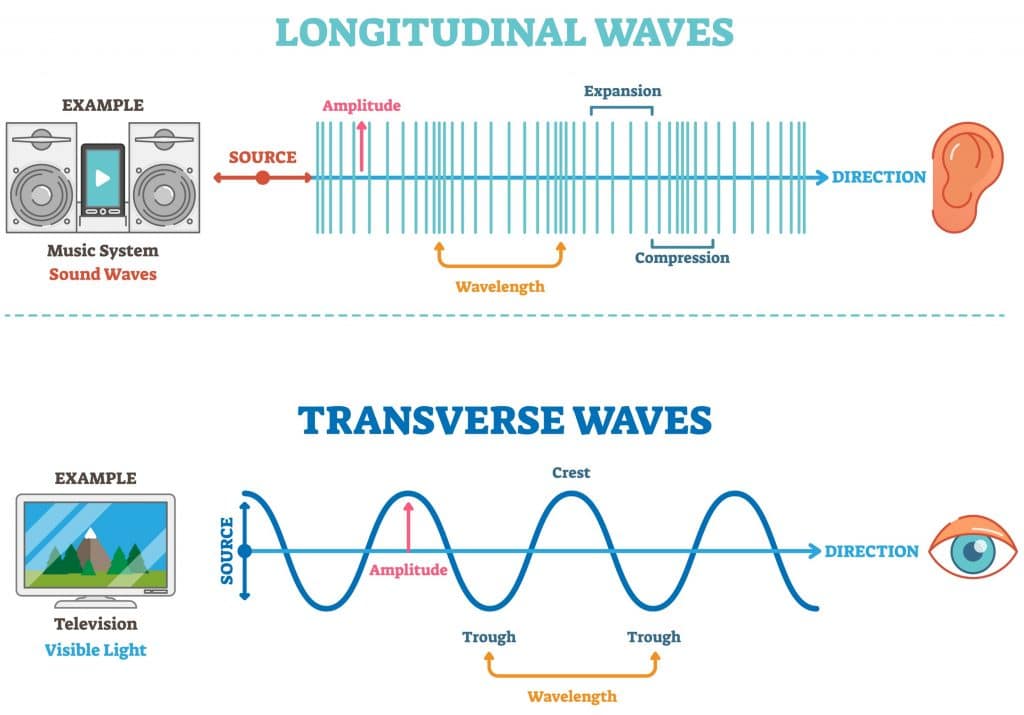
Waves can be grouped into different categories based on how they travel. Mechanical waves are waves that can only travel through a medium. Two common types of mechanical waves are transverse waves and compressional waves. A compressional wave is also called a longitudinal wave. In a transverse wave, the matter in the medium moves back and forth at a right angle to the direction the wave travels. This motion is called perpendicular. In a compressional wave, the matter in the medium moves back and forth in the same direction that the wave travels.
Review:
- Describe three characteristics of waves.
- Do waves carry matter? Explain your answer.
- Compare transverse waves and compressional waves.