
Section 1: Waves
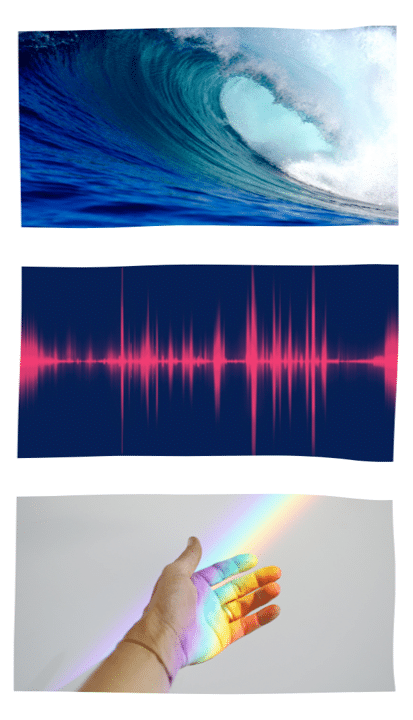
While some types of waves may be more familiar than others, we are surrounded by a world of waves: water waves, sound waves, light waves, and electromagnetic waves. Waves are a repeating movement of disturbance that transfers energy through matter and space. All waves carry energy without transporting matter from place to place. Molecules pass energy along to neighbor molecules, which then give energy to their neighbor. All waves are produced by vibrations. Waves will travel as long as there is energy to carry them. A medium is a matter through which a wave travels. A medium can be a solid, a liquid, a gas, or a combination. For example, a wave in an ocean travels through water, and a sound wave travels through the air. However, not all waves need a medium to travel. Light and radio waves can travel through space.

 When a falling rock hits the water, it transfers some of its kinetic energy to nearby water molecules. Those molecules then pass their energy along to neighboring molecules, which then pass it on to their neighboring molecules. The traveling energy creates a wave on the surface of the water. A wave will only exist as long as there is enough energy. Eventually, the ripple will stop because there is no more energy. If there were a rubber duck in the water, it would not move from its location since the energy of the rock did not transfer to it. Waves only carry energy; they do not carry matter. They don’t even carry water, which is often a misconception.
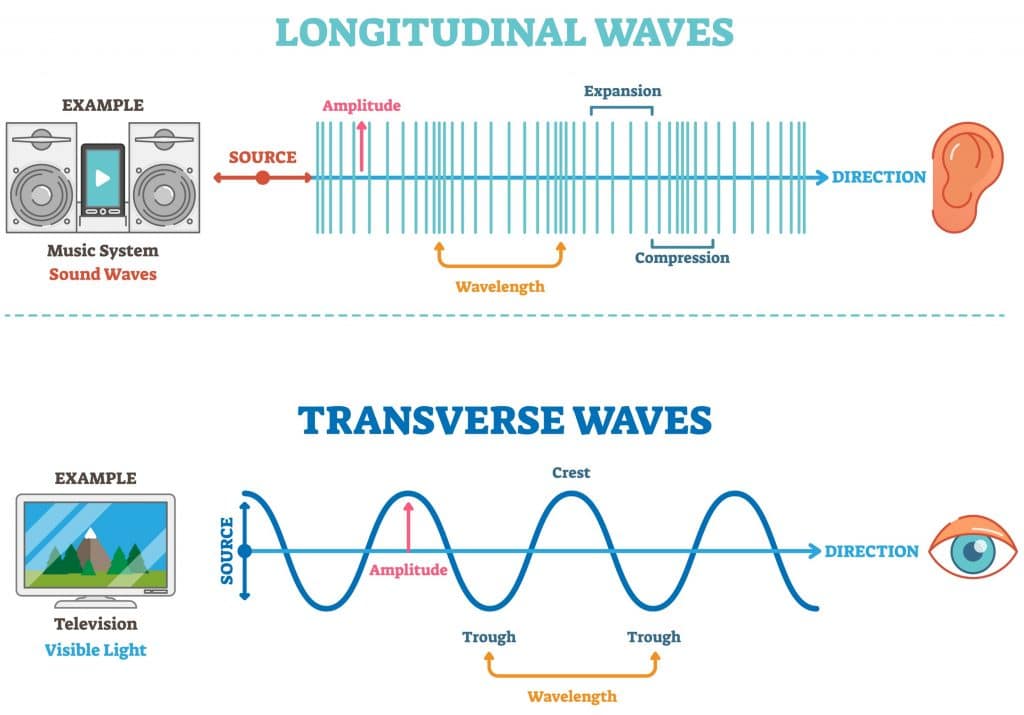
Mechanical waves are waves that can only travel through a medium. There are two types of mechanical waves: transverse and compressional waves. A compressional wave is also called a longitudinal wave. Transverse waves occur when the matter moves back and forth at a right angle to the direction the wave travels. The motion is perpendicular. In a compressional wave, the matter in the medium moves in the same direction that the wave travels.
Review:
- Describe three characteristics of waves.
- Do waves carry matter? Explain your answer.
- Compare transverse waves and compressional waves.