
Section 1: Sound
Sound is all around us, even when we cannot see what is causing it. When a moving object travels through the air, it creates vibrations. These vibrations allow us to hear sound. We rely on sound to gather information about the world around us and to communicate with one another.
Sound waves are compressional waves that form when vibrating objects collide with air molecules. However, sound does not travel at the same speed through every material. The speed of sound depends on the temperature and state of the medium it travels through. Sound moves faster through solids and liquids than through gases because the molecules in solids and liquids are closer together. For example, sound travels faster through water than through air because water particles are packed more closely together. Temperature also affects sound speed. As the temperature of a medium rises, its molecules move faster and can pass along sound vibrations more quickly.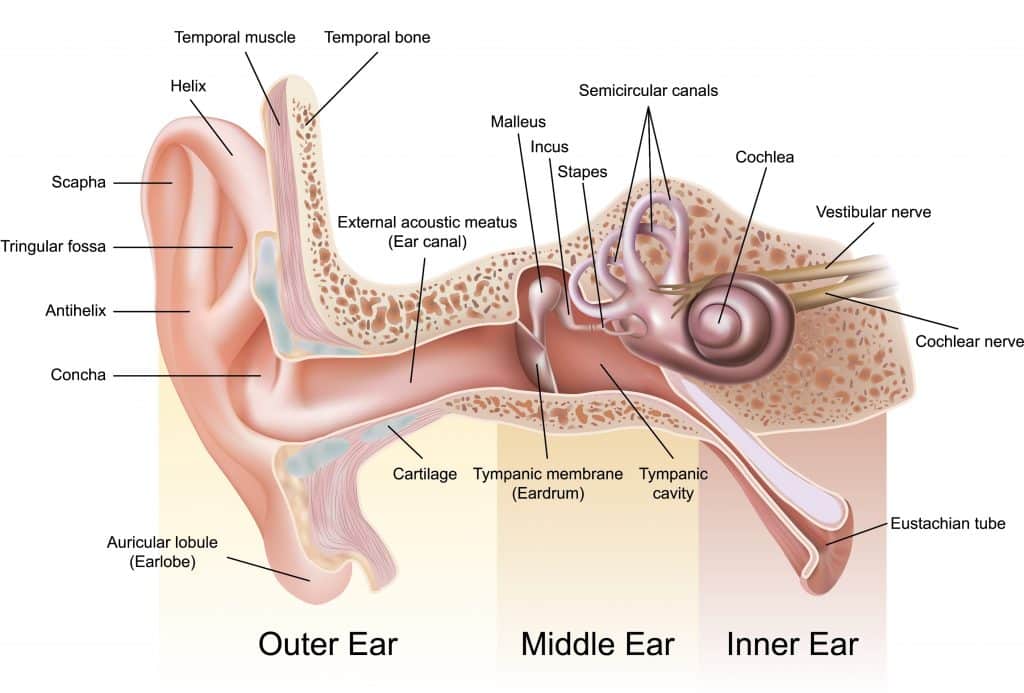
To understand how we hear these vibrations, we can look at the parts of the ear. Our ability to detect sound begins with the outer ear. The outer ear helps “catch” compressional sound waves. Its cupped shape and many curves also help us determine the direction from which a sound is coming. From there, sound waves travel into the ear canal and cause the eardrum, a thin cone-shaped piece of skin, to vibrate.
These vibrations then move into the middle ear, where three tiny bones called the hammer, anvil, and stirrup amplify the sound. After that, the vibrations reach the inner ear, which contains the cochlea. The cochlea converts vibrations into nerve impulses that travel along the auditory nerve to the brain. Finally, the brain’s cerebral cortex interprets these impulses as the sounds we hear.
Not all sounds are heard the same way. Some sounds seem loud, while others are soft. Loudness is the human perception of sound intensity, which is measured in units called decibels (dB). Intensity refers to the amount of energy flowing through a particular area in a given amount of time. Sound waves with higher intensity carry more energy than sound waves with lower intensity.
As high-intensity sound waves reach your ear, they cause your eardrum to move back and forth a greater distance than low-intensity sound waves. As a result, louder sounds are produced when the intensity of a sound wave increases. However, excessively loud sounds can damage hearing. Humans can usually tolerate sounds up to about 120 dB before pain and possible permanent hearing loss occur. In addition, prolonged exposure to sounds above 85 dB can cause hearing damage over time.
Besides loudness, sound can also differ in pitch, or how high or low it sounds. Pitch is related to the frequency of a sound wave. High-frequency waves produce high-pitched sounds, while low-frequency waves produce low-pitched sounds. Different animals can detect different pitch ranges. For example, bats can hear much higher-pitched sounds than humans can. They use these sounds to navigate dark caves.

Review:
- What are sound waves?
- Explain how we can hear sounds.
- Compare loudness to intensity.