
Section 2: Energy Flow in Ecosystems
Energy flows through an ecosystem, which includes all living and nonliving parts of an environment, in one direction. It moves from the sun, or from chemical energy, to autotrophs (producers) and then to heterotrophs (consumers). Ecologists study feeding relationships to understand how energy is transferred within ecosystems.

A food chain shows how energy and matter move through an ecosystem in a series of steps, as organisms eat and are eaten. For example, in a food chain of grass → grasshopper → gecko → owl, grass is the primary producer because it makes its own food using sunlight. The grasshopper is a primary consumer, the gecko is a secondary consumer, and the owl is a tertiary consumer or top predator. When organisms die, decomposers break them down, returning nutrients to the environment and continuing the cycle.
However, feeding relationships in ecosystems are often more complex than a single food chain. A food web shows all the interconnected food chains within a community, illustrating the many possible paths energy can take. Most organisms have varied diets and may feed at different trophic levels, so they are part of multiple food chains at once. In a food web, arrows point from one organism to another to show the direction of energy transfer. These connections reveal how changes to one population—such as a decrease in a prey species—can affect many other organisms in the ecosystem. Because of these many interactions, a food web provides a more accurate representation of how energy flows and how organisms depend on one another within an ecosystem.
Each organism in a food chain or food web represents a feeding step, or trophic level, where matter and energy are transferred. As energy moves from one trophic level to the next, some of it is always lost, usually as heat.
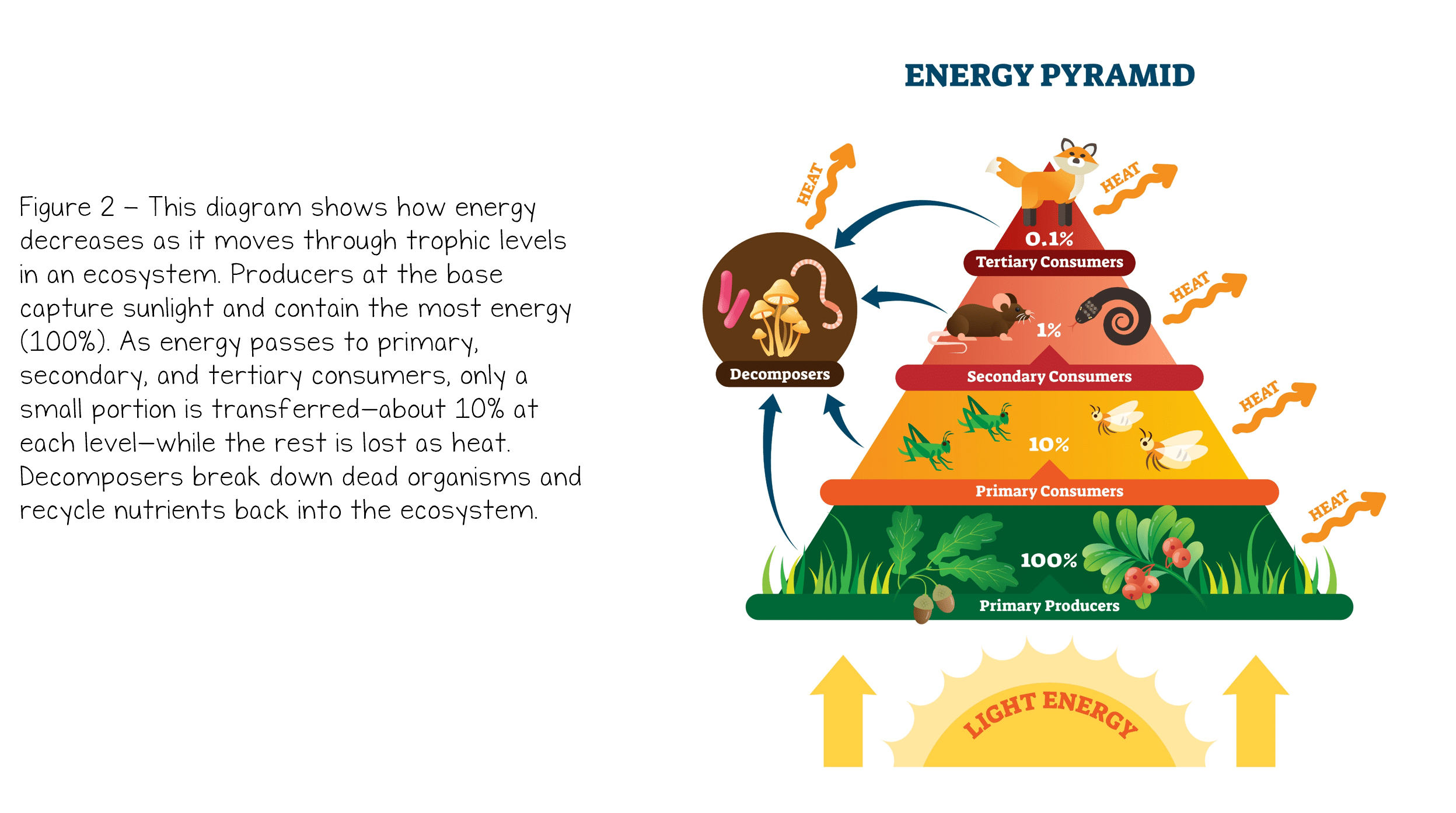
A biological pyramid is a diagram that shows the amount of energy or matter at each trophic level. There are three main types of biological pyramids. An energy pyramid illustrates the flow of energy through an ecosystem, showing that less energy is available at higher trophic levels. A biomass pyramid represents the total amount of living organic matter, or biomass, present at each level. A pyramid of numbers shows the total number of individual organisms at each trophic level. These pyramids help scientists visualize how energy decreases and how populations change as you move up through an ecosystem.
Each organism in a food chain or food web represents a feeding step, or trophic level, in transferring matter and energy. Energy is always lost between trophic levels. A biological pyramid is a diagram that shows the amounts of energy or matter at each trophic level. There are three different types: energy pyramid, biomass pyramid, and pyramid of numbers. An energy pyramid shows the flow of energy from one trophic level to the next, comparing the energy used by each organism. With each increasing trophic level, some energy is lost. A biomass pyramid compares each organism’s biomass, or living organic matter available, at each trophic level. Finally, a pyramid of numbers shows the total number of organisms at each trophic level.
Review:
- How does energy flow in an ecosystem?
- Compare a food chain to a food web.
- What do each of the three types of energy pyramids illustrate?