
Section 2: Standards of Measurement
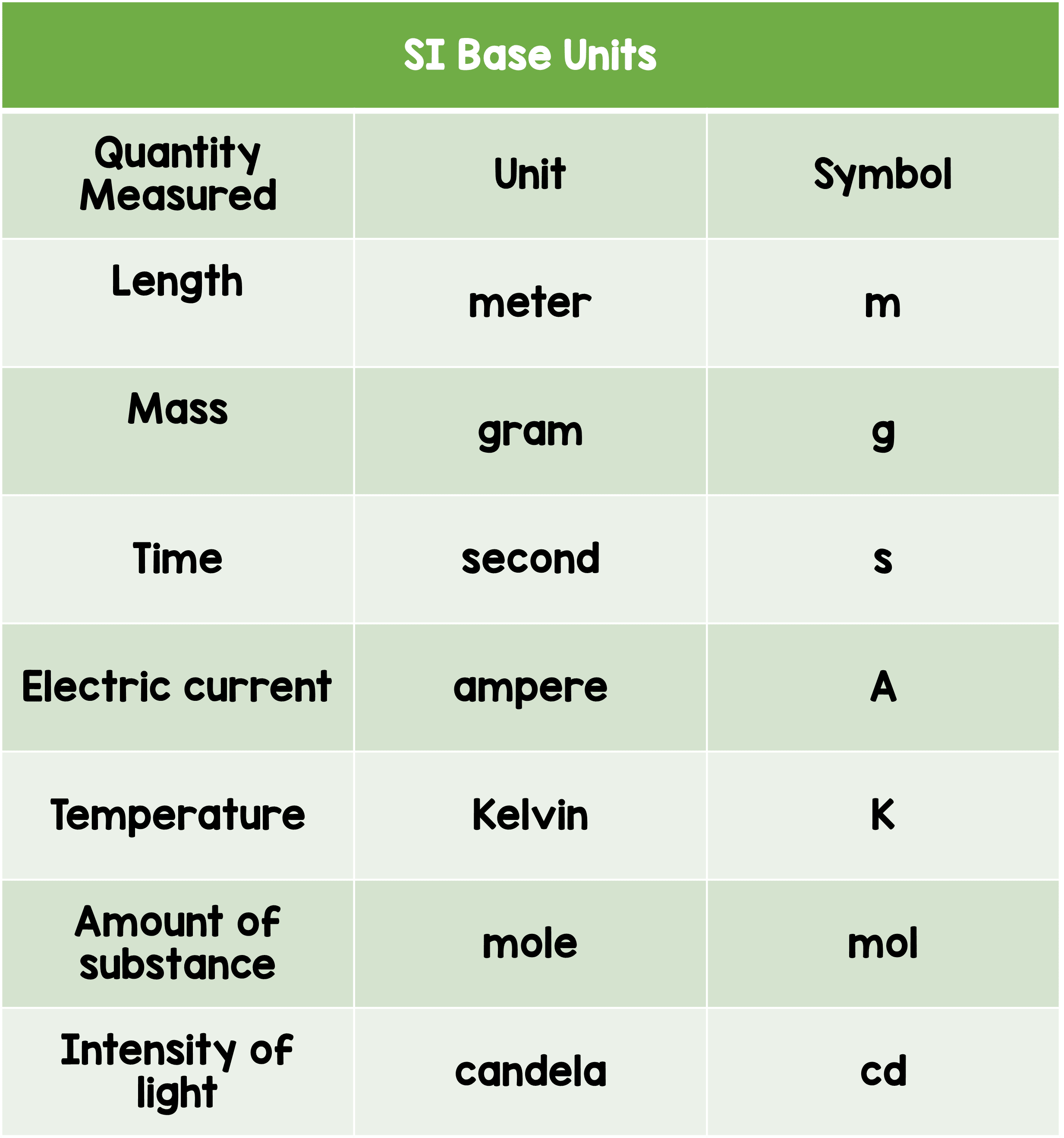
The standard system of measurement used by scientists worldwide is the International System of Units (SI). SI is part of the metric system and is based on powers of ten. This makes it easier to convert between units because you simply move the decimal point. For example, 10 millimeters = 1 centimeter, 100 centimeters = 1 meter, and 1,000 meters = 1 kilometer. Each unit is ten times larger than the next smallest unit and one-tenth the size of the next largest unit.
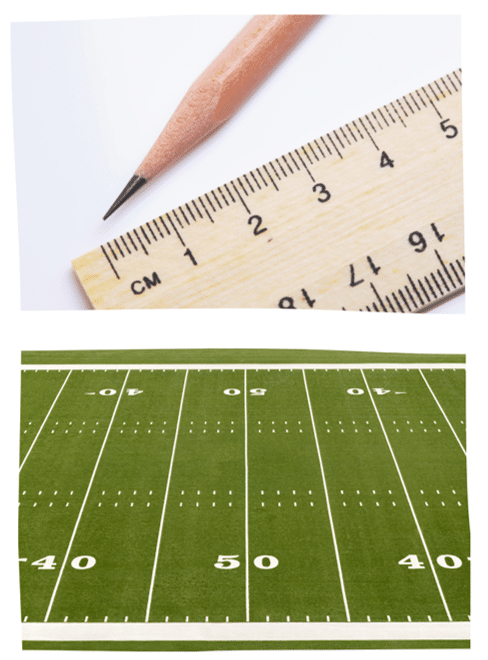
Length is the distance between two points. Scientists choose the unit of measurement based on the object’s size. Small objects, like a paperclip or pencil, are usually measured in centimeters (cm) or millimeters (mm). Larger distances, like the length of a football field or a classroom, are measured in meters (m).
 Mass is the amount of matter in an object. It is measured in grams (g) or kilograms (kg). Smaller objects, like a coin, are measured in grams, while heavier objects, like a bowling ball, are measured in kilograms. It is important to remember that mass is different from weight. Weight depends on gravity, but mass does not change based on location. For example, an object would weigh less on the Moon, but its mass would stay the same.
Volume is the amount of space an object takes up. Liquids are usually measured in liters (L) or milliliters (mL). For solid objects, volume can be calculated using the formula length × width × height.
For irregularly shaped solids (objects without straight edges), scientists often use water displacement to measure volume. This method works because when an object is placed in water, it pushes water out of the way. The amount of water that rises (or spills out) equals the volume of the object.
Density describes how tightly packed the matter in an object is. It tells us how much mass is in a certain amount of space. The formula for density is mass/volume.
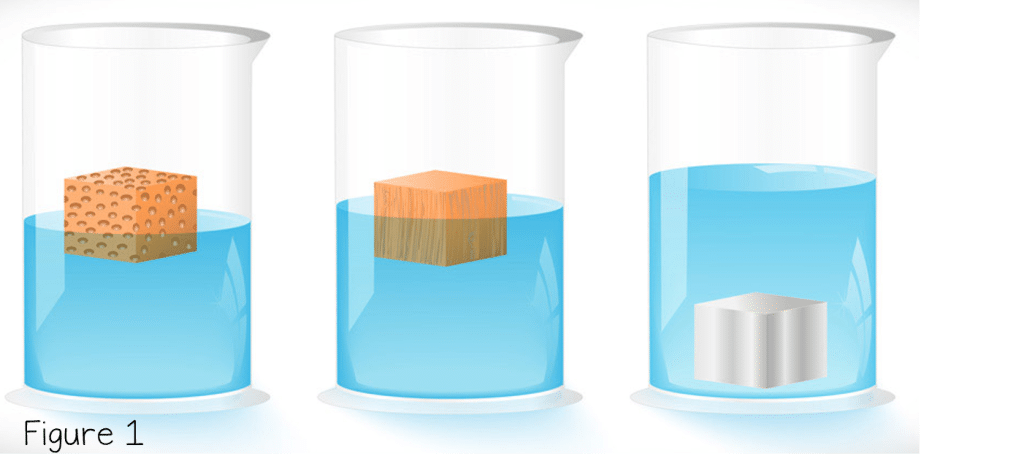
If you look at Figure 1, you can see that the first object (a sponge-like block) floats high in the water because it is less dense than water. The second object floats but sits lower in the water. This means that it is closer to the density of water. The third object sinks to the bottom because it is denser than water. This tells us an object will float if it is less dense than water, sink if it is denser than water, and hover in the middle if it has about the same density.

Time is the interval between two occurring events, which can be measured by a stopwatch or a clock. The SI unit for time is the second (s). Time is important in experiments because it helps scientists measure how quickly something happens, such as how fast someone can run. Using SI units allows scientists to communicate clearly and accurately.
Review:
- What is the unit of measurement for temperature?
- How do you calculate density?
- What is time?