
Section 1: Nutrition and Energy
 When we consider our entire planet—all living organisms and the environments they inhabit—we are describing the biosphere. Within the biosphere, all organisms depend on their environment for both energy and the materials needed to survive. Ecology is the study of how organisms interact with one another and with their environment. One of the most important roles of ecologists is to examine how energy flows through ecosystems. By studying this energy flow, scientists can understand feeding relationships and identify patterns within biological communities.

All organisms require energy to grow, develop, and reproduce. However, organisms cannot create energy—they must obtain it from external sources. For most life on Earth, the sun is the primary source of energy. Organisms called autotrophs, or primary producers, capture energy from sunlight or from chemical compounds to make their own food. Plants, algae, and cyanobacteria use sunlight during photosynthesis to produce carbohydrates. These organisms form the foundation of nearly all food webs, supplying energy to other organisms.
However, not all ecosystems rely on sunlight. Scientists have discovered communities that exist in complete darkness, such as deep-ocean environments. In these ecosystems, certain bacteria use a process called chemosynthesis. Instead of sunlight, they use energy from chemical reactions—often from substances released by hydrothermal vents or other extreme environments—to produce food.
Humans, animals, fungi, and even bacteria are heterotrophs, organisms that rely on other organisms for their energy and food. They are called consumers, and they vary in the way they eat.
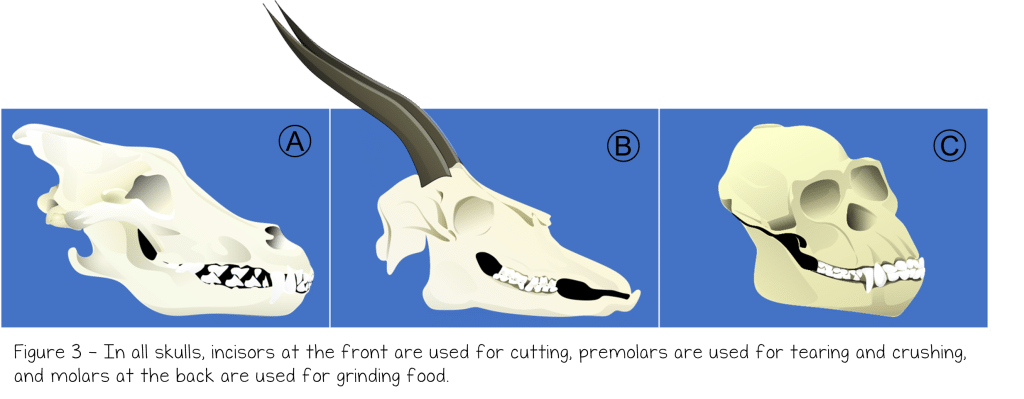
Carnivores, such as wolves or dogs (Skull A), eat other animals and have sharp, pointed teeth. Their long canines are used for catching and tearing prey, while their premolars and molars are adapted for slicing meat. Herbivores, like gazelles (Skull B), eat plants and have teeth specialized for grazing. Their incisors are used to clip grasses and leaves, while their large, flat premolars and molars grind tough plant material. They typically have reduced or absent canines. Omnivores, such as chimpanzees (Skull C), eat both plants and animals and have a combination of tooth types. They use incisors for cutting food, canines for tearing, and molars for grinding.
In mammals, feeding habits are often determined by the shape and structure of their teeth. Teeth are important structures that support an organism’s growth and survival. Most mammals have four main types of teeth: incisors for cutting, canines for stabbing and tearing, premolars for crushing and shearing, and molars for grinding food.
Not all consumers hunt or graze. Some obtain energy from dead material. Detritivores, such as worms and mites, feed on plant and animal remains. Decomposers, including bacteria and fungi, break down this organic matter, returning nutrients to the soil and supporting new plant growth.
Review:
- How do consumers obtain energy and nutrients?
- How are detritivores different from decomposers?
- Compare the four main types of teeth.