
Section 3: Sponges, Cnidarians, & Worms
Invertebrates, or animals without backbones, make up about 95 percent of the animal kingdom. Most invertebrate species live in aquatic or moist terrestrial habitats, which contributes to their incredible diversity across different phyla.

Among the simplest of these animals are sponges. Sponges typically lack body symmetry and can vary widely in size, shape, and color depending on their environment. They are sessile, meaning they remain attached to one place—often the ocean floor—for their entire lives. Although they lack true tissues or organs, sponges have specialized structures that enable them to survive. They are filter feeders, drawing in water through tiny pores and trapping food particles as it moves through their bodies with the help of flagella. Their soft bodies are supported and protected by spicules, small, spike-like structures composed of calcium or silicon dioxide. Sponges can reproduce both sexually and asexually, increasing their ability to survive in changing environments.
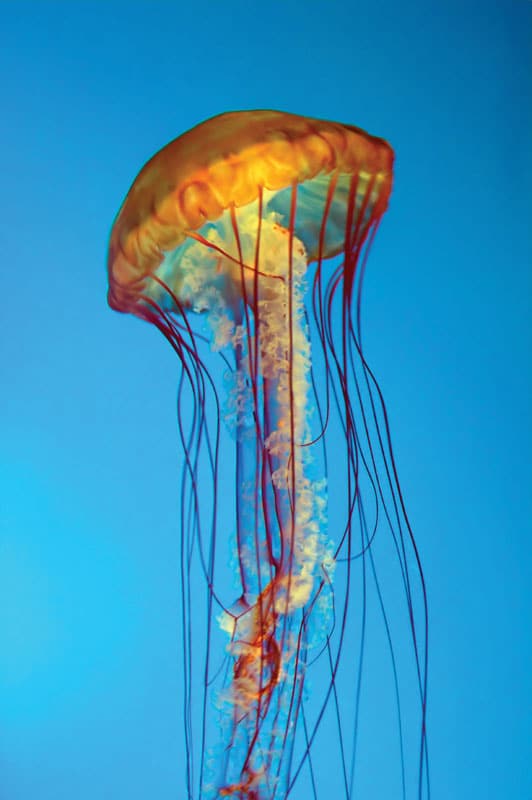
Moving to more complex invertebrates, cnidarians include jellyfish, sea anemones, and corals. These animals have radial symmetry, with body parts arranged around a central point. Cnidarians exist in two main body forms: the polyp, which is tube-shaped with tentacles pointing upward, and the medusa, which has an umbrella-like shape with tentacles hanging downward. A defining feature of cnidarians is the presence of nematocysts, specialized stinging cells used to capture prey and defend against predators. When triggered, these cells release venom that can paralyze prey, allowing the tentacles to pull it toward the mouth. Cnidarians reproduce both sexually and asexually, often through a process called budding, where a new organism grows from the parent.

Further increasing in complexity are worms, which are divided into three major groups: flatworms, roundworms, and segmented worms. Unlike sponges and cnidarians, worms have bilateral symmetry, meaning their bodies can be divided into mirror-image halves. Flatworms have long, flattened bodies and a simple, incomplete digestive system with only one opening. Some are free-living, while others, like tapeworms, are parasitic and live inside a host. Roundworms have a more advanced digestive system with two openings—a mouth and an anus—and their bodies are shaped like a tube within a tube. Many roundworms are decomposers in soil, while others can also be parasitic. Segmented worms, such as earthworms, have bodies divided into repeating sections. They possess a closed circulatory system, meaning blood flows through vessels, along with a nerve cord and a complete digestive tract.
Review:
- Identify three characteristics of sponges.
- Compare a polyp to a medusa.
- What is a closed circulatory system?