
Section 3: Motion and Forces
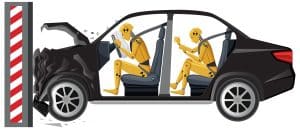
Imagine a crash test dummy sitting in a car during a collision test with its seat belt securely fastened. During the crash, the dummy experiences powerful pushes and pulls as the car suddenly slows down. These interactions demonstrate the effects of force in action. In science, a force is a push or pull exerted on an object. Forces can cause an object to start moving, stop moving, speed up, slow down, or change direction. Forces act on objects in many different ways every day. For example, kicking a soccer ball applies a force that moves the ball across the field, while gravity pulls a falling object toward Earth. In the crash test example, several forces act on the dummy simultaneously. Gravity pulls the dummy downward toward the seat, while the seat belt applies a force that keeps the dummy from moving forward too far during the collision. Without the seat belt, the dummy would continue moving forward because of inertia.
When two or more forces act on an object at the same time, they combine to create a net force. The net force is the overall force acting on an object after all the individual forces are added together. If the forces are balanced, the net force is zero, and the object’s motion does not change. For example, when a book rests on a table, gravity pulls the book downward while the table pushes upward with an equal force. Because these forces are balanced, the book remains still. If the forces are unbalanced, the net force is not zero, and the object’s motion changes. In a crash test, the forces acting on the dummy become unbalanced during the collision, causing rapid changes in motion. Engineers study these forces carefully to design safer cars, stronger seat belts, and airbags that reduce injuries during accidents. By understanding how forces affect motion, scientists and engineers can improve technology and protect people in real-world situations.
Friction is a force that opposes the motion of two surfaces that are in contact with each other. Whenever two objects rub against one another, friction slows or resists their movement. This resistance is caused by tiny irregularities, or microscopic bumps, on the surfaces called microwelds. Even surfaces that feel smooth contain small, rough areas that catch against each other, creating friction.
Friction plays an important role in everyday life. Without friction, people would not be able to walk without slipping, car tires could not grip the road, and pencils would not leave marks on paper. Although friction can slow motion, it is also useful because it provides control and stability.
There are four main types of friction: static friction, sliding friction, rolling friction, and fluid friction. Static friction occurs when two surfaces are in contact but are not moving past each other. This type of friction prevents motion from starting. For example, when you try to push a heavy crate across the floor, static friction resists the initial movement of the crate. Once enough force is applied to overcome the static friction, the crate begins to move. Sliding friction occurs when two surfaces slide past one another. This type of friction is usually weaker than static friction but still acts to slow motion. For example, when a sled moves down a snowy hill, sliding friction occurs between the sled and the snow. Rolling friction occurs when a round object rolls across a surface. Because rolling objects make less contact with the surface, rolling friction is usually less than sliding friction. A basketball rolling across a court or a skateboard moving along a sidewalk are examples of rolling friction. Fluid friction occurs when an object moves through a fluid, whether a liquid or a gas. Air resistance is a form of fluid friction. For example, a skydiver experiences fluid friction as air pushes against the body during the fall. Similarly, boats moving through water experience fluid friction between the water and their hulls.
The amount of friction between objects depends on the types of surfaces involved and the force pressing them together. Rough surfaces usually create more friction than smooth surfaces. By understanding friction, scientists and engineers can design safer roads, faster vehicles, and more efficient machines.
Not all objects fall to Earth at the same rate because of air resistance, a type of fluid friction that opposes the motion of objects moving through air. As an object falls, it collides with air molecules, which push against the object and slow its motion. This opposing force causes deceleration and affects how quickly the object can fall. The amount of air resistance an object experiences depends on several factors, including its speed, size, shape, and surface area. Objects with a larger surface area collide with more air particles and experience greater air resistance. In contrast, objects with a smaller surface area experience less air resistance and therefore fall faster.
Skydivers also experience the effects of air resistance. When a skydiver first jumps from an airplane, gravity pulls the diver downward, causing acceleration. As the diver speeds up, air resistance increases until it balances the force of gravity. At this point, the diver reaches terminal velocity, where the speed remains constant because the forces are balanced. Opening a parachute greatly increases surface area, increasing air resistance and slowing the skydiver’s descent. By understanding air resistance, scientists and engineers can design safer parachutes, faster race cars, and more efficient airplanes.
Review:
- What is a net force?
- Compare static friction to sliding friction.
- Explain air-resistance.