
Section 3: Compositions & Characteristics of Oceans
Earth’s oceans are all connected; however, scientists separate the ocean waters into five main oceans that we recognize. The Pacific Ocean is the largest and deepest of the oceans. It’s larger than all of Earth’s continental land mass put together, covering about 60 million square miles. The Atlantic Ocean is half the size of the Pacific, covering about twenty percent of Earth’s surface. The Indian Ocean is the third largest ocean. It is located between India, Africa, and the Indonesian Islands. Due to its location within the tropics, most of this ocean has warm surface temperatures. The Southern Ocean surrounds Antarctica and is covered by ice for part of the year. Finally, the Arctic Ocean is the smallest and shallowest ocean. It is located near the North Pole and is also covered by ice for part of the year.
Ocean water covers seventy-five percent of the Earth’s surface. The condition of ocean water changes dramatically from the surface to the deep ocean floor. Salinity measures the mass of dissolved solids in a mass of water. Seawater has an average salinity of 35 parts per thousand (ppt), so 1 kg of ocean water contains about 35 g of salt. The salinity of water is also higher in warmer water than in polar water, since it evaporates faster, leaving more salt at the surface.
Temperature also changes from the surface to about 1000m, depending on whether it is in a polar or tropical region. Water near the surface is affected by the weather and is typically warmer. In the deep zone of the ocean, the water is frigid. Water pressure also increases as you descend through it. The density of seawater is related to both salinity and temperature. Ocean water is layered, meaning the densest layers are at the bottom and the least dense are at the top. Since cold water is denser than warm water, salt water is denser than fresh water. This results in seawater having greater buoyancy.
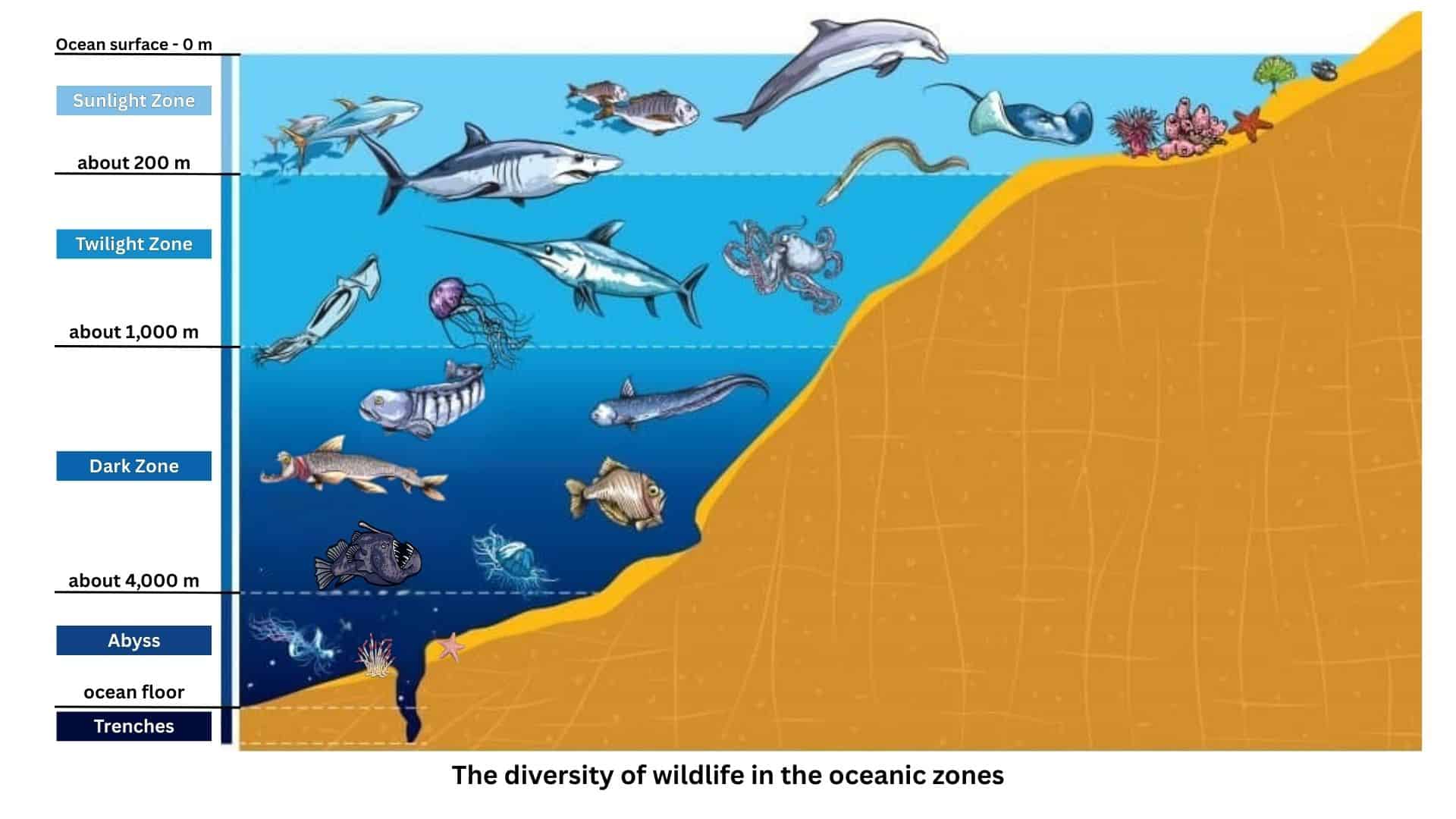
Oceans are divided into zones based on physical characteristics, including sunlight, temperature, salinity, and density.
The Surface Zone (Sunlight Zone) extends from the surface down to approximately 200 meters. In this zone, there is plenty of sunlight and heat, although both decrease the deeper you go. Organisms that perform photosynthesis are located here because it’s the only open ocean part that gets enough sunlight to support growth. Most marine animals, such as whales, sharks, and jellyfish, are in the surface zone.
The Twilight Zone starts from the bottom of the sunlight zone to the point where sunlight cannot reach. This zone, extending down to approximately 1000 meters, is home to fish and invertebrates such as swordfish and wolf eels. At night, many swim to the sunlight zone to hunt and feed.
The Deep Zone (Midnight Zone) is 15 times the size of the surface zone, making it the largest ecosystem on Earth. Organisms in this zone live in complete darkness. Sunlight cannot penetrate beyond about 1000 meters, so the entire zone from 1000 to 4000 meters is completely dark. Many animals that live here have specialized glowing organs called photophores, like those of fireflies, which are used to attract prey, confuse enemies, or find a mate. The organisms produce light in their photophores through a chemical process called bioluminescence. Animals in this zone must be good hunters to survive, as resources are limited.
The Abyssal Zone (Abyss) has crushing pressure and temperatures near freezing. This zone contains over 75 percent of the ocean floor covered with deep, soft sediments of mud and ooze. Here, organisms rely almost entirely on food sinking from above. Therefore, many animals here, such as sea stars, hagfish, and giant isopods, are scavengers.
The Trenches are a unique zone in that they exist only in certain places around the world —the deep, wide trenches of the ocean floor. The deepest parts of the ocean make up this zone, and despite the incredible pressure and near-freezing temperatures, life perseveres here. Invertebrates such as starfish, tubeworms, and the bacteria that live inside them have all adapted to this environment in unique ways.
Review:
- Identify the five oceans.
- What does salinity mean?
- Explain bioluminescence.