
Section 2: Fresh Water
All fresh water on Earth begins as precipitation. Some of this water evaporates quickly or soaks into the soil, while the rest becomes runoff, which is water that flows over the ground surface. The type of ground surface affects whether water soaks into the ground or flows away as runoff. For example, soil contains spaces that allow water to soak in more easily, while pavement does not. The rate of rainfall also affects the amount of runoff. In addition, water flows more quickly down a steep slope than across flat land.
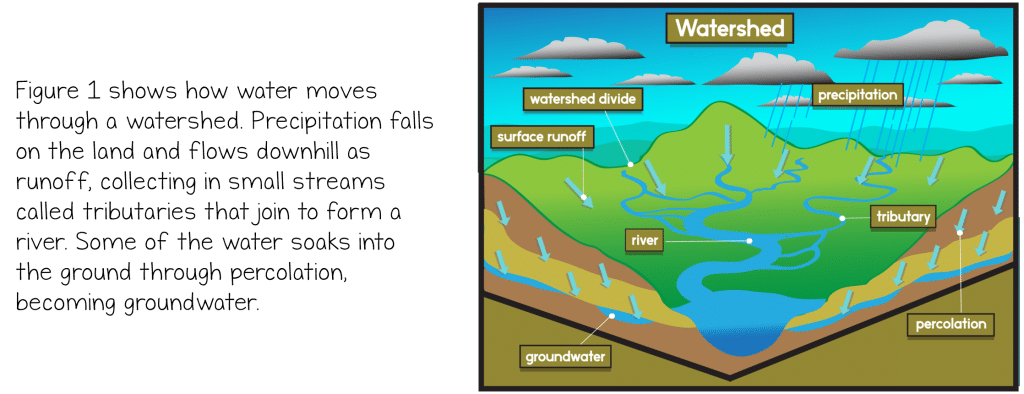
Over time, rivers shape the land through erosion, which wears away landforms, and deposition, which builds new landforms. A river system includes a main river and all of its tributaries, or smaller streams that flow into it. The land area that supplies water to a river system is called a watershed.
Ponds and lakes form when water collects in low-lying areas or hollows in the land. They are supplied by rainfall, melting snow, and runoff. Ponds often contain diverse habitats, with bottoms commonly covered in plants and weeds. Because ponds are shallow, sunlight reaches the bottom, allowing plants to grow through photosynthesis. Lakes are often deeper and can change with the seasons. As water temperatures shift, the water mixes, allowing nutrients to circulate throughout the lake.
Wetlands are areas that are covered with a shallow layer of water for part or all of the year. The three common types of wetlands are marshes, swamps, and bogs. Some coastal wetlands contain both fresh and salt water, such as salt marshes and mangrove forests. Wetlands provide a rich supply of nutrients and habitats for many organisms. They are also important because they help control flooding by absorbing excess runoff.
Glaciers are huge masses of ice and snow that move slowly over land. They form in places where more snow falls each year than melts. Over time, layers of snow are pressed tightly together and gradually turn into solid ice. Sometimes, large pieces of glaciers break off and fall into the ocean. These floating pieces of ice are called icebergs. Nearly 90 percent of an iceberg lies below the surface of the water. Glaciers store a large portion of Earth’s fresh water—about two-thirds of the world’s supply.
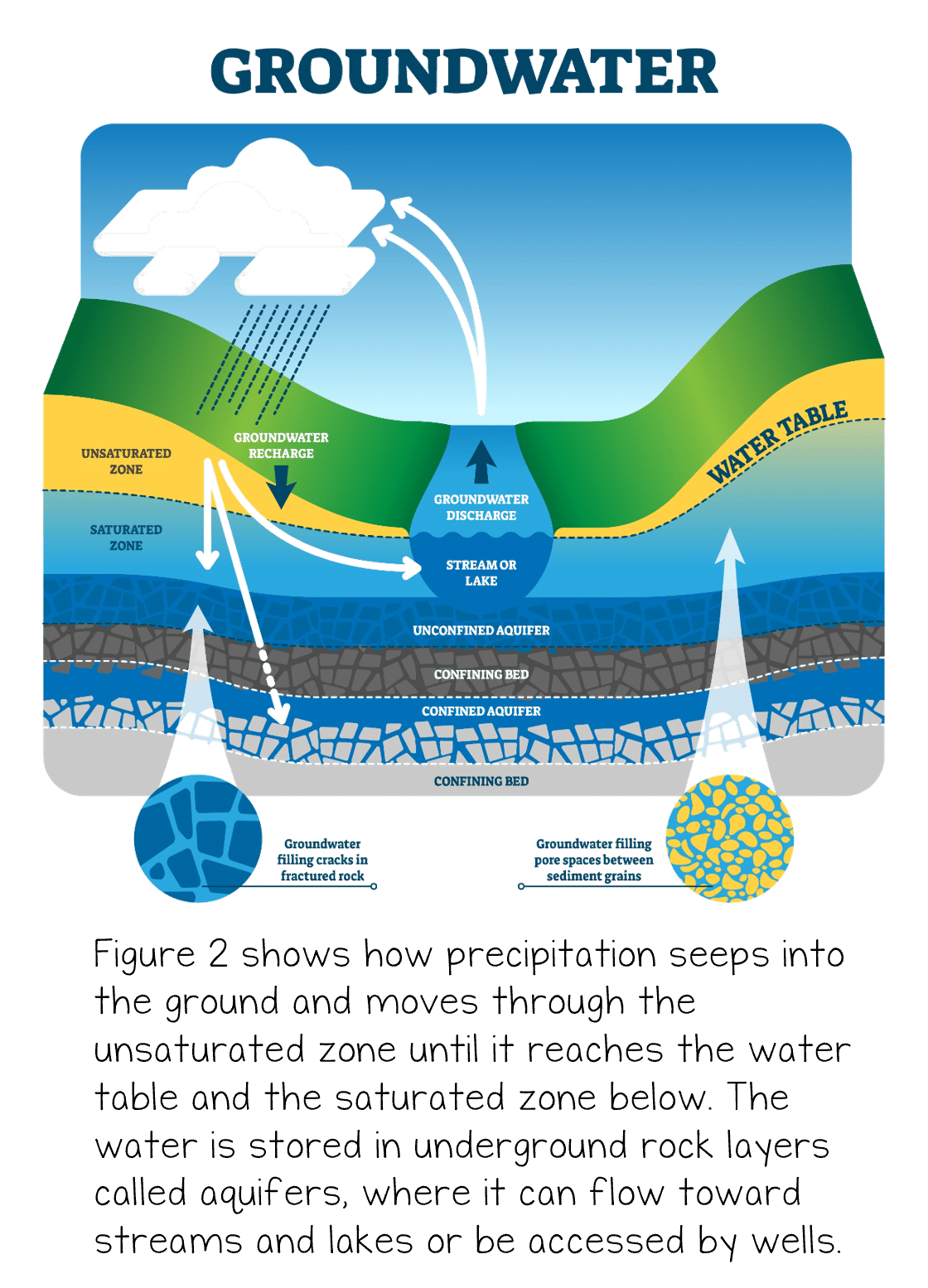 Groundwater forms when precipitation infiltrates the soil and moves through the spaces between soil particles and through cracks in rock layers. Materials that allow water to pass through easily are called permeable, while materials that do not allow water to pass through easily are called impermeable.
Below Earth’s surface are different layers of soil and rock that contain water. The saturated zone is the area in which all soil and rock pores are filled with water. The water table is the upper surface of the saturated zone. Above this level is the unsaturated zone, where the spaces contain a mixture of air and water rather than being completely filled.
Underground rock layers that hold water are called aquifers. People obtain groundwater from aquifers by drilling wells, which are man-made holes that reach below the water table. In some cases, water in an aquifer is under pressure. When a well is drilled into this type of aquifer, the pressure can force water upward without pumping. This type of well is called an artesian well.
Groundwater can also naturally reach the surface. A spring forms when groundwater flows or bubbles out through cracks in rock. Some springs are heated by magma deep underground. A geyser is a type of hot spring that erupts when heated water and steam build up pressure, forcing hot water up through narrow openings in the ground.
Review:
- Where does all fresh water come from?
- Compare the saturated zone to the unsaturated zone.
- What is a geyser?