
Section 2: Atmosphere Energy Transfer

Almost all of the energy in Earth’s atmosphere comes from the Sun. This energy travels to Earth by radiation, which is the transfer of energy through electromagnetic waves that can move through empty space. Because radiation does not require matter to travel, energy from the Sun can pass through the vacuum of space and reach Earth.
About 99% of the Sun’s radiant energy that reaches Earth is in the form of visible light, infrared radiation, and ultraviolet light. Most of the sunlight we receive is visible light, which appears as a mixture of all the colors seen in a rainbow. When sunlight passes through a prism or water droplets in the air, these colors can be separated and seen individually. Another form of solar energy is infrared radiation, which has wavelengths longer than visible light. Although infrared radiation cannot be seen, it can be felt as heat. For example, when sunlight warms your skin or heats the ground on a sunny day, you are feeling infrared radiation. The Sun also emits ultraviolet (UV) radiation, which has shorter wavelengths and higher energy than visible light. UV radiation can break chemical bonds and damage living cells, which is why too much exposure can cause sunburn. Fortunately, much of this harmful radiation is absorbed by the ozone layer in the stratosphere.
As sunlight enters Earth’s atmosphere and reaches the surface, some of the energy is absorbed by land, water, and living things. The surface then releases this energy back into the atmosphere as infrared radiation, or heat. Certain gases in the atmosphere, called greenhouse gases, absorb and trap some of this heat energy. This natural process helps regulate Earth’s temperature and keeps the planet warm enough for life. The warming effect caused by these gases is known as the greenhouse effect, which acts like a blanket surrounding Earth and preventing too much heat from escaping into space.
Three types of thermal energy transfer work together to heat the troposphere: radiation, conduction, and convection. Each process moves energy in a different way and helps distribute heat throughout the lower atmosphere.
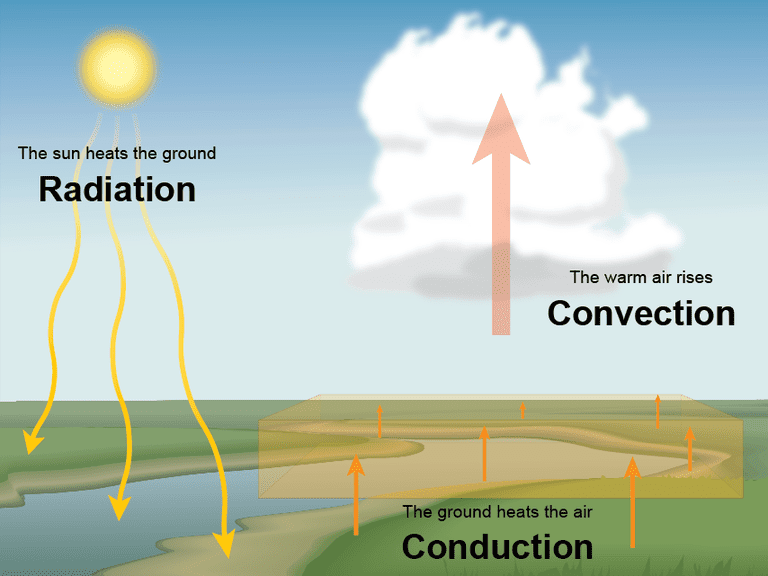
Radiation is the direct transfer of energy by electromagnetic waves. Energy from the Sun reaches Earth through radiation and warms the planet’s surface. Once the surface absorbs this energy, it begins to warm the air above it. Conduction is the transfer of thermal energy through the contact of particles of matter. This process occurs when the warmed ground transfers heat directly to the air in contact with it. Because air is a poor conductor, conduction only warms a thin layer of air closest to Earth’s surface.
After this air is warmed, convection moves the heat higher into the atmosphere. Convection transfers thermal energy through the movement of particles within a fluid, such as air. Warm air near the surface becomes less dense and rises, while cooler, denser air sinks to take its place. This continuous movement creates convection currents that circulate heat through the troposphere and play an important role in forming clouds and weather patterns.
The strength of this vertical air movement determines the stability of the atmosphere. Stability refers to whether circulating air motions will be strong or weak. Stable conditions occur when air moves only slightly, which often leads to calm weather. Unstable conditions occur when air rises quickly and circulates strongly, often producing clouds, storms, and thunderstorms.
One special condition that can affect air movement is called a temperature inversion. Normally, air temperature decreases with altitude. During a temperature inversion, however, temperature increases with altitude. This warmer layer of air traps cooler air near the ground, preventing it from rising. As a result, pollutants can become trapped close to Earth’s surface, sometimes leading to smog in cities or valleys.
Review:
- Explain the characteristics of radiation.
- What is the Greenhouse Effect?
- What are the three types of energy transfer?