
Section 4: The Planets
The solar system contains eight planets that orbit the Sun. Scientists classify these planets based on their location and composition. The inner planets orbit between the Sun and the asteroid belt, while the outer planets orbit beyond the asteroid belt. Planets are also grouped by what they are made of. Terrestrial planets are mostly rocky, while giant gaseous planets are made mainly of gases and ices.
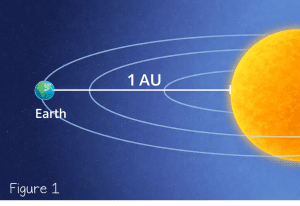 Because objects in the solar system are extremely far apart, astronomers use a special unit of distance called an astronomical unit (AU). On Earth, distances are usually measured in meters or kilometers. In space, however, distances are much larger. One astronomical unit is approximately 150 million kilometers, the average distance from Earth to the Sun.
The outer planets include Jupiter, Saturn, Uranus, and Neptune. These planets are much larger than the inner planets and are composed mostly of gas and ice. Jupiter is the largest planet in the solar system and the fifth planet from the Sun. Its atmosphere is made mainly of hydrogen and helium, and powerful storms occur there. The most famous of these storms is the Great Red Spot, a giant storm that has lasted for hundreds of years. Jupiter also has many moons, including four large ones that have their own thin atmospheres.
Saturn is the sixth planet from the Sun and the second largest in the solar system. It is well known for its wide rings, which are made of countless pieces of ice and rock. Its atmosphere also contains hydrogen, helium, ammonia, methane, and water vapor. Uranus is the seventh planet from the Sun and is a large, gaseous planet. Methane in its atmosphere gives the planet its blue-green color. Uranus is unusual because its axis is tilted so much that the planet appears to roll around the Sun like a ball as it orbits. Neptune is the eighth planet from the Sun and the farthest known major planet in the solar system. It is a cold, gaseous planet with strong winds and violent storms. Neptune also has geyser-like eruptions that release nitrogen gas from its surface.
Closer to the Sun are the inner planets, which include Mercury, Venus, Earth, and Mars. These planets are smaller and made mostly of rock and metal. Mercury is the planet closest to the Sun. It has almost no atmosphere and experiences extreme temperature changes. During the day, the surface facing the Sun can reach about 430°C. Mercury’s surface is covered with many craters and steep cliffs.
Venus, the second planet from the Sun, is similar in size and mass to Earth. However, it has a very thick atmosphere of clouds that traps heat through a strong greenhouse effect. As a result, surface temperatures range between 450°C and planet from the Sun and the only known planet that supports life. Water exists on Earth in solid, liquid, and gaseous forms, and the atmosphere protects the planet from many meteoroids and harmful solar radiation. Mars, the fourth planet from the Sun, is often called the Red Planet because iron oxide in its rocks gives the surface a reddish color. Mars has a thin atmosphere, which leads to extreme temperatures, strong winds, and large dust storms. It also has polar ice caps, seasons, and evidence that water once existed on its surface.

Review:
- Identify the inner planets.
- List three characteristics of Mars.
- List three characteristics of Jupiter.