
Section 3: Solar System
After learning about Earth, the Moon, and their motion in space, it is helpful to look at the larger system they belong to—the solar system. The solar system includes the Sun and all the objects that orbit it.
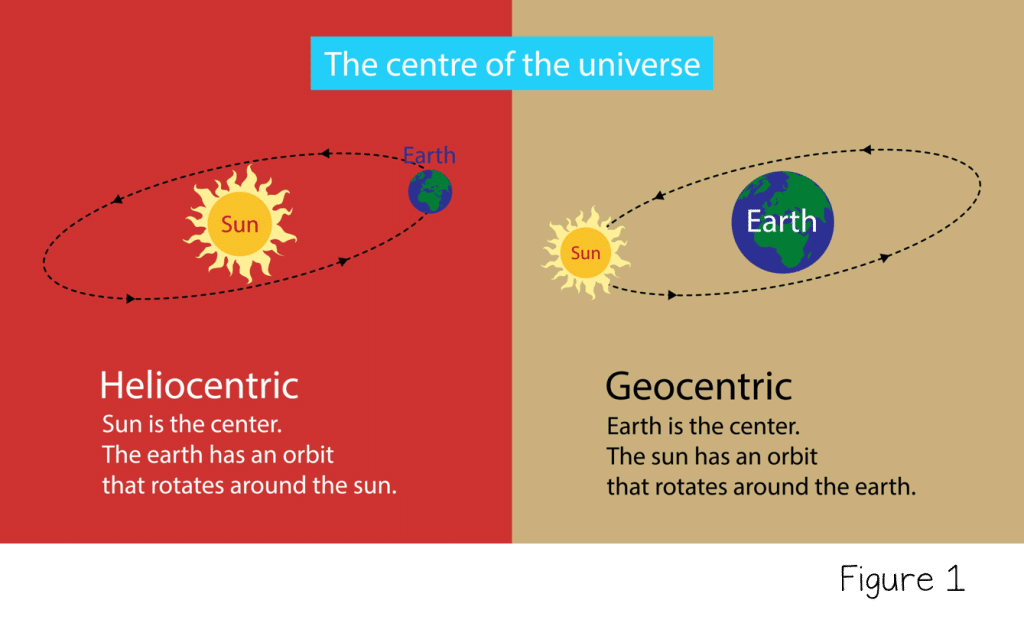
For many centuries, people tried to understand how objects in space move. Early Greek astronomers believed that the planets, the Sun, the Moon, and the stars all revolved around Earth. This explanation was called the geocentric, or Earth-centered, model. Over time, new observations led scientists to question this idea. Nicholas Copernicus proposed that the Sun is at the center of the solar system and that Earth and the other planets revolve around it. Later, Galileo Galilei used a telescope to make observations that supported this idea, including evidence that the Moon revolves around Earth. This explanation became known as the heliocentric, or Sun-centered, model.
Astronomers also wanted to understand how the solar system formed. Most scientists believe the solar system began about 4.6 billion years ago from a large cloud of gas and dust. Shock waves from a nearby supernova, or exploding star, may have caused this cloud to compress and begin spinning. As it spun faster, the material flattened into a rotating disk of heated gas and dust. At the center of this disk, temperatures and pressure became high enough for nuclear fusion to begin, forming the Sun. Meanwhile, the remaining material in the disk gradually clustered together to form asteroids, comets, planets, and other objects. Over time, heavier rocky materials formed planets closer to the Sun, while lighter gases and ices collected farther away. This process eventually produced the solar system we observe today.
Today, astronomers classify several different types of objects that orbit the Sun. A planet is a large object that orbits the Sun, has a nearly spherical shape, and has cleared most other objects from its orbit. A dwarf planet is also spherical and orbits the Sun, but it does not have enough mass to clear nearby objects from its orbit. This means its gravity is strong enough to remove or dominate nearby debris. A dwarf planet also orbits the Sun and has a nearly spherical shape, but it does not have enough mass to clear other objects from its orbit. One well-known example is Pluto, which is located in a region of space beyond Neptune called the Kuiper Belt. The Kuiper Belt is a wide area filled with icy objects and leftover material from the formation of the solar system.
Other smaller objects are also part of the solar system. An asteroid is a small, rocky object that orbits the Sun and is most commonly found in the asteroid belt between Mars and Jupiter. Asteroids range in size from less than a meter to several hundred kilometers across. A comet is made of gas, dust, and ice and travels around the Sun in a long, oval-shaped orbit. As a comet gets closer to the Sun, its ice heats up and turns into gas, forming a glowing coma and tail. As comets travel and break apart, they can leave behind smaller pieces of debris. A meteoroid is a small piece of rock or metal that forms from these fragments or from collisions between asteroids.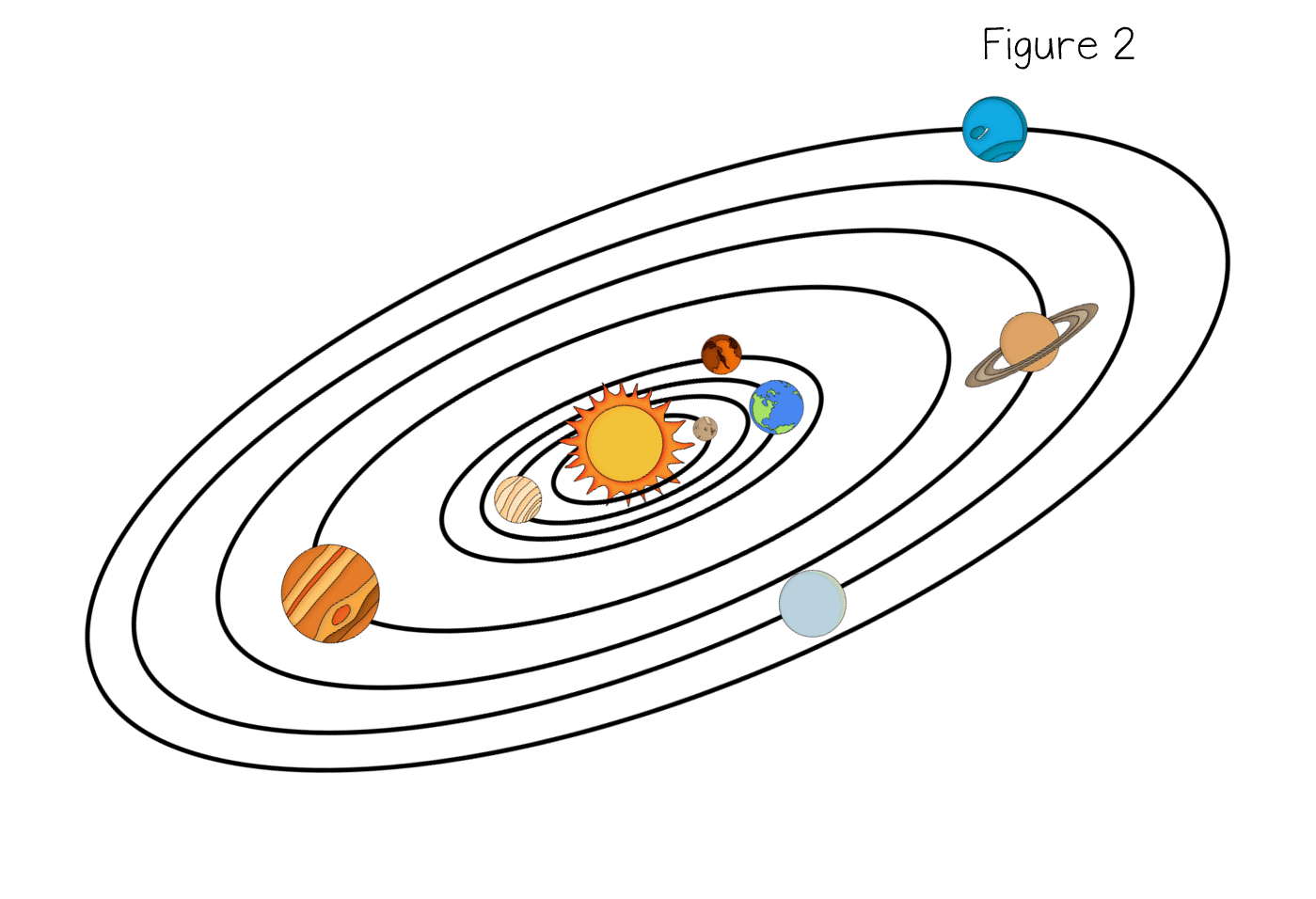
Review:
- Compare the geocentric model to the heliocentric model.
- What is the difference between an asteroid and a meteoroid?
- What is a comet made up of?