
Section 1: Intro to Animals – Fish & Amphibians

The classification of organisms helps scientists organize living things based on shared characteristics. Over time, this system has allowed scientists to better understand how species are related and how they have changed throughout Earth’s history. One major group identified by classification is the chordates, which includes all vertebrates. All vertebrates belong to the phylum Chordata. Chordates share several important features at some point during their development. One of these is the notochord, a flexible rod that provides support along the back. In many vertebrates, the notochord is eventually replaced by a backbone. Chordates also have a dorsal nerve cord, which runs along the back and functions similarly to a spinal cord, carrying messages between the brain and the rest of the body. In addition, chordates have pharyngeal slits, or openings in the throat area. In aquatic organisms like fish, these slits develop into gills used for breathing, whereas in other vertebrates, they either disappear or develop into different structures before birth.
Vertebrates are defined by one key feature: a backbone, or vertebral column, made up of individual bones called vertebrae. This backbone is part of an internal skeleton, known as an endoskeleton. The endoskeleton supports the body, protects vital organs, and provides attachment points for muscles, allowing movement. Vertebrates are divided into five major groups—fish, amphibians, reptiles, birds, and mammals—each with unique adaptations that help them survive in different environments.
Evidence from fossils shows that the earliest vertebrates were fish, which were also the first animals to develop bony internal skeletons. Today, fish remain the most diverse group of vertebrates. All fish live in water and are ectothermic, meaning their body temperature depends on the surrounding environment. Because they cannot generate much internal heat, they are often called “cold-blooded.” In contrast, endothermic animals, such as birds and mammals, can regulate their own body temperature by producing internal heat and are commonly referred to as “warm-blooded.”

Fish share several key characteristics that make them well adapted to life in water. Most have scales that protect their bodies and fins that help them move and steer. They obtain oxygen using gills that extract it from water. Most fish reproduce through sexual reproduction with external fertilization. During a process called spawning, males and females release sperm and eggs into the water at the same time. This increases the chances that fertilization will occur and that the offspring will survive.

The earliest fish were jawless fish, such as lampreys and hagfish. These fish lack jaws and have soft, eel-like bodies with slimy skin and no scales. Instead of bone, their skeletons are made of cartilage, a flexible connective tissue. Jawless fish rely on their notochord for support. Because they lack jaws, many are filter feeders, taking in water and trapping food particles. Some, like lampreys, are parasitic and attach to other fish to feed on their body fluids. Hagfish are scavengers that feed on dead or decaying organisms and are known for producing large amounts of slime as a defense.
Over time, fish evolved jaws, leading to the development of cartilaginous fish, such as sharks, skates, and rays. These fish still have cartilage skeletons, which make them lighter and more flexible than bony fish. Their skin is covered in tiny, tooth-like structures called dermal denticles, which reduce friction and help them swim efficiently. Their jaws allow them to grasp and consume larger prey, giving them an advantage as predators.
The most advanced and diverse group of fish is the bony fish, which includes species like tuna, trout, salmon, and carp. As their name suggests, their skeletons are made of hard bone, providing strong support and protection. Bony fish also have a specialized structure called a swim bladder, a gas-filled organ that helps control buoyancy. This allows them to maintain their position in the water without constantly swimming, conserving energy.

While fish are fully adapted to life in water, some vertebrates evolved features that allowed them to survive both in water and on land. This important evolutionary step led to the development of amphibians, which bridge the gap between aquatic and terrestrial life. The word amphibian comes from a Greek term meaning “to live a double life,” reflecting on their unique life cycle. Amphibians, such as frogs, toads, and salamanders, spend their early stages in water and typically move onto land as adults. Like fish, amphibians are ectothermic vertebrates, meaning their body temperature depends on their surroundings. Because of this, amphibians are usually found in moist environments such as streams, rivers, lakes, and ponds. Their permeable skin allows water and gases to pass through easily. Amphibians use both lungs and their skin to breathe. As adults, they develop lungs that allow them to take in oxygen from the air on land. At the same time, they can also exchange oxygen (O₂) and carbon dioxide (CO₂) directly through their moist skin. This is why they must stay in damp environments—if their skin dries out, gas exchange cannot occur effectively. However, this same feature also makes them highly sensitive to environmental changes, such as pollution or habitat loss.
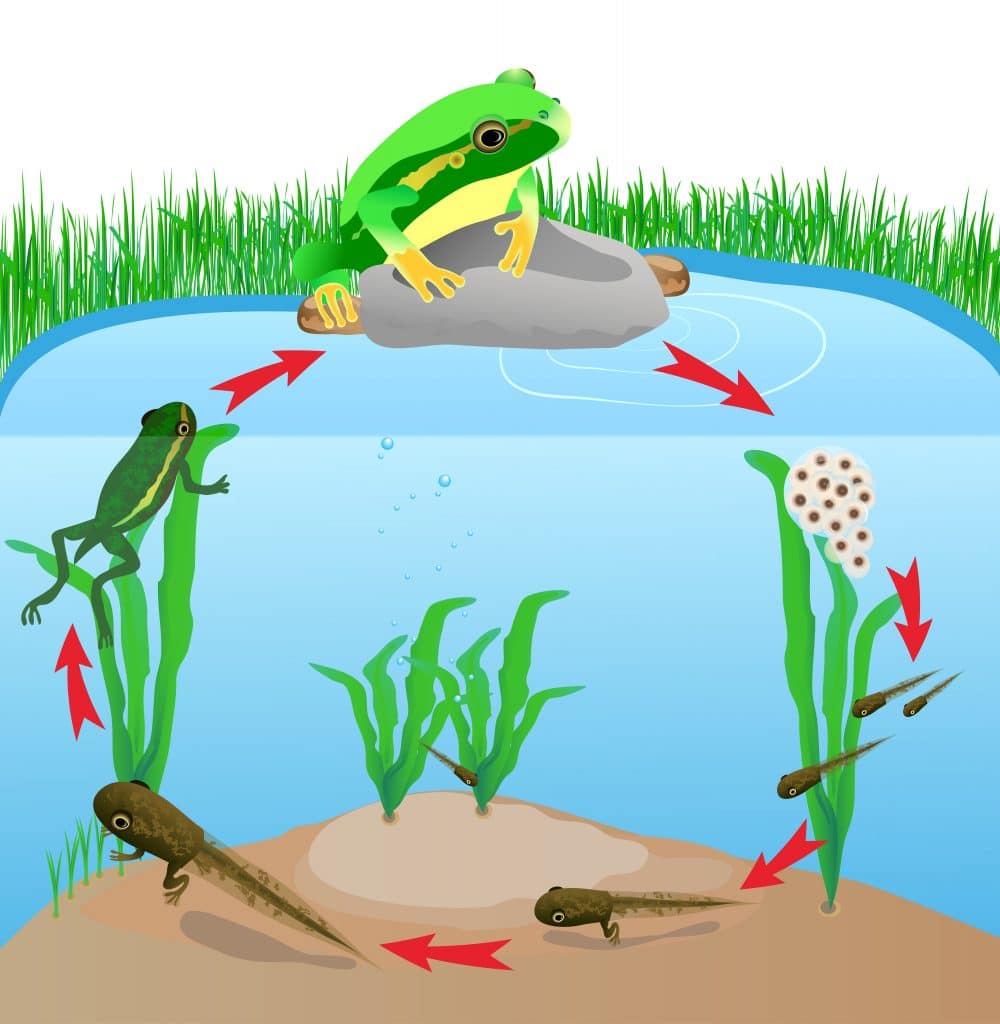
Most amphibians go through metamorphosis, a process of dramatic physical change from an egg to an adult. For example, frogs lay their eggs in water to keep them from drying out. When the eggs hatch, the young, called tadpoles, live entirely in water and breathe using gills. As they grow, they develop legs, their bodies change shape, and their lungs mature. Eventually, the tadpole loses its tail and becomes an adult frog capable of living on land and breathing air.
Review:
- What is a chordate?
- Compare ectotherms to endotherms.
- What is the function of a swim bladder?