
Section 5: Insects
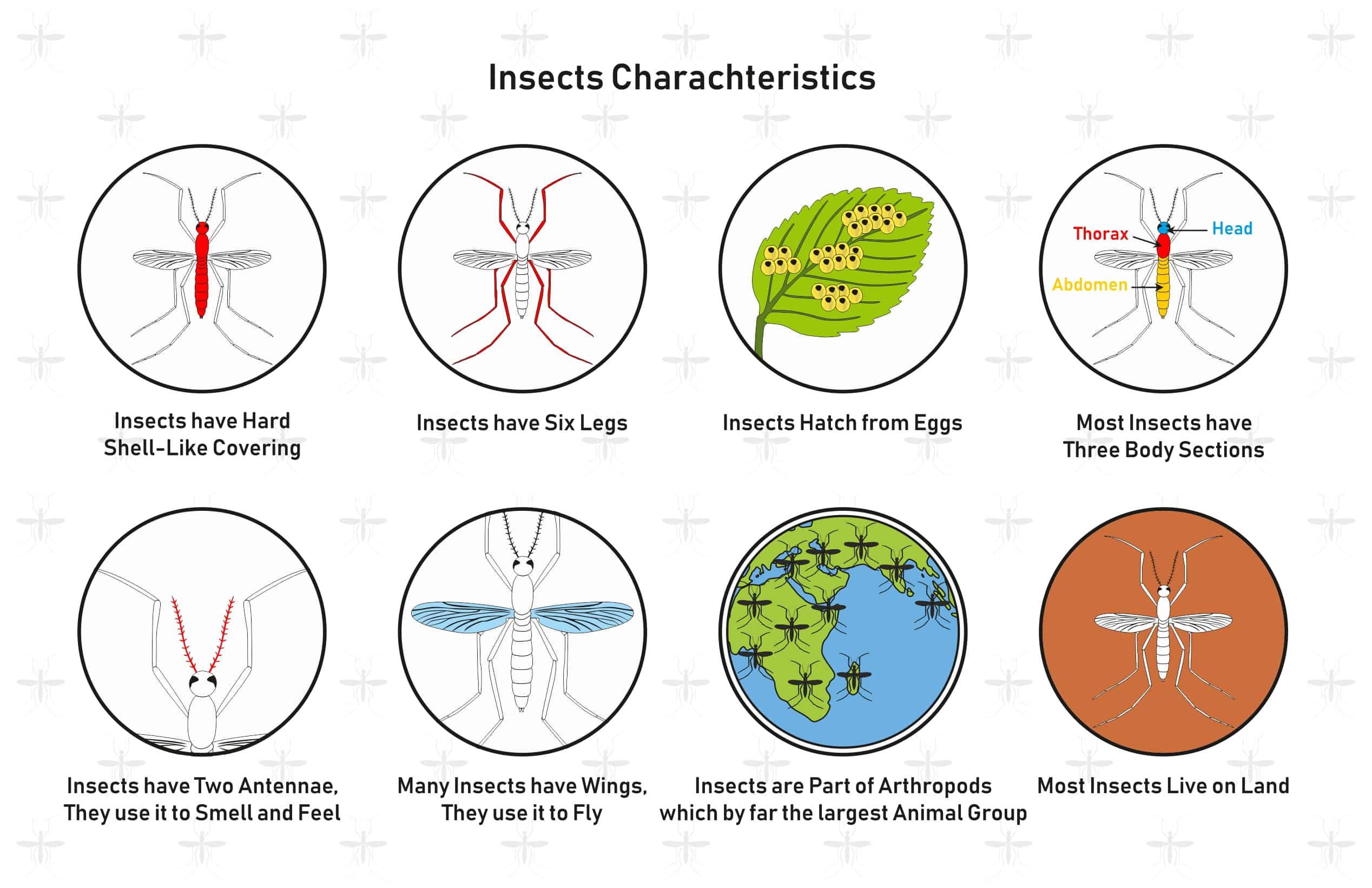 Insects are the largest, most common, and most successful group of arthropods. Their success is largely due to their specialized body structures and ability to adapt to many different environments. Adult insects have six legs, usually two pairs of wings, and a segmented body divided into three main sections: the head, thorax, and abdomen. The head contains important sensory structures. This is where the antennae are located, which insects use to feel, smell, and sometimes taste their surroundings. Many insects also have compound eyes, made up of thousands of tiny lenses, allowing them to detect movement quickly and see a wide field of view. The thorax is the middle section of the body and is responsible for movement. It is where the legs and wings attach, enabling insects to walk, jump, or fly. Wings are especially important because they help insects find food, escape predators, and locate mates. The abdomen contains many of the insect’s vital internal organs, including the digestive system, heart, and reproductive organs. Insects also have specialized mouthparts adapted to their diet. For example, some insects use strong jaws called mandibles for chewing and grinding food, while others have mouthparts designed for piercing or sucking.
During their life cycle, many insects undergo metamorphosis, in which their body structure and appearance change dramatically. Each insect species undergoes either complete metamorphosis or incomplete (gradual) metamorphosis, depending on how these changes occur.
In complete metamorphosis, insects develop through four distinct stages: egg, larva, pupa, and adult. A common example is a ladybug. The cycle begins when a female lays her eggs, often on the underside of leaves for protection. When the eggs hatch, they become larvae, active feeding stages that grow quickly. As the larvae grow, they molt several times, shedding their exoskeleton to allow for increased size. After reaching full size, the larva attaches itself to a surface and enters the pupa stage. Inside this protective case, major changes occur—structures such as wings and antennae form as the insect transforms into an adult. Once development is complete, the adult emerges. At first, its wings are soft, but they harden over time. The adult insect then feeds, reproduces, and continues the cycle. This complete transformation allows insects to occupy different roles at each life stage, reducing competition for food and increasing their chances of survival.
 In contrast to complete metamorphosis, some insects undergo incomplete (gradual) metamorphosis, which lacks a distinct larval or pupal stage. Instead, the young insect, called a nymph, looks like a smaller version of the adult but lacks fully developed wings and reproductive structures. A common example is the dragonfly. The life cycle begins when a female lays her eggs in still water or on aquatic plants. When the eggs hatch, they become nymphs, which live in water and actively hunt prey using a specialized, extendable mouthpart. As the nymph grows, it undergoes multiple molts—sometimes up to fifteen—shedding its outer covering to allow for growth. Eventually, the nymph leaves the water and attaches to a surface for its final molt. During this stage, a fully winged adult emerges from the old exoskeleton. Once its wings expand and harden, the adult dragonfly begins flying, feeding, and searching for a mate. This gradual development allows the insect to grow steadily while maintaining a similar body form, with each stage becoming more like the adult.
Insects play a crucial role in maintaining healthy ecosystems. In fact, many ecosystems depend on insects to function properly. Without them, food webs would be disrupted, and many plant species—including important crops—would struggle to survive. One of the most important roles insects play is pollination. Bees and other pollinators transfer pollen from one plant to another, allowing plants to reproduce and produce fruits and seeds that humans and other animals rely on for food.
In addition to their helpful roles, some insects can have negative impacts. Certain species act as disease carriers, spreading illness to plants, animals, and even humans. Others, like locusts, can cause major damage to agriculture by consuming large amounts of crops in a short time, threatening food supplies. Because of both their positive and negative effects, insects are also used in pest management strategies. One method is biological control, which involves introducing a natural predator to reduce the population of harmful insects. For example, gardeners often release ladybugs because they feed on aphids, small insects that damage plants by sucking their sap. Using natural predators helps control pests without relying on harmful chemicals.
Overall, insects have a powerful influence on ecosystems. Whether acting as pollinators, pests, or natural pest controllers, they play multiple roles that help maintain environmental balance.
Review:
- Identify the body parts of an insect.
- Compare complete metamorphosis to gradual metamorphosis.
- How do insects play a role in developing ecosystems?