
Section 2: Determining Ages of Rocks
One way scientists determine the age of a fossil is by dating the rock layer in which it was found. To do this, geologists determine both the relative age and the absolute age of rocks. A rock’s relative age is determined by comparing it with the ages of other rocks. In contrast, the absolute age of a rock is the number of years that have passed since it formed. Although it is often difficult to determine the exact absolute age, geologists can usually estimate it within a certain range of years.
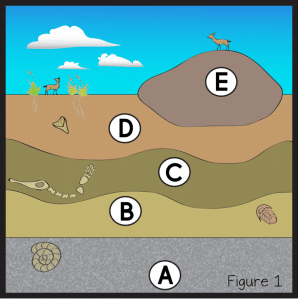 To determine relative age, geologists often use the law of superposition. This principle states that in horizontal layers of sedimentary rock, the oldest layer is found at the bottom, and each layer above it is younger than the one beneath it. Figure 1 shows how the law of superposition can be used to determine the relative age of rock layers. In this example, layer A is the oldest because it lies at the bottom. Each layer above it formed later, so B is younger than A, C is younger than B, and D is younger than C. The top layer, E, is the youngest rock layer because it formed last. By studying the order of rock layers and the fossils within them, geologists can reconstruct the sequence of events that occurred in Earth’s history.
Geologists also examine other features in rock layers. For example, an extrusion occurs when lava flows onto Earth’s surface and hardens. Because the lava forms after the rock beneath it, the extrusion is always younger than the rocks below it. An intrusion forms when magma cools and hardens beneath Earth’s surface, creating a mass of igneous rock. Since the magma pushes into existing rock layers, an intrusion is always younger than the surrounding rock. A fault, which is a break in Earth’s crust, is also younger than the rocks it cuts through. In addition, geologists may find an unconformity, which is a gap in the geologic record where some rock layers have been removed by erosion.
 Figure 2 shows how index fossils help geologists match rock layers that are found in different locations. Even though erosion has separated the rock formations, the same fossils appear in similar layers on each side. For example, the layer containing ammonite fossils appears in the top reddish layer in both locations. Because ammonites lived during a specific period of time and were widely distributed, they serve as index fossils. By identifying the same index fossils in rock layers that are far apart, geologists can determine that those layers formed during the same time period. This allows scientists to match rock layers across large distances and better understand Earth’s geologic history.
In addition to relative dating, geologists can determine the absolute age of rocks using a method called radioactive dating. Most elements are stable, meaning they do not change over time. However, some elements exist in unstable forms that gradually break down. An element is a substance made of atoms that are all of the same type.
When an unstable element breaks down, it releases particles and energy in a process called radioactive decay. These unstable elements are known as radioactive elements.
Radioactive elements decay at a predictable rate. The time it takes for half of the radioactive atoms in a sample to decay is called the half-life. Over time, the original radioactive element slowly decays into a different element. During this process, the amount of the radioactive element decreases while the amount of the new element increases. By measuring the amounts of these elements in a rock sample, geologists can determine the rock’s approximate absolute age.
Review:
- What is the law of superposition?
- Why are index fossils important?
- What is radioactive decay?