
Section 3: Geological Time Scale
Earth’s geologic history is organized into a timeline called the geologic time scale. This timeline divides Earth’s long history into smaller sections that help scientists understand major changes that have occurred over time. The four main divisions of the geologic time scale are eons, eras, periods, and epochs.
Eons are the longest units of geologic time and are marked by major changes in the types of organisms found in fossils. Each eon is divided into eras, which are defined by significant worldwide changes in life on Earth. Eras are further divided into periods, which are often named after places where important rocks and fossils were first discovered. Periods are then divided into smaller units called epochs, which are characterized by more specific differences in life forms and environmental conditions.
The earliest and longest part of Earth’s history is called Precambrian Time. Precambrian Time began when Earth formed about 4.6 billion years ago and lasted until about 544 million years ago, covering nearly 88 percent of Earth’s history. During this long span of time, many important features of our planet began to develop.
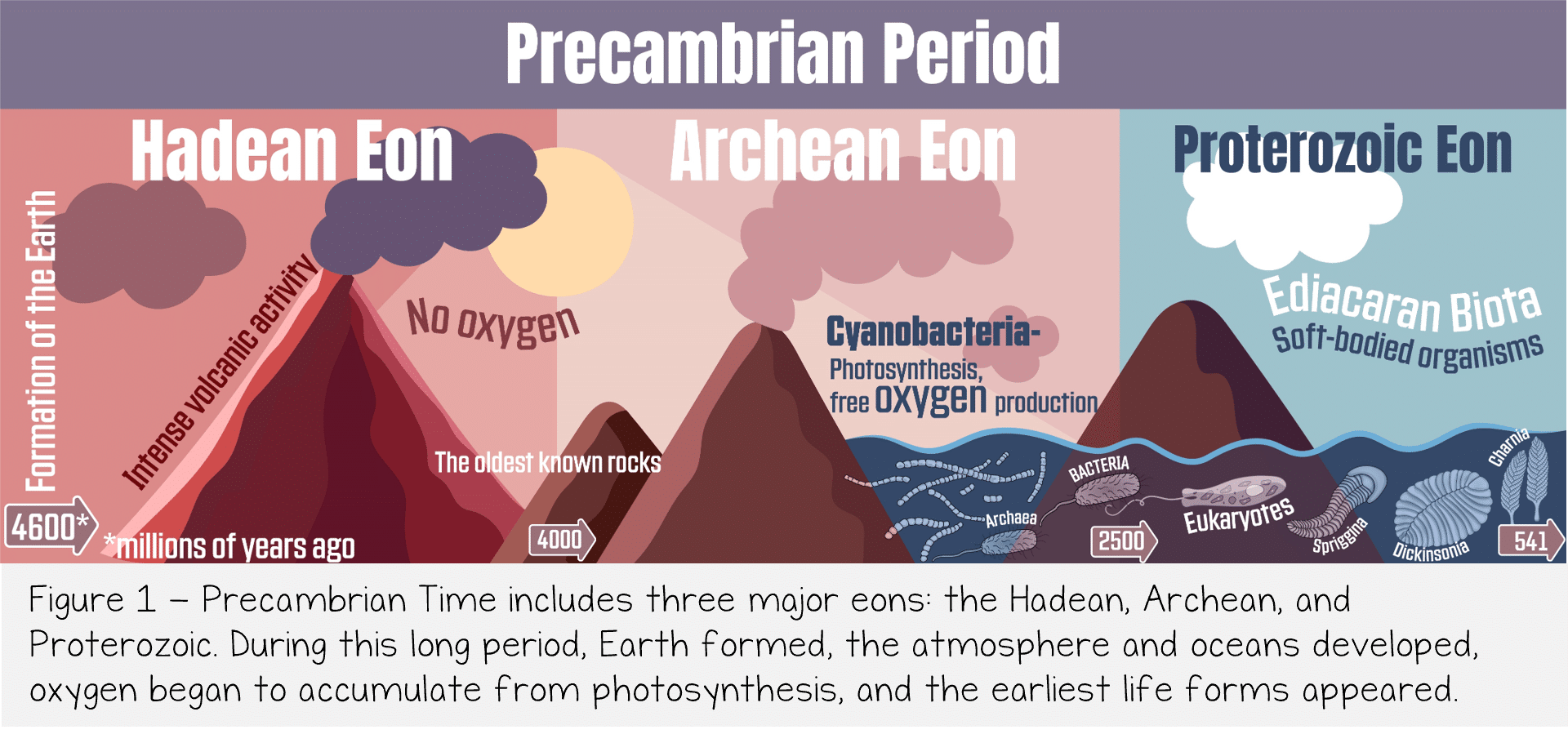
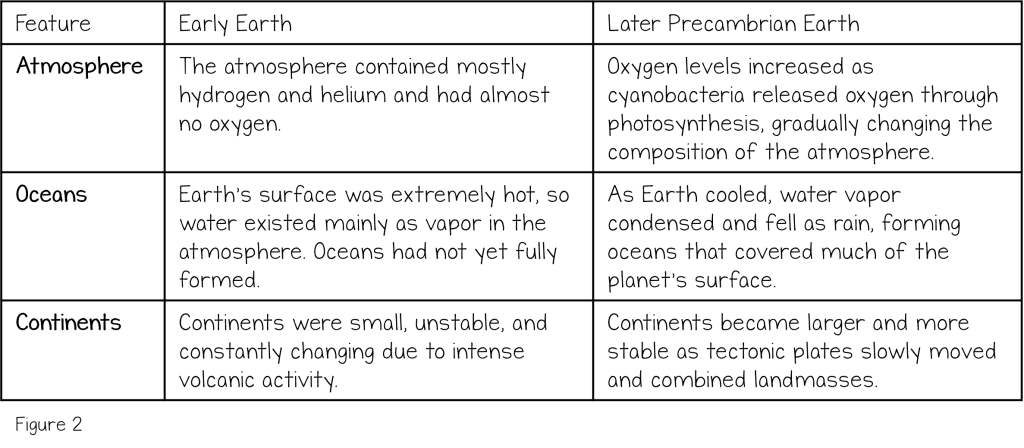
In the early part of Precambrian Time, Earth’s atmosphere was very different from today’s. It was made mostly of gases such as hydrogen and helium and contained very little oxygen. Over time, tiny organisms called cyanobacteria, often referred to as blue-green algae, began producing oxygen through photosynthesis. This gradually added oxygen to the atmosphere and helped create the conditions needed for more complex life to develop.
Earth’s early oceans were also very different from the oceans we know today. At first, Earth’s surface was extremely hot, causing water to remain as vapor in the atmosphere. As the planet slowly cooled, water vapor condensed into clouds and eventually fell as rain. This rain filled low areas on Earth’s surface, forming the first oceans. These early oceans contained high levels of dissolved minerals and elements released by volcanic activity.
At the same time, Earth’s continents were beginning to form. In the earliest stages of Earth’s history, the crust was unstable and constantly changing due to volcanic activity and tectonic processes. During Precambrian Time, however, continents gradually stabilized and grew larger as tectonic plates moved.
Review:
- Epochs are divided into periods that are characterized by what?
- What period of time does Precambrian time cover?
- What are cyanobacteria?