
Section 5: Communicating with Radio Waves
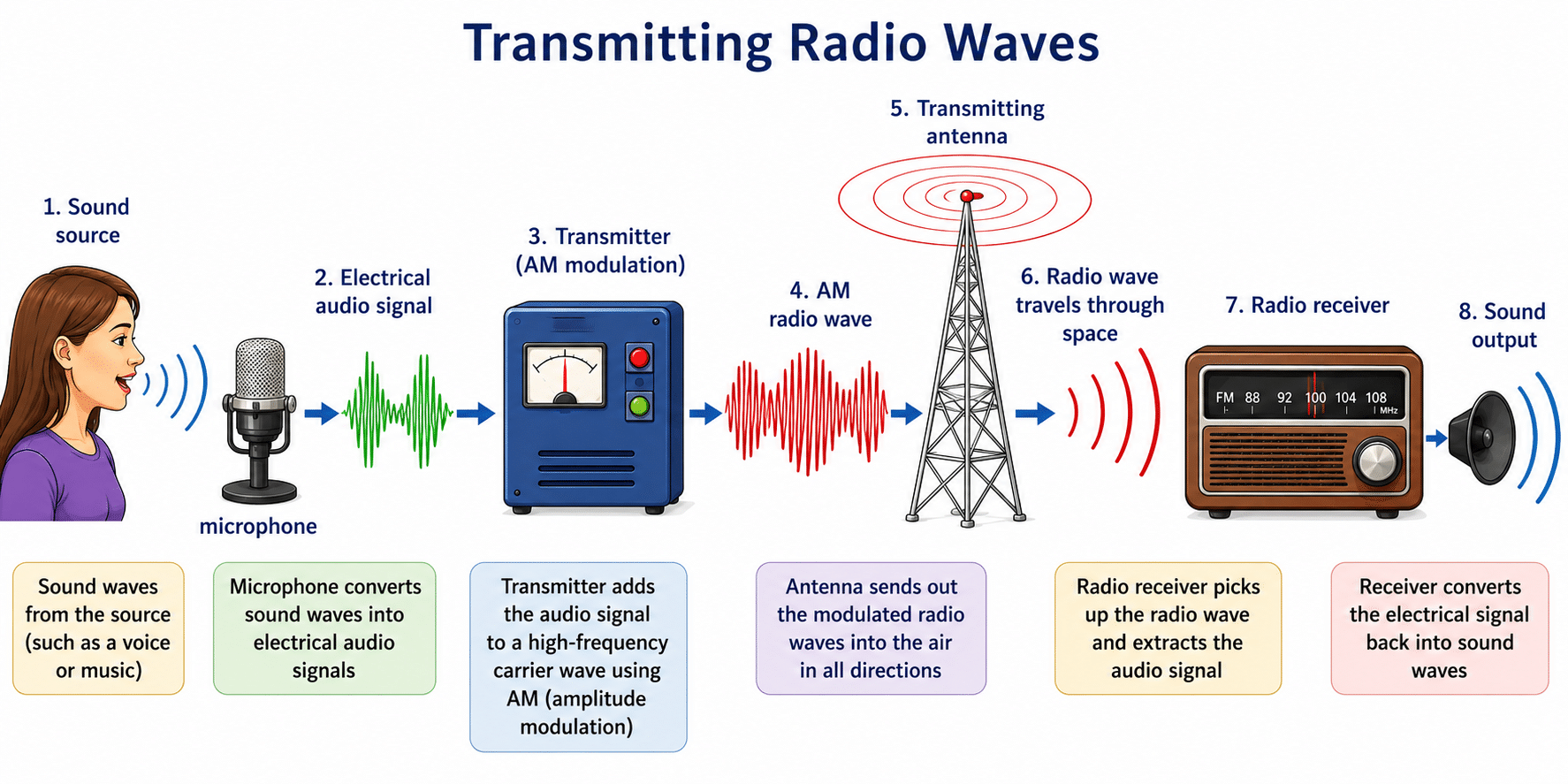 Radio, television, telephones, and GPS systems all rely on electromagnetic waves to send and receive information. These technologies work by converting signals into electromagnetic waves that can travel long distances quickly through the air or space.
For example, a radio converts electromagnetic waves into sound waves during a radio transmission. Each radio station is assigned a specific radio frequency called a carrier wave. This carrier wave carries information from the broadcasting station to radios tuned to the same frequency. Information can be added to the carrier wave in two main ways. In amplitude modulation (AM), the amplitude, or height, of the carrier wave is changed to transmit information. In frequency modulation (FM), the carrier wave’s frequency is varied instead. FM broadcasts usually produce clearer sound because they are less affected by interference.
Television technology also depends on electromagnetic waves to transmit both sound and images. In traditional television systems, FM radio waves are used to transmit audio signals, while AM signals are used to transmit video information. Older televisions used cathode-ray tubes (CRTs) to create images on the screen. Inside the tube, electron beams strike spots coated with chemicals that glow red, green, or blue. Together, these colored spots combine to form the images viewers see on the screen.
Communication devices such as telephones also use electromagnetic waves. Telephone signals are converted into electrical signals that can be transmitted as radio waves between microwave towers. These towers relay signals over long distances, allowing people to communicate from almost anywhere.

Another important use of electromagnetic waves is in the Global Positioning System (GPS). GPS is a network of satellites, ground stations, and receivers that work together to determine location. Satellites send high-frequency microwave signals toward Earth, and GPS receivers use these signals to calculate precise positions. Today, GPS technology is widely used in cars, smartphones, airplanes, and ships to help people navigate and reach their destinations.
Review:
- What is a cathode-ray tube?
- Explain the difference between AM and FM.
- Explain how GPS works.