
Section 1: Properties of Minerals
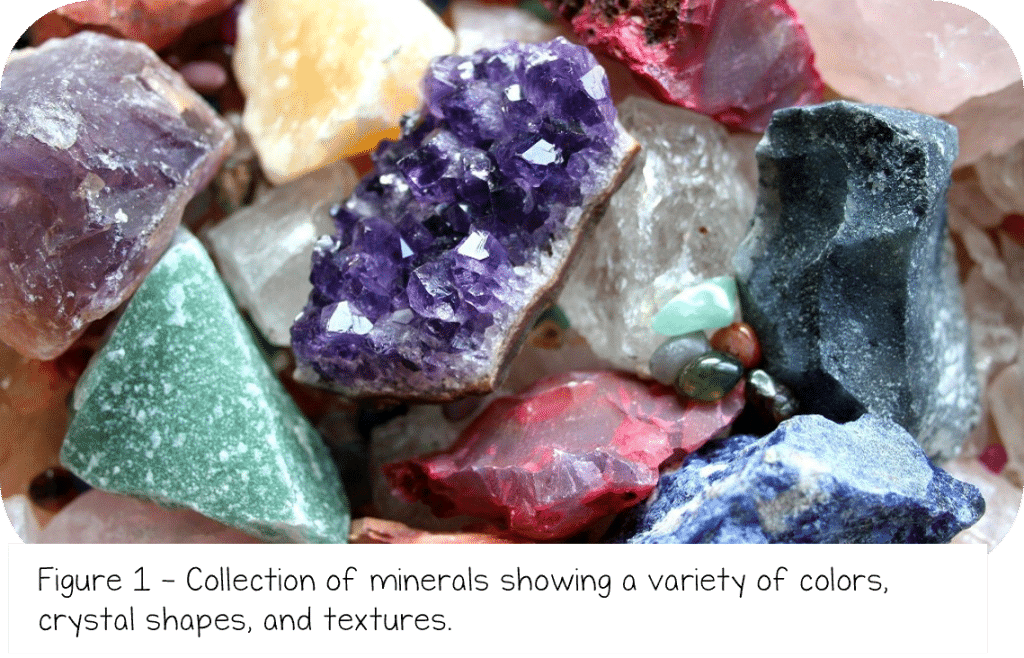 A mineral is a naturally occurring, inorganic solid with a crystal structure and a definite chemical composition. These characteristics determine each mineral’s physical and chemical properties. To be classified as a mineral, a substance must meet five specific criteria.
First, a mineral must form naturally on Earth. Second, it must be inorganic, meaning it cannot come from something that was once living. Third, a mineral must be a solid, with a definite shape and volume. Fourth, its particles must be arranged in a repeating pattern that forms a crystal structure. Finally, it must have a definite chemical composition, meaning it is made of specific elements combined in a particular way.
Scientists identify minerals by examining their physical properties. Color is often the most noticeable feature, but it is not always the most reliable for identification because some minerals can appear in different colors. A mineral’s color is determined by the elements in its chemical structure. For example, azurite is deep blue because it contains copper. Streak is the color of a mineral’s powder. It is tested by rubbing the mineral on unglazed porcelain. The streak can sometimes differ from the mineral’s outer color. Luster describes how light reflects from a mineral’s surface. Minerals may appear glossy, dull, or metallic.
 Another important property is density, which measures how much mass is packed into a given volume. In general, metallic minerals tend to have higher densities than nonmetallic minerals. Hardness is measured using the Mohs hardness scale, which ranks ten minerals from softest to hardest. On this scale, each mineral can scratch those below it but not those above it. Talc is the softest mineral, while diamond is the hardest.
Minerals also have distinct crystal shapes. As minerals form, atoms bond together in repeating patterns that create specific crystal structures. These crystal systems are grouped into categories based on the number and angles of their crystal faces.
When minerals break, they do so in characteristic ways. Cleavage occurs when a mineral splits along flat, smooth surfaces. A fracture occurs when a mineral breaks in an uneven or irregular way. Some minerals have special properties that help identify them, such as magnetism or the ability to glow under ultraviolet light.
By studying these properties, scientists can accurately identify and classify minerals found in Earth’s crust.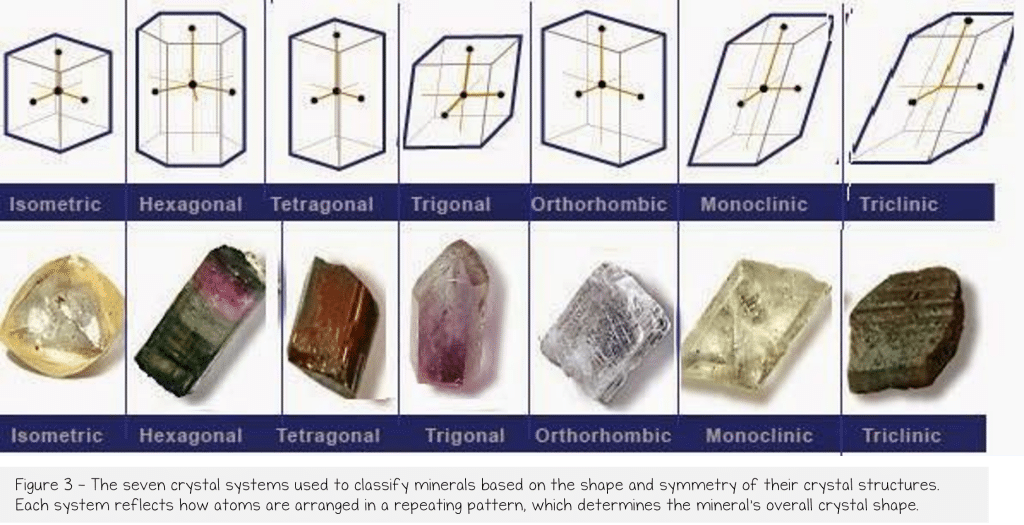
Review:
- Identify three characteristics of minerals.
- What does Mohs hardness scale measure? What is the softest mineral?
- What is a crystal system?