
Section 3: Describing Matter
All matter has both physical and chemical properties that help describe how a substance looks, behaves, or changes. These properties allow scientists to identify and classify different kinds of matter.
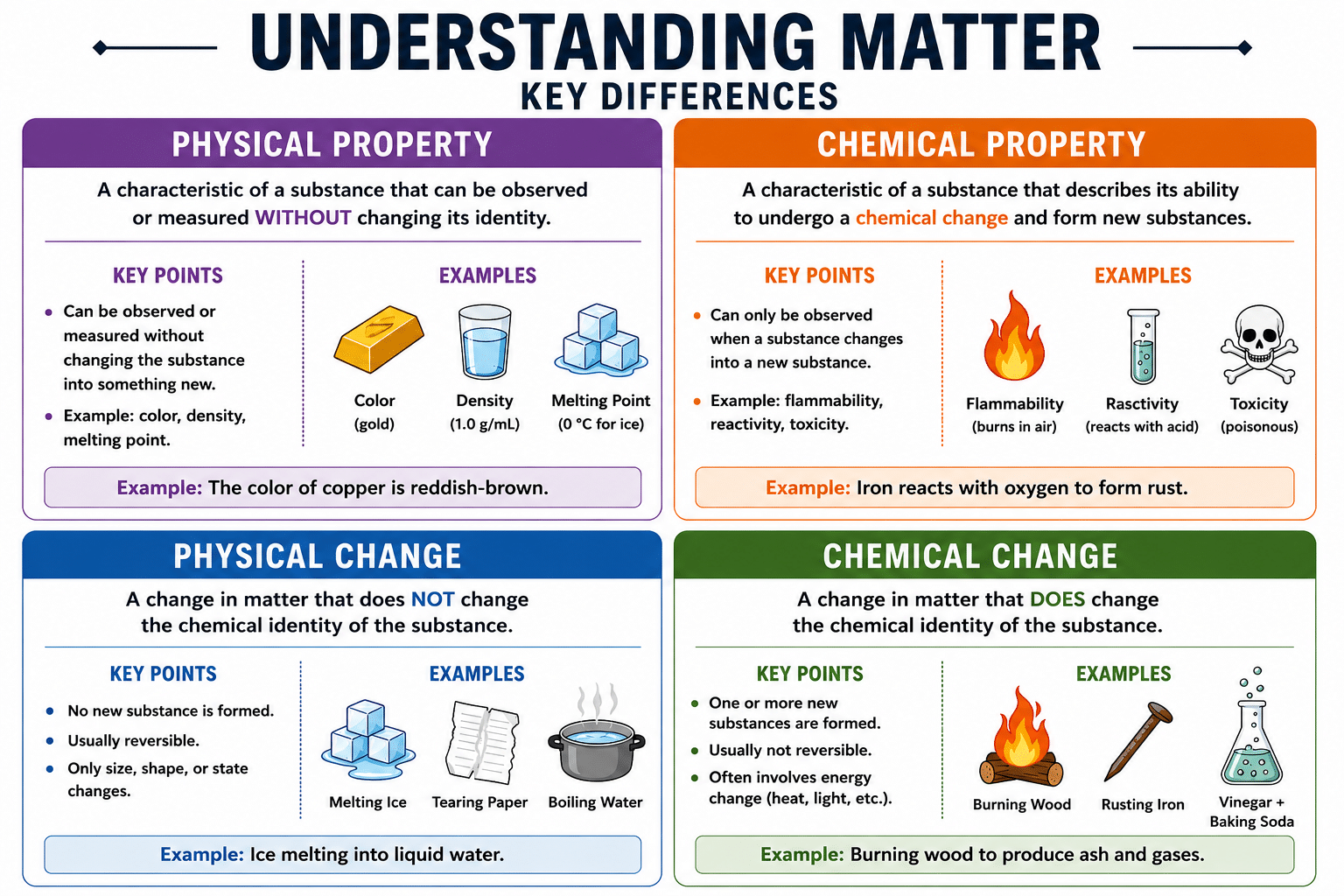 A physical property is a characteristic that can be observed or measured without changing the substance’s identity. For example, tearing or crumpling a piece of paper changes only its shape, not what it is made of. The paper is still paper after these changes occur. Physical properties include characteristics such as color, hardness, density, and boiling and melting points.
In contrast, a chemical property describes a substance’s ability to change into a new kind of matter. When a chemical change occurs, the original substance is transformed into one or more new substances with different properties. For example, if you burn a piece of paper, it turns into ash and gases that are different from the original paper. This ability to burn is called flammability, which is a chemical property. Other chemical properties include combustibility, acidity, and rust resistance.
A physical change is a change in the size, shape, or state of matter without changing the substance’s identity. Even though the substance’s appearance may change, the material itself remains the same. For example, when water freezes, it changes from a liquid into a solid, but it is still water. Its composition has not changed. Physical changes are often reversible. If heat is added to an ice cube, it melts and changes back into liquid water.
In contrast, a chemical change occurs when one substance changes into a completely different substance with new properties. During a chemical change, the starting substances, called reactants, are transformed into new substances called products. A firework explosion is an example of a chemical change because the chemicals inside the firework react to form new substances while releasing light, sound, and heat.
Although the substances change during a chemical reaction, the total amount of matter remains the same. This idea is explained by the law of conservation of mass, which states that mass is neither created nor destroyed during a chemical change. In other words, the total mass of the reactants before the reaction is equal to the total mass of the products after the reaction.
Review:
- Explain the difference between a physical property and a physical change.
- Give one example of a chemical change.
- What is the law of conservation of mass?