
Section 1: Bacteria

Bacteria are microscopic organisms that live almost everywhere, including soil, water, and even inside other living things. Because they are so small—typically ranging from one to five micrometers—they can only be seen with a microscope. A bacterium is a prokaryote, meaning it lacks a nucleus and other membrane-bound organelles.
Scientists identify and classify bacteria based on several characteristics, including their shape, the composition of their cell walls, how they move, and how they obtain energy. One common way to classify bacteria is by shape. Bacilli are rod-shaped, cocci are spherical, and spirilla are spiral or corkscrew-shaped.
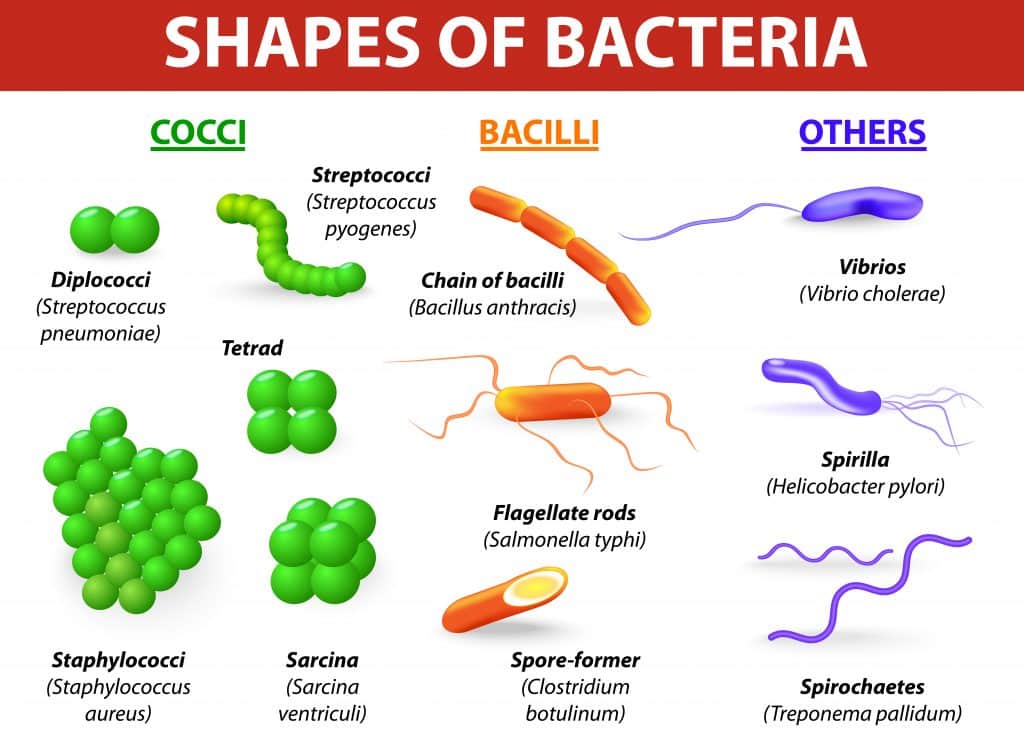
Bacteria have a simple cell structure. A cell membrane surrounds the cell and helps control what enters and leaves. Outside the membrane is a cell wall made of peptidoglycan, which provides structure and protection. Inside the cell is cytoplasm, where the cell’s DNA is located. Although bacteria have ribosomes for protein synthesis, they lack a nucleus, mitochondria, or chloroplasts.
Scientists also use a technique called Gram staining to classify bacteria. This method determines whether a bacterium’s cell wall contains a thick layer of peptidoglycan, helping to distinguish between different types of bacteria.
Bacteria move in a variety of ways depending on the species. Some are propelled by flagella, whip-like structures that enable them to swim. Others move by gliding along surfaces using substances they secrete, while some are simply carried by air, water, or other external forces.
Bacteria also differ in how they obtain energy. Some are autotrophs and can make their own food using sunlight or chemical energy. Others are heterotrophs and must obtain food by consuming other organisms or organic materials. Like many living things, most bacteria use respiration to break down food and release energy. While some bacteria live freely in the environment, others act as parasites, living on or inside other organisms.
Under favorable conditions, bacteria can reproduce very quickly. Because they are prokaryotic, they do not have separate male or female cells. Instead, they reproduce asexually through a process called binary fission, in which one cell divides to form two genetically identical cells. Although bacteria reproduce asexually, they can still increase genetic diversity through a process called conjugation. During conjugation, a hollow bridge forms between two bacterial cells, allowing DNA to pass from one cell to another.
When environmental conditions become unfavorable, such as when food is scarce, some bacteria can form endospores. An endospore is a highly resistant structure that protects the bacterium’s DNA by enclosing it within a thick internal wall. In this dormant state, the bacterium can survive harsh conditions until the environment becomes favorable again.
Review:
- How are prokaryotes identified?
- What is the function of the flagella?
- What is binary fission?