
Section 2: Cellular Respiration
Cells need a constant supply of energy to carry out life processes such as growth, movement, and repair. This energy is obtained through a process called cellular respiration, in which cells break down glucose to release stored energy. Cellular respiration is different from the term respiration, which is often used to describe breathing. While breathing involves taking in oxygen and releasing carbon dioxide, cellular respiration is a chemical process that occurs inside cells to produce energy.
During cellular respiration, cells use oxygen to break down glucose, a sugar found in the food that organisms eat. This process releases energy that cells can use immediately, along with carbon dioxide and water as waste products.
The overall process can be summarized by the following equation:

In this equation, glucose and oxygen are the reactants or starting substances. Carbon dioxide, water, and energy are the products. The carbon dioxide and water produced are removed from the body, often through exhaling.
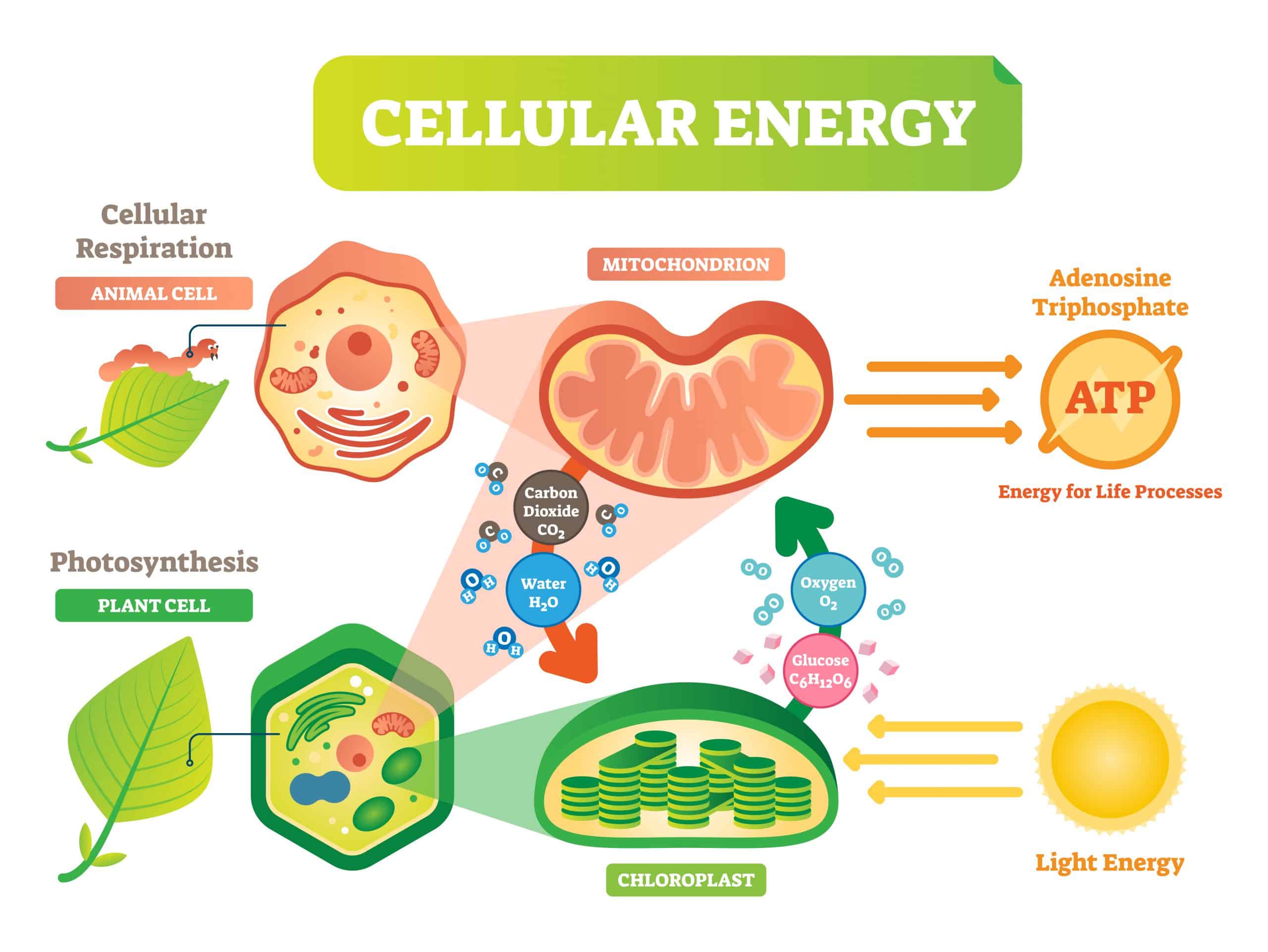
Cellular respiration takes place in two main stages within the cell. The first stage occurs in the cytoplasm, where glucose is broken down into smaller molecules. This stage does not require oxygen and releases only a small amount of energy. The second stage occurs in the mitochondria, which are organelles often called the “powerhouses” of the cell. At this stage, the smaller molecules are further broken down in oxygen-dependent reactions. These reactions release a large amount of energy that the cell can use.
When oxygen is not available, cells can still release energy through a process called fermentation. Fermentation allows cells to continue producing small amounts of energy without using oxygen. There are different types of fermentation. For example, alcoholic fermentation is used by yeast during baking, while lactic acid fermentation occurs in muscle cells during intense exercise. This process can cause a burning sensation in muscles when they work hard.
Cellular respiration and photosynthesis are closely connected processes. Photosynthesis stores energy by producing glucose and oxygen, while cellular respiration releases that energy by using glucose and oxygen to produce carbon dioxide and water. In this way, the products of one process become the reactants of the other, forming a cycle that supports life on Earth.
Review:
- How are photosynthesis and cellular respiration different?
- What is the role of mitochondria in cellular respiration?
- Identify two types of fermentation.