
Section 3: Methods of Science
Science is all about asking questions and seeking answers about the world around us. At the center of this process is scientific inquiry, which is a set of steps scientists use to ask questions, gather evidence, and draw conclusions. Scientific inquiry begins with a hypothesis, a possible explanation for an observation that can be tested by scientific investigation. From there, scientists make predictions, statements of what will happen next in a sequence of events.
As scientific investigations continue, scientists collect data and look for patterns in their observations. Over time, these patterns can lead to the development of either a scientific theory or a scientific law. A scientific theory is a well-supported explanation of a natural phenomenon. It explains how and why something happens based on extensive evidence gathered from many experiments and observations. For example, the Big Bang Theory explains how the universe began and has expanded over time, based on evidence such as galaxies moving farther apart.
In contrast, a scientific law is a rule that describes a consistent pattern in nature. Laws explain what happens, often using mathematical relationships, but they do not explain why it happens. An example is the Law of Gravity, which describes how objects are pulled toward one another based on their masses and the distance between them.
Understanding the difference between theories and laws helps us see how science works. Laws describe patterns we observe in the natural world, while theories provide explanations for those patterns. Together, they allow scientists to better understand, predict, and explain the world around us.
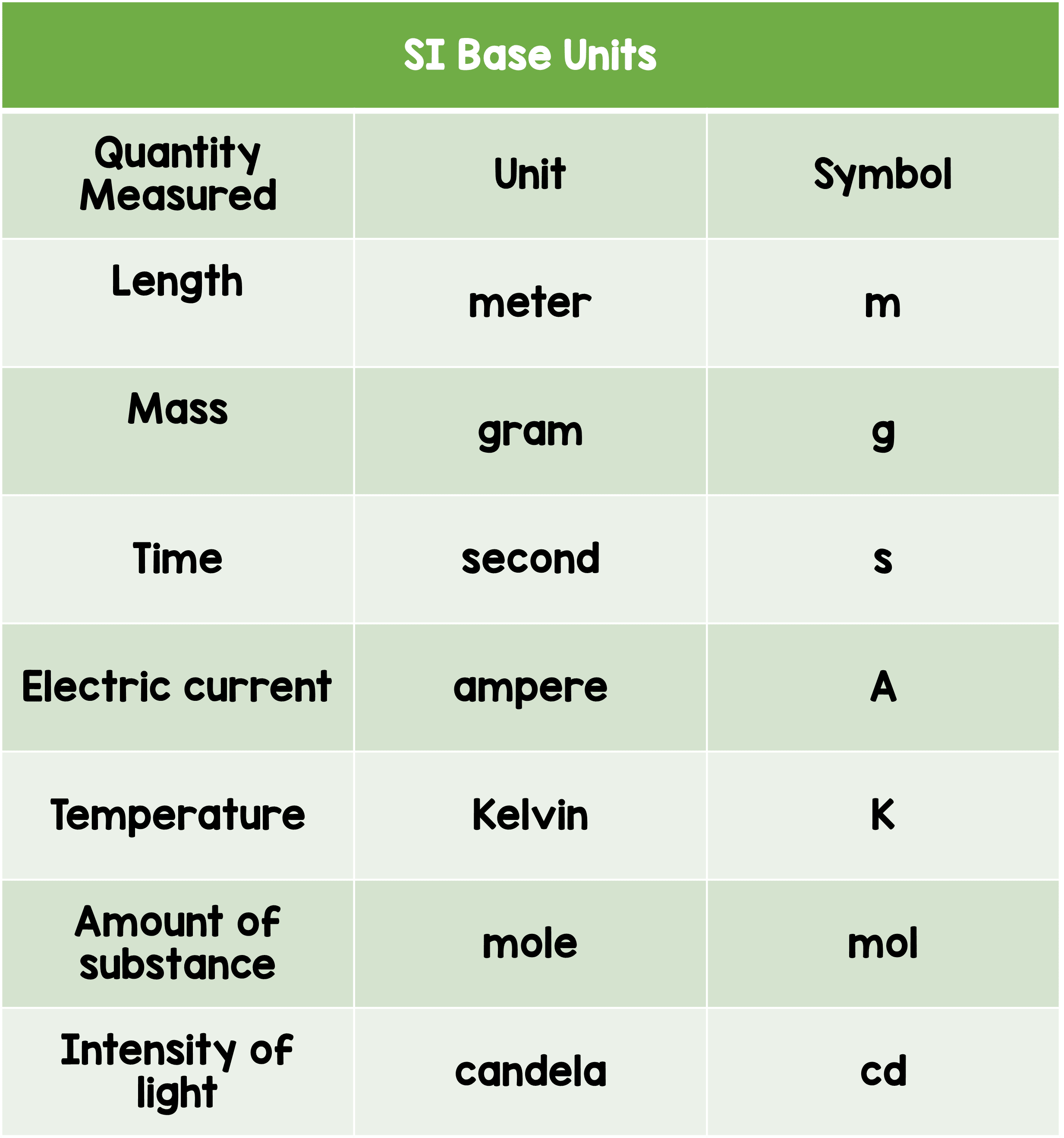
The International System of Units (SI) is the standard system of measurement used by scientists around the world. It provides a consistent way to measure and compare quantities, making it easier to share and understand scientific data.
As shown in the chart, each type of measurement has a base unit and a symbol. For example, length is measured in meters (m), mass in grams (g), and time in seconds (s). Other important SI units include the ampere (A) for electric current, the kelvin (K) for temperature, the mole (mol) for the amount of a substance, and the candela (cd) for light intensity.
Scientists often use these units in real-world situations. For example, the height of a tree might be measured as 10 meters, the mass of a rock could be 500 grams, and the time for an experiment might be 60 seconds. Temperature in scientific studies is often recorded in kelvins, such as 300 K for a warm environment. In chemistry, the amount of a substance might be measured in moles, such as 2 mol of a compound. Using SI units ensures that measurements are accurate, consistent, and understood by scientists everywhere.
Earth scientists use a variety of tools to observe and study the natural world. Common tools include binoculars, a compass, a wind vane, an anemometer, and a streak plate. Binoculars help scientists see distant objects more clearly, such as approaching weather systems or faraway landforms. A compass shows magnetic north and is used to determine direction and navigate in the field. To study wind, scientists use a wind vane, which rotates to show wind direction, and an anemometer, which measures wind speed. In addition, a streak plate—a piece of hard, unglazed porcelain—is used to help identify minerals by observing the color of their powder.
Standard tools used by Earth scientists include binoculars, a compass, a wind vane, an anemometer, and a streak plate. Binoculars allow us to view distant objects more clearly, such as approaching weather or distant landforms. A compass shows magnetic north and is used by earth scientists to navigate and determine direction. A wind vane is a device that rotates to show the direction of the wind. An anemometer is a tool used to measure wind speed and wind force. Finally, a streak plate is a hard, unglazed porcelain plate used by earth scientists to identify minerals.
Review:
- What is a hypothesis?
- Why do you think all scientists use the same measurement system?
- What is an anemometer used for?