
Section 1: The Study of Earth Science
The field of Earth science is dedicated to the study of the Earth and its place in the universe. Earth scientists rely on foundational concepts as they examine Earth’s structure, evolutionary history, and position in the solar system. They also examine how forces have changed the Earth’s surface throughout its history, including both constructive and destructive forces. Constructive forces build up Earth’s surface. Examples include volcanic eruptions that create new land and tectonic plate movements that form mountains. Destructive forces slowly wear down Earth’s surface over time. Weathering, erosion, earthquakes, and glaciers slowly break apart mountains and reshape landscapes.
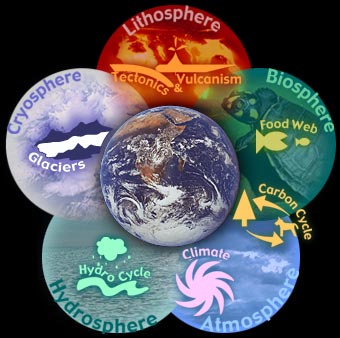
A system is a group of interconnected components that work together as a whole. Earth is a system made up of several smaller systems, called spheres, that constantly interact. Matter and energy constantly move between these spheres. Earth’s systems include the atmosphere, lithosphere, cryosphere, hydrosphere, and biosphere.
- Atmosphere – The thin layer of gases that surrounds Earth. It allows for varied climate and long-term weather conditions.
- Lithosphere – The solid, rocky outer layer of Earth that forms Earth’s rigid outer shell, excluding the oceans. It includes mountains, valleys, and continents.
- Hydrosphere – It encompasses all of the waters on the Earth’s surface, including lakes and oceans. The hydrosphere is a significant factor in shaping weather and climate.
- Biosphere – Is the part of the planet where living things can be found, from the upper atmosphere to the bottom of the oceans, showcasing the incredible diversity of life on Earth.
- Cryosphere – All frozen water on Earth, including glaciers, ice caps, and permafrost. It affects the global climate and sea level.
Earth scientists focus their studies on the sphere that is our planet, a field that includes several branches. Geology is a branch of Earth science that centers on the forces that have shaped the Earth. A geologist investigates how rocks and minerals form, delves into the causes of earthquakes, and analyzes volcanic formations. Some specialize in soil science, while others explore the dynamics of rivers and lakes. Oceanography, on the other hand, focuses on the vast ocean, examining everything from its chemical composition to the intricate ecosystems of marine organisms. Some scientists study the physical properties of the oceans, such as waves and ocean currents, while others explore the composition of ocean water and marine life.
Meteorology is the study of conditions in the atmosphere. Meteorologists examine weather patterns and use radar and satellites to make accurate weather predictions. Astronomy, in contrast, focuses on objects beyond Earth, including the solar system, stars, and galaxies. Astronomers use telescopes and satellites to observe space and study planets and the universe as a whole. Another important branch is environmental science, which examines Earth’s environments and natural resources. It also explores how human activities affect these systems and seeks ways to reduce negative impacts.
Review:
- Identify Earth’s five systems.
- Describe the characteristics of a geologist.
- What is environmental science?