
Section 5: Ocean Currents & Climate

Another type of water movement occurs in currents. Currents are large streams of moving water that flow through the oceans. Surface currents are driven by wind and affect water to depths of several hundred meters. These currents can move as fast as 100 kilometers per day. Surface currents also influence climate by warming or cooling the air above them, which affects nearby land. Earth’s oceans contain large circular systems of surface currents called gyres. Gyres in the Northern Hemisphere rotate clockwise, while gyres in the Southern Hemisphere rotate counterclockwise.
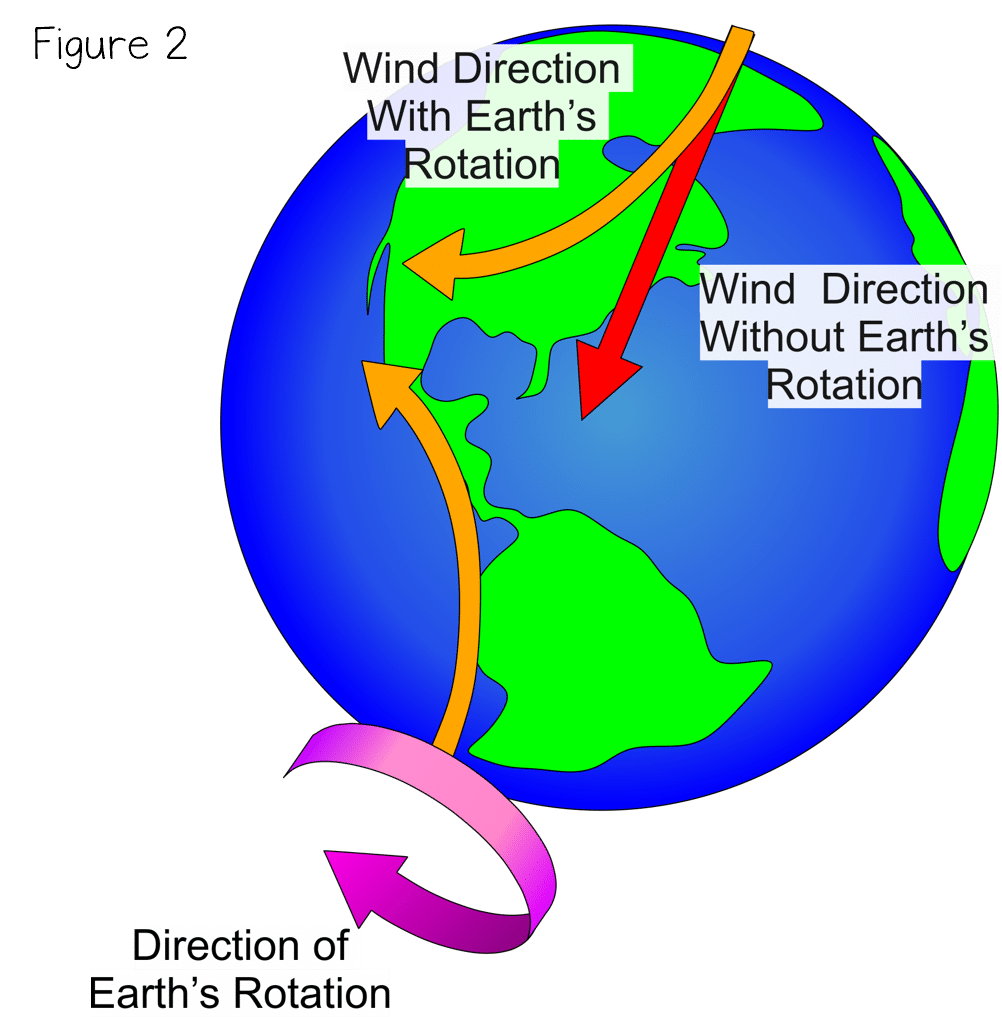
The Coriolis effect is the apparent movement of wind and water to the right or left caused by Earth’s rotation. It plays an important role in shaping global wind patterns and ocean currents. In the Northern Hemisphere, the Coriolis effect causes moving air and water to curve to the right, creating a clockwise motion. In the Southern Hemisphere, moving air and water curve to the left, producing a counterclockwise motion.
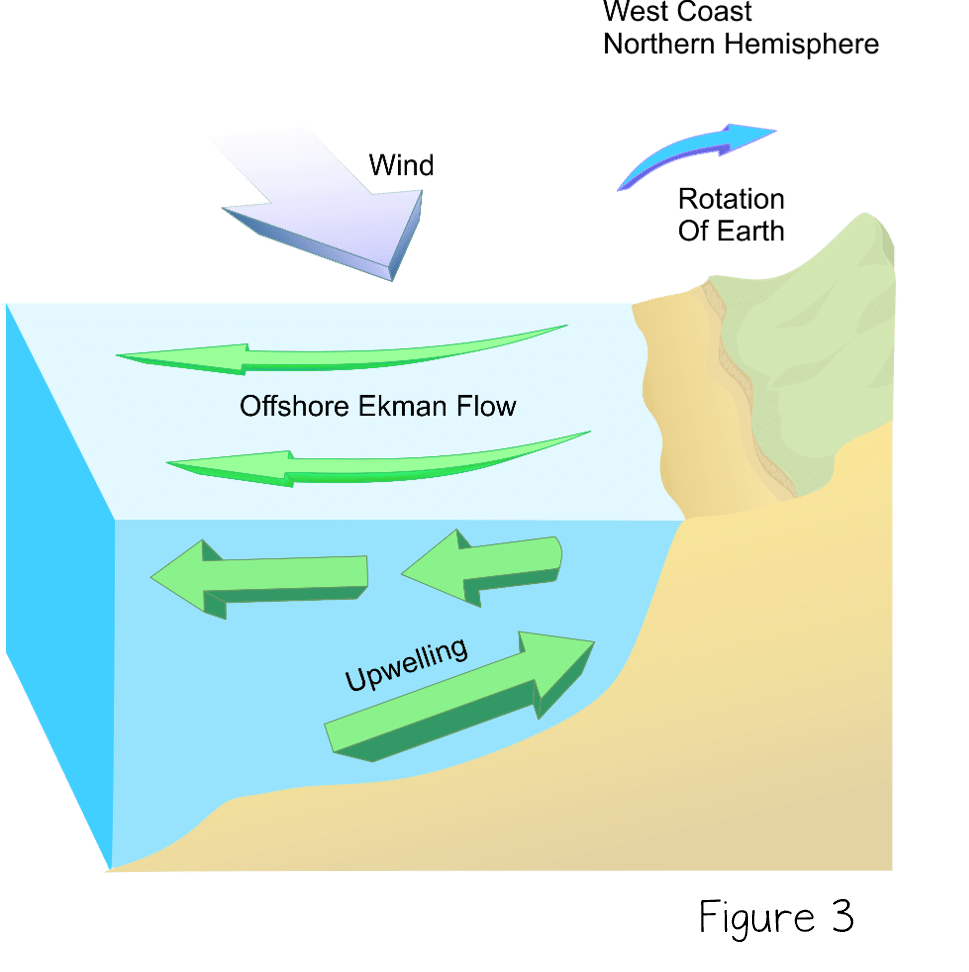
Deep currents are driven by density differences in ocean water, influenced by temperature and salinity. Dense, cold water sinks and begins to move through the deep ocean. In some areas, this deep water rises to the surface through upwelling, the movement of cold, nutrient-rich water upward to replace warmer surface water pushed away by the wind.
As shown in Figure 3, wind moving across the ocean surface can push warm surface water away from the coast. When this happens, colder water from deeper layers rises to take its place. Deep currents move much more slowly than surface currents, but they play an important role in mixing ocean water around the globe. These currents help carry cold water from the poles toward the equator. Upwelling also brings tiny organisms, minerals, and other nutrients from deep ocean layers to the surface, helping support and maintain ocean ecosystems.
Ocean currents do more than move water—they also help influence conditions on land. One of the most important effects of ocean circulation is its impact on climate. Climate is the pattern of temperature and precipitation typical of an area over a long period of time. Solar energy drives ocean convection currents, helping move warm and cold water around the planet. As surface currents travel through the oceans, they can warm or cool the air above them, which influences the climate of nearby coastal regions.
Another major ocean current system that affects weather and climate is the Great Ocean Conveyor Belt. This system is a global “belt” of surface currents and deep, density-driven currents that move water throughout the world’s oceans. By circulating warm and cold water, the conveyor belt helps distribute thermal energy around Earth and plays an important role in regulating the global climate.
Review:
- What is a surface current?
- Explain the Coriolis effect.
- Define climate.