
Section 4: Classification
To organize the wide variety of living things on Earth, scientists use classification, a system that groups organisms based on shared characteristics. In the 1730s, Swedish botanist Carolus Linnaeus developed a system for naming organisms called binomial nomenclature. “Binomial” means “two names,” and “nomenclature” means “naming system.” This method gave each species a unique scientific name, making communication among scientists more accurate and consistent worldwide.
In binomial nomenclature, the first part of the name is the genus, and the second part identifies the species. Together, these two names describe a specific organism. For example, the scientific name of the red fox is Vulpes vulpes, where Vulpes is the genus, and vulpes is the species name.
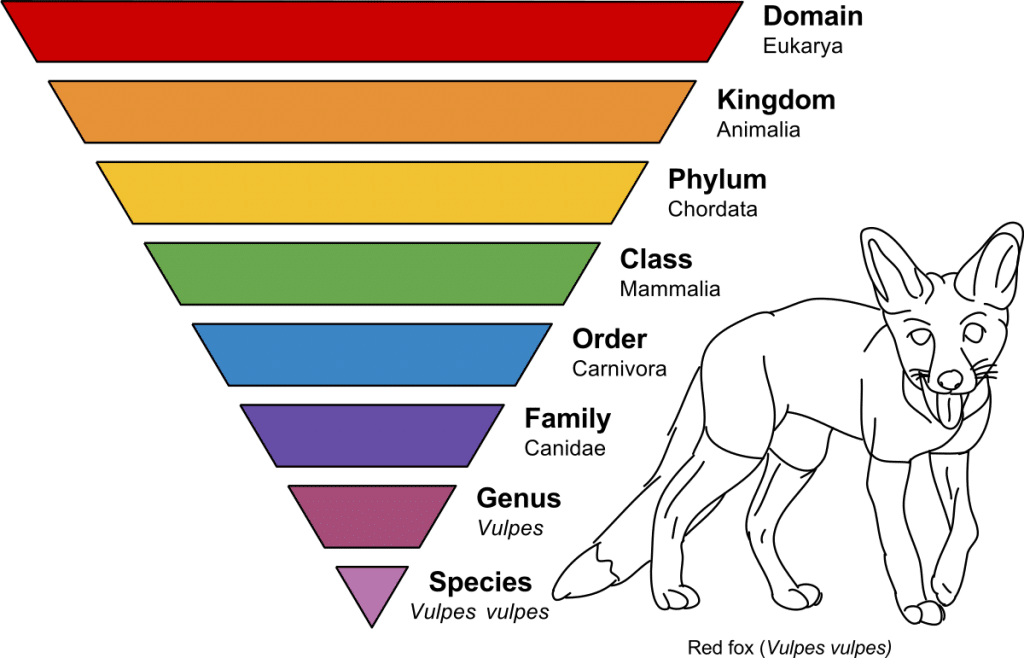
Linnaeus also created a system for grouping organisms based on their similarities, helping scientists better understand relationships among living things. The science of naming and classifying organisms is called taxonomy. The classification system is organized into a hierarchy of groups, from the most specific to the most general. A species is the smallest group, including organisms that can reproduce and produce fertile offspring. Similar species are grouped into a genus, and related genera are grouped into a family. Families are grouped into orders, orders into classes, classes into phyla, and phyla into kingdoms.
Today, scientists often include an even broader category called a domain, which is above the kingdom and represents the largest grouping of organisms. This hierarchical system helps scientists organize life on Earth and understand how different organisms are related.

Classification is the process of organizing a large group of organisms into smaller, more specific groups based on their similarities. To help identify unknown organisms, biologists use a tool called a dichotomous key. The word dichotomous comes from dichotomy, meaning “divided into two opposite parts.”
A dichotomous key is made up of a series of paired statements that describe opposite characteristics of the same trait. At each step, the user selects the statement that best matches the organism. This choice leads to another set of paired statements or to the organism’s identity.
In the example shown, the key begins by asking whether the organism has fur or no fur.
- If it has fur, it is identified as a mammal.
- If it does not have fur, the key moves to the next characteristic.
The next step asks whether the organism has feathers or not.
- If it has feathers, it is a bird.
- If not, the key continues.
The key then examines skin type:
- Dry skin leads to reptiles.
- Moist skin leads to another choice.
Finally, the key looks for scales or no scales:
- If scales are present, the organism is a fish.
- If scales are absent and the skin is moist, it is an amphibian.
This step-by-step process shows how scientists use observable traits to narrow down possibilities and accurately identify organisms.

While classification keys can be used to identify organisms based on visible traits, modern scientists often use a method called evolutionary classification, which focuses on how closely organisms are related. This approach is based on phylogeny, the study of the evolutionary relationships among living and extinct organisms.
Evolutionary classification groups organisms into categories called clades. A clade includes a common ancestor and all of its descendants, showing how species are connected through evolution. This method helps scientists better understand how organisms have changed over time and how they are related. A cladogram is a diagram used to represent these relationships. It shows how different groups of organisms are connected through evolutionary lineages that branch from common ancestors. Cladograms are based on derived characters, which are traits that appear in the most recent common ancestor of a group and are passed on to its descendants. By studying these shared traits, scientists can determine how closely related different organisms are.
Review:
- What is binomial nomenclature?
- Which group is the largest and most inclusive taxonomic category?
- What is a cladogram?