
Section 4: Classification
To categorize and assign names to organisms, scientists use the process of classification, which organizes species into groups based on their similarities. In the 1730s, a Swedish botanist, Carolus Linnaeus, introduced a system of naming species called binomial nomenclature. Binomial means “two names,” and nomenclature means “list of names.” This system made communication about species easier. The first part of the name is the genus, and the second part of the name refers to the species. For example, the scientific name for a red fox is Vulpes vulpes. Both parts, in this case, represent the genus and species.
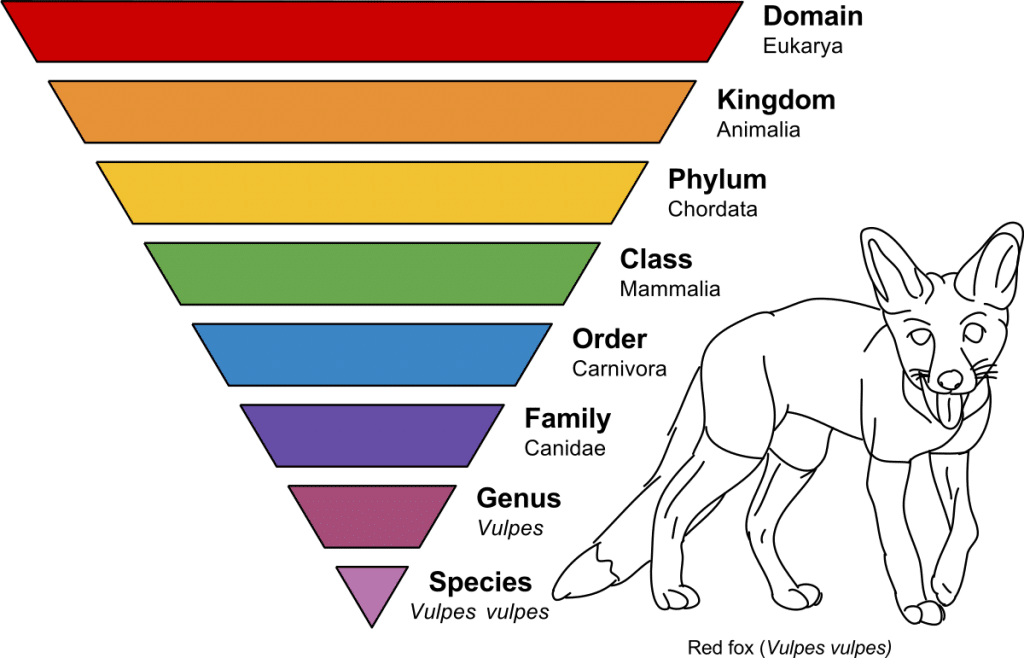
Linnaeus also developed a systematic approach to categorizing organisms into groups, only aiding in our comprehension of their variations and commonalities. The science of naming and identifying organisms is called taxonomy. Seven groups make up the system for scientific classification. At the end is species, a group of organisms that breed and produce offspring. Next, the genus is where similar species are grouped. Next, closely related genera are grouped into a larger category called the family and then placed into larger groups called orders. Then, orders are grouped into classes; classes are grouped into phyla, and phyla are grouped into kingdoms. Kingdoms are the most prominent groups and include plants and animals.
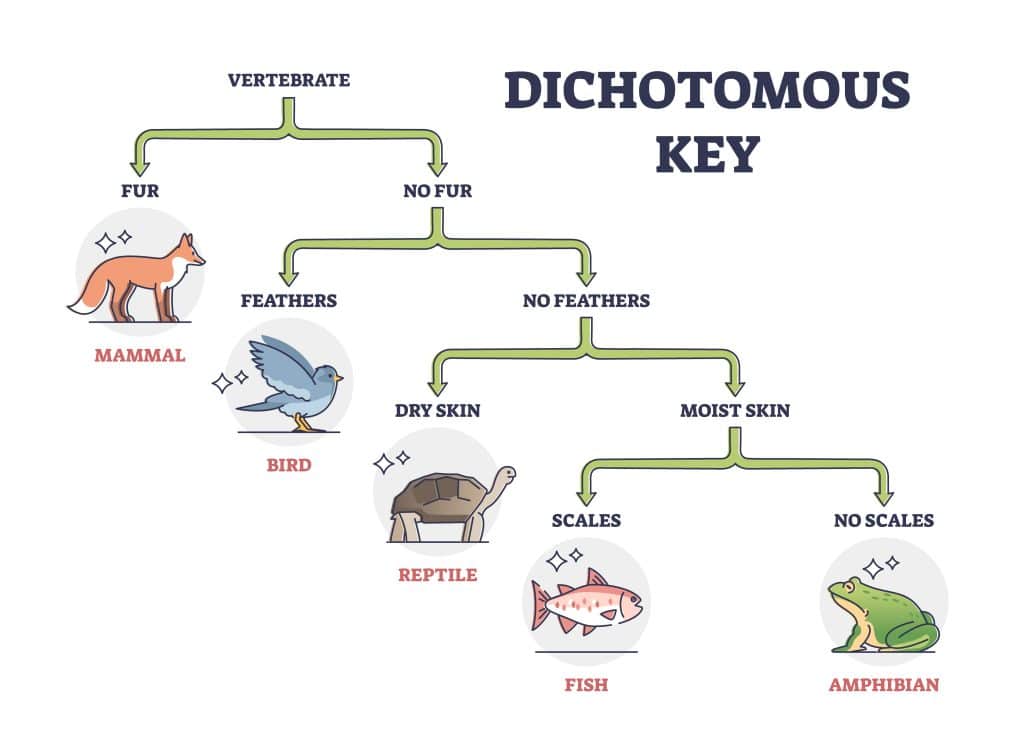
Classification is a way of separating a large group of closely related organisms into smaller subgroups. Biologists use a dichotomous key to help them identify unknown organisms. The word dichotomous comes from the word dichotomy, meaning “two opposite parts or categories.” A dichotomous key consists of paired statements that are opposite of one another about the same trait. The user picks the best description that fits the organism and is led to another set of paired statements or the organism’s identity.
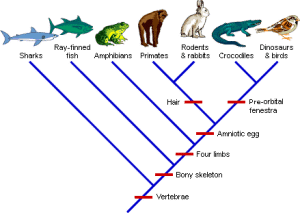 Occasionally, classification keys are used to identify organisms by visible traits. However, modern scientists look at how closely members of a group are related called evolutionary classification. Phylogeny, the study of the relationships between living and extinct organisms, plays a crucial role in this approach. This approach to classification groups species into categories that reflect their evolutionary descent, placing them into clades. Clades consist of species sharing a common ancestry and all its descendants. A cladogram is a diagram that links groups of organisms by showing how evolutionary lines, or lineages, branched off from common ancestors. These focus on studying derived character, a trait that arose in a particular lineage’s most recent common ancestor and was passed on to its descendants.
Review:
- What is binomial nomenclature?
- Which group is the largest and most inclusive taxonomic category?
- What is a cladogram?