
Section 5: Cellular Transport
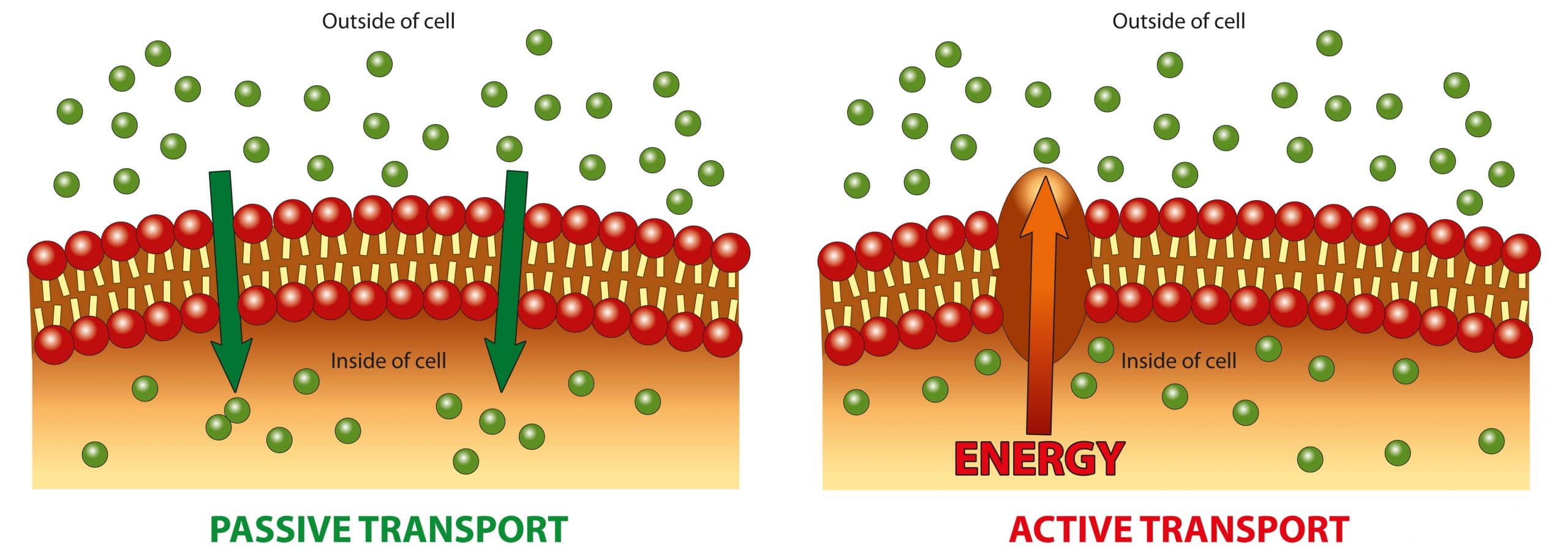
Every living cell exists in a liquid environment that is essential for its survival. To maintain stable internal conditions, the cell must carefully control what enters and leaves. This process is regulated by the plasma membrane, which is selectively permeable, meaning only certain substances are allowed to pass through.
One way substances move across the membrane is through diffusion, the natural tendency of particles to move from an area of higher concentration to an area of lower concentration. This movement continues until the particles are evenly distributed. Diffusion is the primary method by which small molecules move across the membrane and does not require energy. Because no energy is needed, this process is called passive transport.
A special type of passive transport is facilitated diffusion. In this process, some molecules cannot pass through the membrane on their own, so they move through protein channels embedded in the membrane. These proteins help substances cross the membrane without using energy.
In contrast, active transport requires energy because it moves substances against the concentration gradient. This means particles move from an area of low concentration to an area of high concentration, which is the opposite of diffusion. The concentration gradient refers to the difference in the concentration of a substance across a space or membrane. Cells use energy to push molecules against this gradient when they need to maintain specific internal conditions.
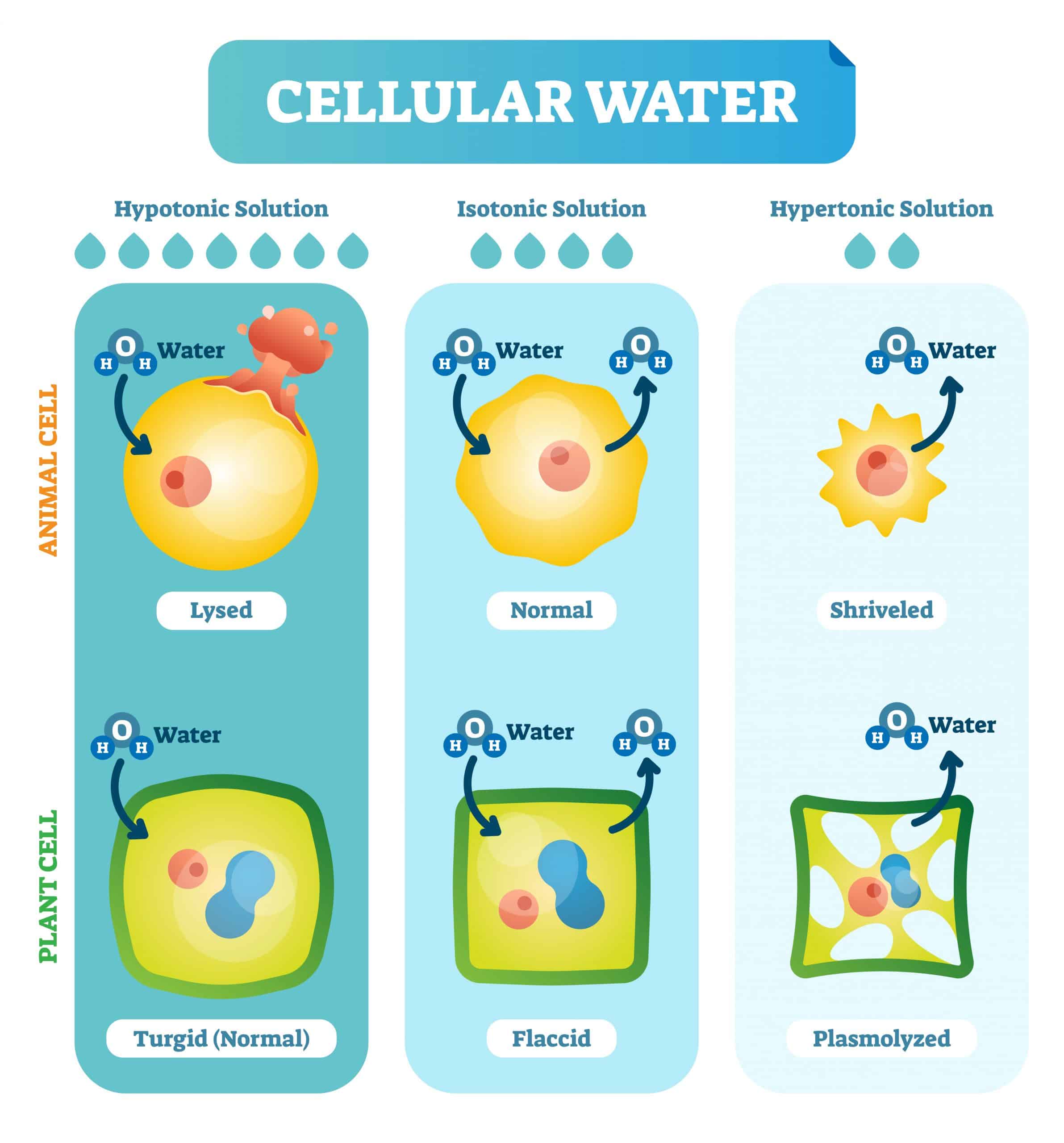
Semipermeable membranes allow certain substances to pass through while blocking others. Because of this, particles can move across the membrane from areas of higher concentration to areas of lower concentration through passive transport. One especially important substance that moves across cell membranes is water. The diffusion of water across a selectively permeable membrane is called osmosis. Osmosis helps cells maintain homeostasis, which is the regulation of stable internal conditions necessary for survival.
The movement of water during osmosis depends on the type of solution surrounding the cell. There are three main types of solutions:
- In an isotonic solution, the concentration of water is the same inside and outside the cell, so water moves in and out at equal rates. As a result, the cell’s volume remains the same.
- In a hypertonic solution, the surrounding solution has a lower concentration of water than the inside of the cell. Water moves out of the cell, causing it to shrink or shrivel, which can lead to cell death.
- In a hypotonic solution, the surrounding solution has a higher water concentration than the inside of the cell. Water moves into the cell, causing it to swell and potentially burst.
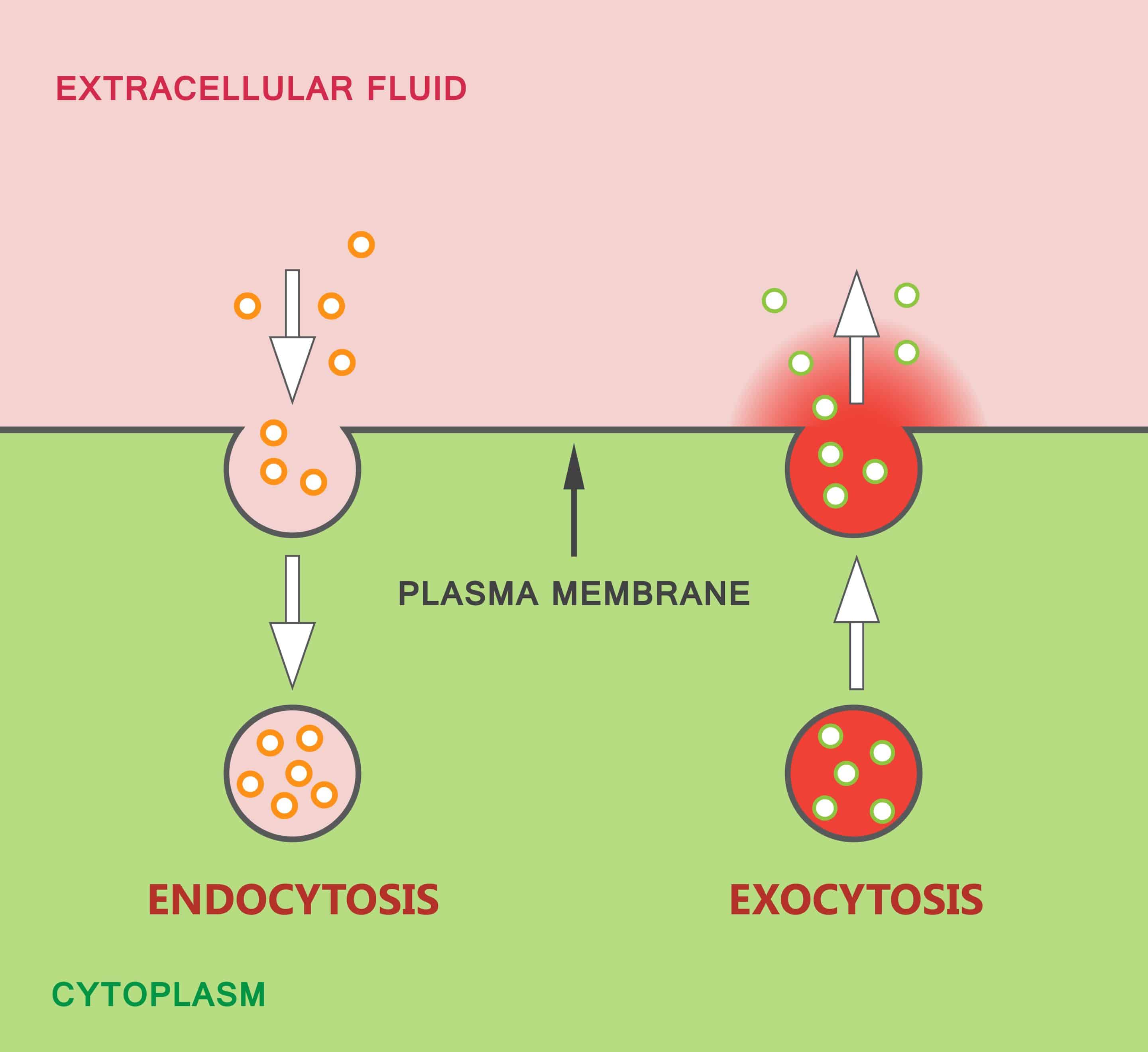
Endocytosis and exocytosis are processes that cells use to move substances into and out of the cell when those substances are too large to pass through the plasma membrane by diffusion or transport proteins. In endocytosis, the cell membrane surrounds and engulfs large particles or materials from outside the cell. The membrane then pinches off, forming a vesicle—a small, membrane-bound sac—that brings the substance into the cell. In exocytosis, the opposite process occurs. A vesicle inside the cell moves to the plasma membrane and fuses with it, releasing its contents outside the cell. This process is often used to remove waste or to secrete important materials such as proteins.
Review:
- What is active transport?
- Explain how osmosis affects cells.
- Compare endocytosis and exocytosis.