
Section 4: Metals, Nonmetals, and Metalloids
Metals are good conductors of heat and electricity. Most metals are solid at room temperature, with mercury as a notable exception, as it is a liquid. Metals are generally shiny, malleable, and ductile, meaning they can be hammered into thin sheets or stretched into wires. On the periodic table, metals are located to the left of the zigzag “stairstep” line.
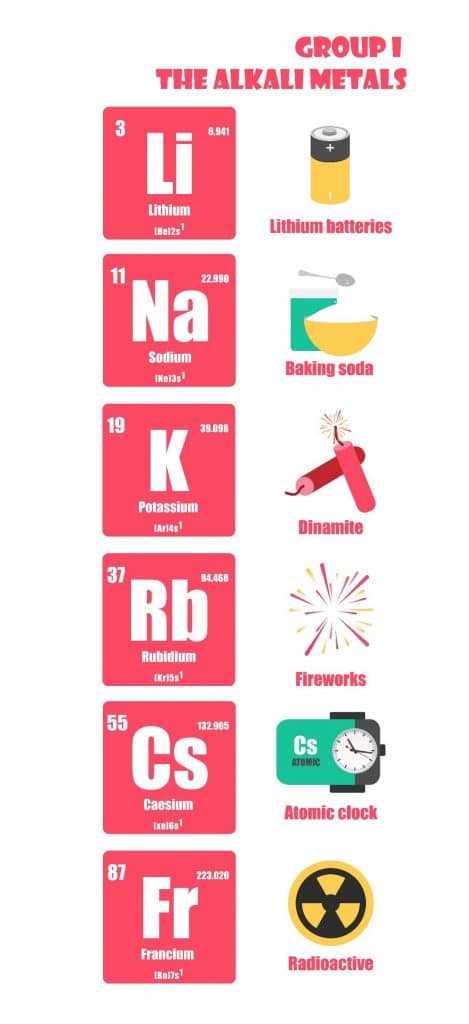
The first column of the periodic table, known as group 1, contains the alkali metals. These are the most reactive metals on the periodic table. Alkali metals have one electron in their outer energy level, which they easily lose when forming chemical bonds. When alkali metals react with water, they produce compounds called alkalis and release hydrogen gas. Because of their high reactivity, they are not found in nature in their pure form. Instead, they are combined with other elements in compounds. Alkali metals are soft enough to be cut with a knife and are shiny and silver-colored when freshly cut. To prevent them from reacting with oxygen or moisture in the air, they are often stored in airtight containers or under oil.
Next to the alkali metals in group 2 are the alkaline earth metals. These metals have two electrons in their outer energy level. Like alkali metals, they readily combine with other elements, but they are less reactive. Alkaline earth metals are shiny, malleable, ductile, and solid at room temperature. Many are commonly found in minerals within Earth’s crust and are important in building materials, living organisms, and everyday products.

The transition elements are found in groups 3 through 12 of the periodic table. They make up the largest section of the table and include many familiar metals such as iron, copper, silver, and gold. Most transition elements are hard, dense metals that conduct heat and electricity well. Unlike the highly reactive alkali and alkaline earth metals, transition elements are generally less reactive and are often found uncombined in nature. Many transition elements also form colorful compounds. Although most are solids at room temperature, mercury is unusual because it is a liquid.
Within the transition elements are two special rows called the inner transition metals. The first row is the lanthanide series, which includes elements 58 through 71. These elements are sometimes called rare earth metals, although many are relatively abundant in Earth’s crust. Lanthanides are shiny, dense metals that tarnish quickly when exposed to air. They are often used in electronics, magnets, and rechargeable batteries. The second row is the actinide series, which includes elements 90 through 103. This group is named after the element actinium. All actinides are radioactive, and many are produced artificially in laboratories or nuclear reactors. These elements are dense, high-melting-point metals that are highly reactive, so they are rarely found in nature in pure form. Some actinides, such as uranium and plutonium, are used as fuel in nuclear power plants.
On the right side of the stairstep line are the nonmetals. Nonmetals are usually gases or brittle solids at room temperature. In general, they are poor conductors of heat and electricity. Many nonmetals form ionic or covalent compounds when they combine with other elements. Important nonmetals include oxygen, carbon, nitrogen, and sulfur, which are essential for life.
One important group of nonmetals is the noble gases, located in group 18. Noble gases are colorless, odorless, and tasteless gases that exist as single atoms. Because their outer energy levels are completely filled, they are very stable and rarely react with other elements. As you move down the group, the atoms become larger and denser.
The metalloids, which separate most metals from nonmetals, are found along the stairstep line of the periodic table. Metalloids have properties of both metals and nonmetals. Some metalloids can conduct electricity under certain conditions, making them useful in electronic devices and computer chips. Metalloids are found in groups 13 through 17 and help form the boundary between metals and nonmetals.
Review:
- Explain two characteristics of alkaline earth metals.
- Where are the transition elements found? Give two examples of transition elements.
- Explain three characteristics of noble gases.