
Section 1: Atomic Structure
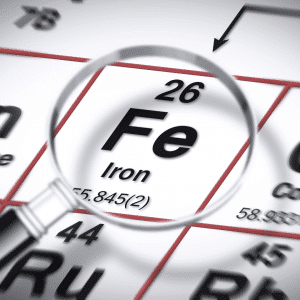
Elements are the basic building blocks of matter. Each element is defined by its unique number of protons. An element is made of only one type of atom and cannot be broken down into a simpler substance by ordinary chemical means. Under normal conditions, elements may exist as solids, liquids, or gases. Scientists use one or two letters, called a chemical symbol, to represent each element. For example, Fe is the chemical symbol for iron.
To understand elements, it helps to look closely at atoms. An atom is the smallest piece of an element that still has that element’s properties. Atoms are too small to be seen with ordinary microscopes. They are made of three main particles: protons, neutrons, and electrons. Protons have a positive charge, electrons have a negative charge, and neutrons have no charge. Protons and neutrons are located in the nucleus, which is the center of the atom. Electrons move around the nucleus.
The number of protons in an atom determines what element it is. For example, every atom with 26 protons is iron. Neutrons help add mass to the atom, while electrons are involved in how atoms interact with other atoms. Protons and neutrons are made of even smaller particles called quarks.
Scientists often use the electron cloud model to describe where electrons are found. In this model, electrons do not move in perfect circles. Instead, they are found in cloudy regions around the nucleus called energy levels. Electrons closer to the nucleus have lower energy, while electrons farther away have higher energy. The outermost energy level is especially important because it helps determine how an atom bonds with other atoms.
Across centuries, many scientists have made significant contributions to the history of the atom.
The Alchemists, scientists who lived during the Middle Ages (700-1500 A.D.), laid the foundational idea that spurred the quest to understand matter’s nature. They believed they could turn other substances into gold, which is impossible.
Democritus, a Greek philosopher (430 B.C.), suggested that matter is made of atoms, but he couldn’t prove it. Atom is Greek for unbreakable.
Robert Boyle (1670) helped transition alchemy to modern chemistry, reporting that elements can’t be broken down and that compounds are combinations of elements.
Antoine Lavoisier (1789), often called the father of modern chemistry, was a French chemist who proved Boyle’s theory and developed the theory of conservation of mass. This theory states that an object’s mass can never be created or destroyed; it can only change form.
John Dalton (1803) revived atomic theory by providing evidence that atoms exist. He determines a compound’s element breakdown and then calculates the weight of each atom. However, he mistakenly believed that compounds contained only one atom of each element, leading him to represent water as HO. His model of the atom is called the “billiard ball” model.
Dmitri Mendeleev (1789) was a Russian scientist who constructed the first periodic table of elements, which was arranged by the element’s atomic mass.
J.J. Thomson (1897), an English scientist, discovered the electron. He decided that an atom is a positively charged sphere in which tiny negatively charged particles called electrons exist. This model is called the “plum pudding” model of the atom.
Robert Millikan (1923) received a Nobel Prize in physics for measuring the negative charge of electrons.
Ernest Rutherford (1911) was an English Scientist who discovered that atoms consist of a positively charged nucleus around which electrons rotate at great speeds.
Niels Bohr (1913) discovered that the number of electrons in the outer shell determines its chemical properties. Introduced the “solar system” model, but it is also called the Bohr Model.
Marie and Pierre Curie (1890-1910) worked with radium to learn more about radioactive elements. They discovered that radioactive elements lose their electrons over time.
Henry Moseley (1913) was a British scientist who created today’s Periodic table, which is based on atomic numbers.
Albert Einstein (1905) published the theory of Relativity, which explains the mass and energy in atoms.
Chien-Shiung Wu (1957) was involved in the Manhattan Project but is best known for her experiments on beta decay. These provided a ground-breaking theory for weak interaction, granting two male physicists the Nobel Prize. However, her key contributions were overlooked.
Maria Goeppert-Mayer (1963) was the second woman to win the Nobel Prize for physics. She proved that the nucleus was made up of closed shells in which pairs of neutrons and protons tended to couple together.
Ida Tacke (1925) discovered the elements rhenium and masurium and, in doing so, suggested the first proposal of the concept of nuclear fission.
Aristotle (335 B.C.) taught that the world is not made of atoms but of four elements: earth, air, water, and fire.
Amadeo Avogadro (1810) discovered that a compound can have more than one atom of an element, as in H2O.
Plato (440 B.C.) was a famous Greek philosopher who coined the term “element.”
Review:
- Identify three characteristics of elements.
- Define proton, neutron, and electron.
- What is the electron cloud model?