
Section 6: Space Exploration
Space exploration is focused on expanding human space travel within the solar system. However, many challenges come with it. Space is a vacuum without air molecules, which means astronauts cannot breathe and are exposed to extreme temperatures. To combat this, space programs must use materials that can withstand these conditions. Telescopes play a vital role in space exploration, using light to produce magnified images that help scientists explore the vastness of space.
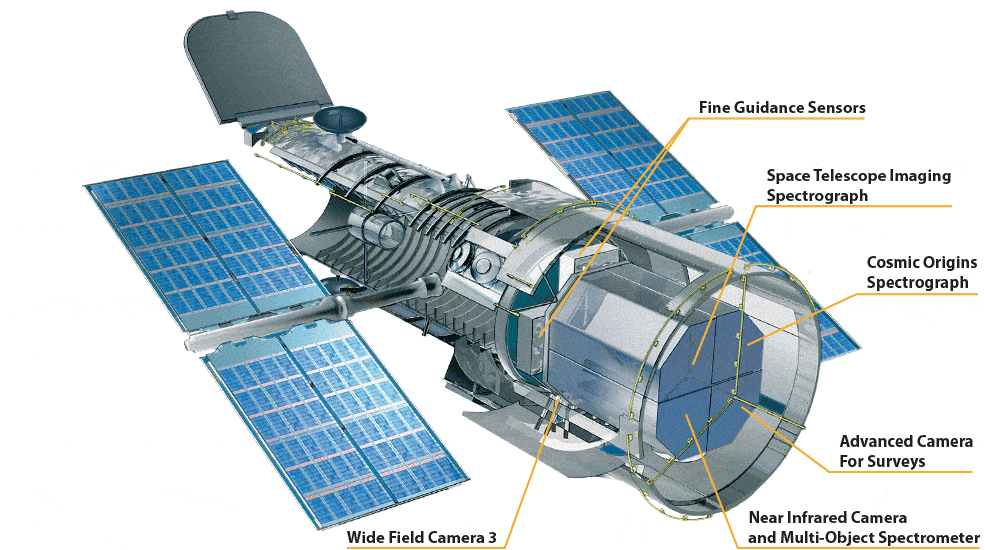
There are two kinds of optical telescopes: the refracting telescope, which uses convex lenses to concentrate light from distant objects, and the reflecting telescope, which uses a concave mirror to focus light. Additionally, some telescopes, like radio telescopes, collect radio waves and microwaves using an antenna that resembles a satellite dish. These instruments help scientists detect distant objects, map the universe, and search for signs of life on other planets. The Hubble Space Telescope, launched into orbit in 1990, is the first optical space-reflecting telescope that collects light at all wavelengths, giving us a clear view of the universe without atmospheric interference.
Sending humans into space has been a significant milestone in space exploration. The Space Race between the United States and the Soviet Union was a driving force behind early space achievements. In 1961, Soviet cosmonaut Yuri Gagarin became the first human to journey into space and orbit Earth, marking a significant victory for the Soviet Union. Shortly after, in 1961, Alan Shepard became the first American astronaut to travel into space, and in 1962, John Glenn became the first American to orbit Earth. 1969 Apollo 11 was launched, carrying Michael Collins, Neil Armstrong, and Buzz Aldrin to the moon. On July 20, 1969, Michael Collins remained in orbit while Neil Armstrong and Buzz Aldrin became the first and second humans, respectively, to walk on the surface of the moon. These milestones fueled competition between the two nations, spurring advances in space technology and exploration.
A space shuttle mission involves launching within a specific window, orbiting Earth to complete tasks such as deploying satellites or conducting scientific experiments, and then returning to Earth, landing much like an airplane. Unlike the Apollo missions, space shuttles were designed for multiple uses, allowing more cost-effective travel. For example, space shuttles, like Discovery, which completed 39 missions, have been crucial for scientific research by launching the Hubble Space Telescope and performing International Space Station (ISS) assembly missions. The ISS is approximately the size of a football field: a 460-ton, permanently crewed platform orbiting 250 miles above Earth, which took 10 years and over 30 missions to assemble.
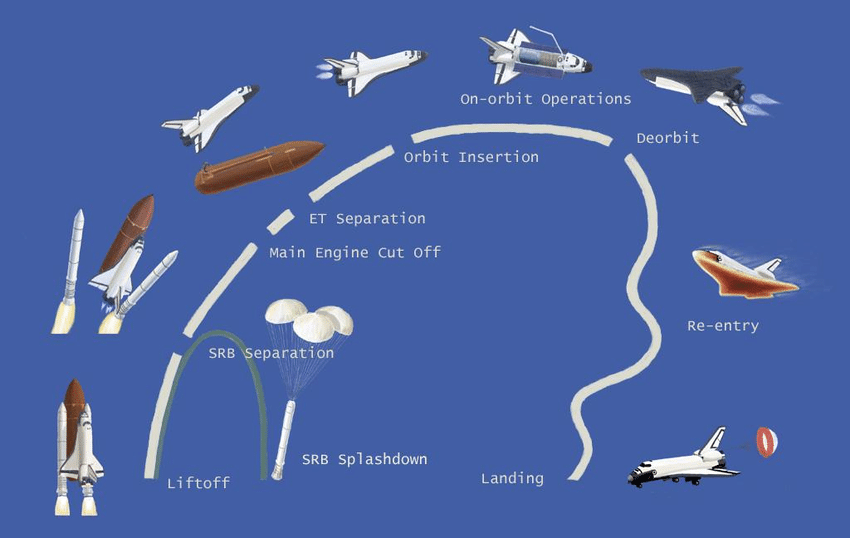
A well-known space shuttle, Discovery, completed 39 missions, including deploying the Hubble Space Telescope, making important contributions to scientific space research.
To leave Earth’s atmosphere and reach space, a way to overcome Earth’s gravity is to use rockets. Rockets propel themselves by ejecting exhaust gases, creating thrust that pushes them forward. Inside the rocket, fuel burns, building pressure that forces the exhaust out and propels the rocket upward. Rockets have been instrumental in launching everything from crewed spacecraft to uncrewed space probes.
A satellite is an object that orbits another object in space. The first artificial satellite, Sputnik 1, was launched by the Soviet Union in 1957. Today, satellites are vital for everyday life, transmitting television signals, monitoring weather patterns, and providing GPS services. They also play an essential role in space science, helping scientists study both Earth and the cosmos.
Most spacecraft, or vehicles designed to travel in space, do not carry humans. Space probes are uncrewed spacecraft sent to explore distant objects in the solar system, like planets, moons, and comets. These robotic explorers gather data and capture images, helping scientists learn more about the universe while undertaking missions that are too long or dangerous for human crews. For example, NASA’s Voyager 1, launched in 1977, has traveled beyond our solar system, sending back invaluable information from interstellar space.
Astrobiology, the study of life in the universe, is a key area of research in space exploration. This field focuses on understanding the potential for life on other planets, moons, or celestial bodies and includes the search for environments that could support life beyond Earth. Space probes play a crucial role in astrobiology by searching for conditions that could indicate the presence of life, such as water, organic molecules, and habitable environments on other worlds.
Review:
- Compare a refracting telescope to a reflecting telescope.
- What is a space shuttle?
- What does an astrobiologist study?