

Valentine’s Day Stem Activities
While Valentine’s Day is often associated with flowers and chocolates, it also offers an excellent opportunity to introduce STEM concepts through fun and engaging activities while reinforcing critical thinking and problem-solving skills.
Color Changing Flower Lab
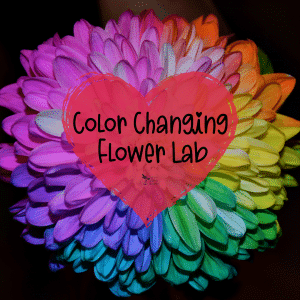 A color-changing flower activity is a fun and educational way to learn about a plant’s vascular system. This activity is found in Plants Demos, Labs, and Science Stations and makes such an ah-ha moment for students!
Using white carnations, follow the directions and have students make observations. This activity can even be done on a large scale as a fun Science Club fundraiser at Valentine’s so students can give colorful flowers to their friends.
Materials:
- White carnations (daisies and other white flowers may work, too!)
- Clear, plastic cups or vases
- Water
- Food coloring
- Scissors or knife
Directions:
- Fill each cup ¾ full with water.
- Add 20 to 30 drops of food coloring to each glass. Lots of color is better! Leave one glass unaltered as your “control.”
- Have an adult cut the stems of the carnations on a diagonal. The cut must be fresh to allow for maximum water absorption.
- Place one carnation in each colored water glass and one in the plain water.
- Watch what happens! The carnations will soak up the water and take on the new colors. This can show in only hours, but may also need to sit overnight.
Examine everything — the stems, leaves, and even deep within the blooms for color changes. Compare the flowers with food coloring to the ones without.
Crystal Hearts Investigation
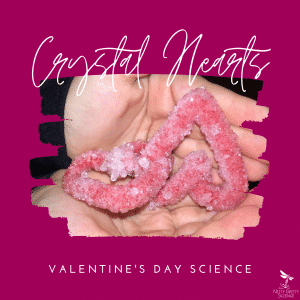 Crystal hearts allow students to demonstrate and observe the making of a crystal using a saturated solution of Borax and water. It’s easy, cheap, and a fun science investigation for Valentine’s Day! Here’s a FREE printable that uses the same idea for winter shapes.
Materials:
- Pipe cleaner
- Wide-mouth cup or jar
- Boiling water
- Borax
- String
- Pen/pencil
- Tape
Procedure:
- Mold pipe cleaner into a heart shape.
- Fill a cup or a jar with hot water and add borax. You need to add as much borax as would dissolve in the water – about 3-4 tablespoons of borax per cup of water.
- Continue to add and stir until there is some borax that won’t dissolve at the bottom of the cup or jar.
- Attach string to pipe cleaner heart, tape the other end of this string to a pen/pencil, and place heart into the borax mixture.
- Let crystals grow overnight, and be amazed the next day by your beautiful heart!
You can add glitter to give it some more pop!
Valentine’s Candy Dichotomous Key
 A dichotomous key is a classification system used to identify unknown organisms or objects by presenting a series of choices that lead to the correct identification. They are widely used in biology, botany, and entomology to aid in species identification. Have your students create a dichotomous key to classify valentine’s candy. Students start at the top of the key and work their way down, making decisions based on the characteristics of the object they are trying to identify.
Click here for a FREE printable!
For a refresher on a Dichotomous Key, check out the Life Science Interactive Notebook, Change Over Time, and Classification chapter.
Heart Pump Model
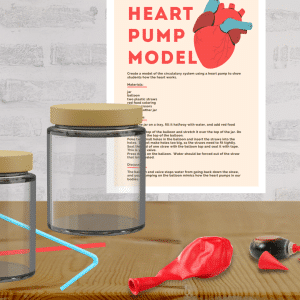 Create a model of the circulatory system using a heart pump to show students how the heart works.
Materials:
- jar
- balloon
- two plastic straws
- red food coloring
- tape & scissors
- tray or another jar
Procedure:
- Place the jar on a tray, fill it halfway with water, and add red food coloring.
- Cut off the top of the balloon and stretch it over the top of the jar. Do not discard the top of the balloon.
- Poke two small holes in the balloon and insert the straws into the holes. Do not make holes too big, as the straws need to fit tightly.
- Seal the end of one straw with the balloon top and seal it with tape. This is your valve.
- Press down on the balloon. Water should be forced out of the straw that isn’t sealed.
Discussion:
The balloon end valve stops water from going back down the straw, and your pumping on the balloon mimics how the heart pumps in our bodies.
Cardio Lab
 Have students use smartwatches or fitness trackers to record their heart rate during physical activities such as running or jumping jacks. The cardio activity should be set for a specific amount of time. Have them calculate their average heart rate and the highest and lowest heart rate they reached. Have them record the data, make a graph to track their progress, and compare them with other students in the class. This is a great way to reinforce concepts such as data collection and analysis. Make sure a teacher or an adult is present during physical activities and check to make sure no students have any physical restrictions. Discuss with students the importance of health and how tracking their heart rate can help them understand how their bodies react to exercise.
This activity and others for the Human Body can be found in the Human Body Unit – 5E Model.
The Science of Love Song
 Last but not least, share this awesome science-themed love song with your class = they’ll “love” it! The Science Love Song by AsapScience.
Happy Valentine’s Day,
Erica and the Nitty Gritty Science Team