
Section 2: Evolution of Populations
Genetically speaking, evolution is a change in the frequency of alleles in a population over time. A population is a group of individuals of the same species living in the same area. Scientists study evolution by observing how certain traits become more or less common across generations. For example, if an area is sprayed with pesticides, insects with alleles that provide resistance are more likely to survive and reproduce. Over time, these resistant traits become more common in the population.
All of the genes in a population make up its gene pool, which includes every allele present. Changes in the gene pool are what drive evolution. Three main sources of genetic variation make evolution possible. First, a mutation is a change in an organism’s DNA. While many mutations are harmful or have no effect, some can be beneficial and increase an organism’s chances of survival. Second, genetic recombination occurs during sexual reproduction. During meiosis, chromosomes are shuffled and combined in new ways, creating unique gene combinations. In humans, this process can produce over 8 billion possible combinations. Finally, lateral gene transfer is the movement of genetic material from one organism to another without reproduction. This process is common in bacteria and can quickly introduce new traits into a population.
The Hardy-Weinberg principle states that allele frequencies in a population will remain constant (genetic equilibrium) unless specific factors cause them to change. For a population to remain in equilibrium, five conditions must be met:
- Mating must be random.
- The population must be very large.
- There must be no movement of individuals into or out of the population (no migration).
- No mutations occur.
- No natural selection takes place.
If any of these conditions are not met, allele frequencies can change, and evolution will occur.
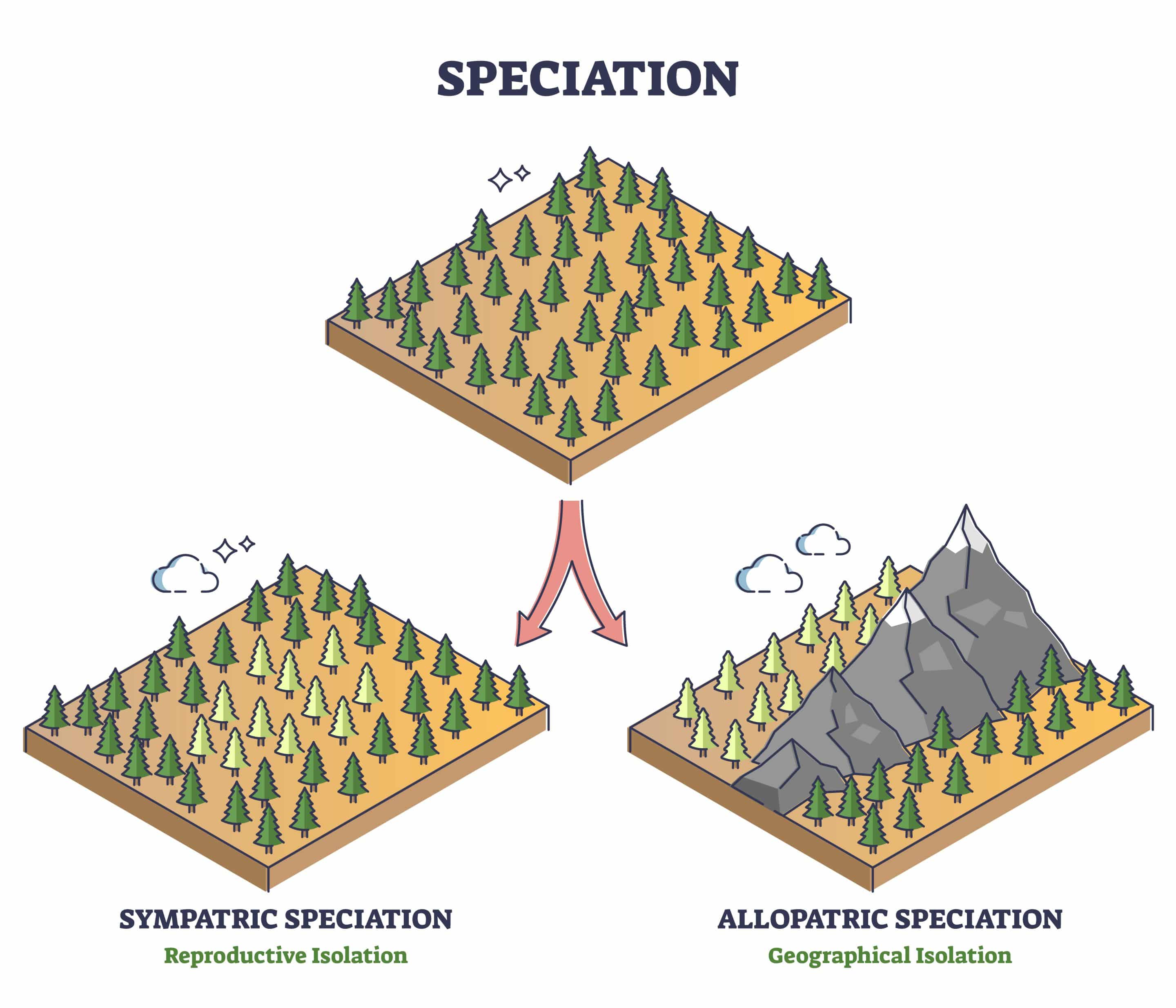
When a population splits and forms two or more new species, the process is called speciation. This process fascinated Darwin because it explains how the diversity of life increases over time. Some differences between species are easy to see, while others are more subtle.
Darwin’s observations of finches in the Galápagos Islands provide a clear example of speciation. First, a small group of finches from South America arrived on the islands. Over time, these birds became separated into different populations, with some moving to other islands. As these populations became isolated, their gene pools began to change. Each group adapted to its specific environment, especially to the types of food available. For example, finches that ate hard seeds developed strong, thick beaks, while others that ate insects developed longer, thinner beaks. Eventually, these differences led to reproductive isolation, meaning the populations could no longer successfully mate with one another. Differences in traits, such as beak shape or mating behaviors, prevented interbreeding. Over time, continued adaptation and competition increased these differences, resulting in the formation of new species. This process occurred repeatedly in the Galápagos, leading to the development of 13 distinct finch species.
Another way new species form is through reproductive isolation, when two populations can no longer interbreed. Barriers that prevent reproduction can lead to the development of separate species over long periods of time. There are three main types of reproductive isolation:
- Behavioral isolation occurs when organisms do not recognize each other’s mating signals or behaviors. For example, a bird may not respond to the mating call of another species.
- Geographical isolation happens when physical barriers, such as mountains, rivers, or oceans, separate populations and prevent them from meeting.
- Temporal isolation occurs when populations reproduce at different times, such as different seasons or times of day.
Over time, these isolating factors prevent gene flow between populations, allowing them to evolve into distinct species.
Review:
- In genetic terms, how is evolution defined?
- What is the Hardy-Weinberg principle?
- Identify and describe the ways in which reproductive isolation can occur.